
The EU 2040 climate target is now a binding part of European climate law. In March 2026, the European Union completed an amendment requiring a 90% reduction in net greenhouse-gas emissions by 2040 compared with 1990. At least 85 percentage points must be achieved within the EU; high-quality international carbon credits may contribute up to five percentage points from 2036.
This final law is different from the European Commission’s July 2025 proposal, which contemplated a smaller credit contribution. A current-affairs answer must therefore use the adopted 85% domestic plus up to 5% international design, not the earlier 3% proposal.
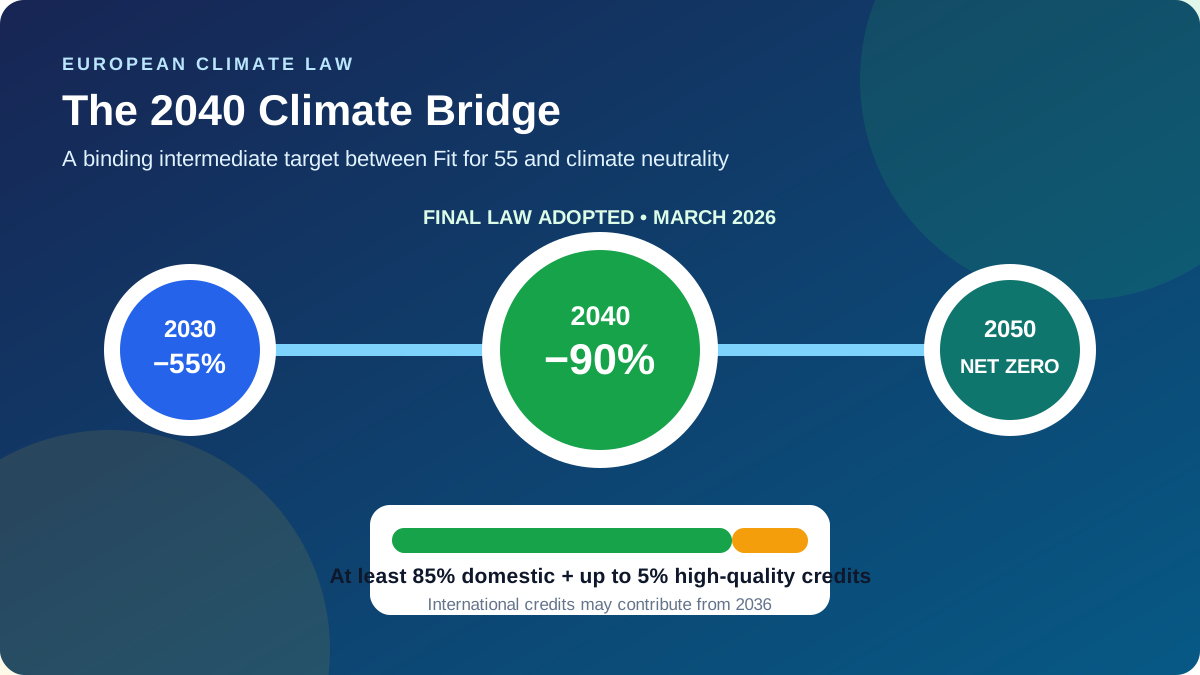
EU climate-law timeline
| Year | Net emissions objective | Legal or policy significance |
|---|---|---|
| 2030 | At least 55% below 1990 | Existing binding target implemented through the Fit for 55 package |
| 2040 | 90% below 1990 | Binding intermediate target adopted in March 2026 |
| 2050 | Climate neutrality | Economy-wide binding objective under the European Climate Law |
The 2040 milestone matters because a 2050 promise alone gives weak guidance to utilities, carmakers, steel plants, building owners and investors making long-lived decisions today. An intermediate target narrows the range of credible investment pathways and reduces the risk of a sudden, disruptive adjustment after 2040.
What does “90% net reduction” mean?
Gross emissions are greenhouse gases released from energy, industry, transport, buildings, agriculture and waste. Removals take carbon dioxide out of the atmosphere through land sinks or durable technological processes. Net emissions are gross emissions minus recognised removals.
The target is therefore not a requirement to eliminate 90% of every sector’s gross emissions. It is an economy-wide net target. Hard-to-abate residual emissions may remain, but they must be balanced within an increasingly strict overall carbon budget and eventually by removals consistent with climate neutrality.
Domestic reductions and international credits
| Component | Final legal position | Key safeguard |
|---|---|---|
| EU domestic action | At least 85% reduction from 1990 net emissions | Most of the transition must occur within Europe |
| International credits | Up to 5% of 1990 EU net emissions, from 2036 | Credits must be high-quality, credible and aligned with the Paris Agreement |
| EU permanent removals | May be integrated to compensate residual hard-to-abate emissions under the EU ETS | Storage must be durable and accounting must prevent reversal or double counting |
| Cross-sector flexibility | Future post-2030 laws may allow greater flexibility across sectors and instruments | Flexibility cannot erase the binding headline target |
The “up to 5%” provision does not mean that Europe can buy 5% of its remaining effort as cheap offsets under any voluntary scheme. Future implementation must define eligibility, accounting, corresponding adjustments, additionality, permanence and safeguards.
Why did the EU include flexibility?
European governments were balancing climate science against high energy costs, industrial competition, household affordability and uncertainty in forests and other natural sinks. Flexibility can lower the cost of achieving a given climate outcome and support mitigation in partner countries.
It also creates three risks:
- quality risk: a credited project may not deliver a real additional reduction;
- delay risk: firms may postpone domestic investment while expecting future credits; and
- justice risk: projects can restrict land or livelihood rights in host communities without fair benefit-sharing.
For credibility, credits must represent reductions that are real, measurable, additional, independently verified and not counted by both the buyer and host country.
How will the target be implemented?
The amended law fixes the destination; the Commission must propose the post-2030 legislation that allocates effort across sectors and instruments. Likely policy areas include:
- power: renewable electricity, grids, storage, efficiency and limited low-carbon firm capacity;
- industry: electrification, hydrogen where appropriate, circular material use and carbon capture for genuinely hard-to-abate processes;
- transport: electric mobility, public transport, rail, clean fuels for aviation and shipping, and demand management;
- buildings: insulation, efficient appliances and low-carbon heating;
- agriculture: methane and nitrous-oxide reduction with protection for food security and farm incomes;
- land: resilient forests, soils and wetlands; and
- removals: certification and durable storage for residual emissions.
The law also delayed the full start of the second emissions-trading system for road transport, buildings and additional sectors from 2027 to 2028. The delay reflects affordability and readiness concerns; it does not cancel ETS2.
Competitiveness and the just transition
Climate policy changes relative prices. Households with inefficient homes may face higher costs before they can afford renovation, while workers in carbon-intensive regions may face job losses. A durable transition needs targeted income support, affordable clean alternatives, worker retraining and place-based investment.
For industry, the central issue is coordinating carbon prices with cheap clean power, grids, permits, innovation finance and lead markets for green materials. A high carbon price without enabling infrastructure can cause production to move; subsidies without performance conditions can become expensive protection.
Role of the EU Emissions Trading System
The EU ETS sets a declining cap for covered emissions and allows regulated installations to trade allowances. It makes scarcity visible through a carbon price. The 2040 law does not itself rewrite every ETS rule, but it guides the future cap and the treatment of permanent removals.
A sound market needs reliable monitoring, a predictable cap, protection against manipulation and clear rules for removals. Temporary forest storage should not be treated as identical to carbon stored durably for centuries.
Implications for India
1. Export competitiveness
EU climate ambition will increase demand for low-carbon steel, aluminium, chemicals, vehicles, batteries and other goods. Indian exporters need product-level emissions data, cleaner power and verifiable supply chains. The lesson for India manufacturing policy is that carbon efficiency is becoming a quality and market-access capability.
2. Carbon Border Adjustment Mechanism
The EU’s Carbon Border Adjustment Mechanism links selected imports to the carbon cost faced by EU producers. Its compatibility, equity and administrative burden remain debated. Indian policy should combine diplomatic engagement with domestic measurement, renewable power, efficient processes and support for smaller exporters.
3. Carbon-credit opportunity
International credits from 2036 could create demand for high-integrity mitigation in partner countries. India is not automatically entitled to supply them. Bilateral arrangements would need to protect India’s own nationally determined contribution, prevent double counting under Paris Agreement Article 6 and ensure local communities receive fair benefits.
4. Climate finance and equity
The EU’s domestic target does not replace developed-country obligations on climate finance and technology. Developing economies still face a high cost of capital. This connects climate ambition with the wider developing-country debt crisis: expensive finance can delay clean infrastructure even where technology is available.
Global significance
The EU accounts for a declining share of annual global emissions, so its target cannot stabilise the climate alone. Its influence operates through technology markets, finance, standards, trade rules and diplomatic signalling. A credible 2040 pathway can lower global clean-technology costs; a protectionist or credit-heavy pathway could deepen North–South mistrust.
Key criticisms
- Ambition criticism: climate groups argue that reliance on credits or uncertain removals may weaken real domestic cuts.
- Cost criticism: industries and some governments fear energy prices, investment burdens and competition from regions with weaker carbon constraints.
- distribution criticism: poorer households and carbon-intensive regions may bear a disproportionate adjustment cost.
- accounting criticism: forests, soil and technological removals have different permanence and should not be merged carelessly.
- trade criticism: external measures may shift the burden to developing-country exporters without adequate finance or technology transfer.
What should happen next?
- Translate the target into transparent sectoral carbon budgets and investment plans.
- Fund grids, storage, building renovation and industrial demonstration before compliance deadlines bite.
- Use social-climate support for vulnerable households and regions, with measurable outcomes.
- Set a strict taxonomy for international credits and permanent removals.
- Publish lifecycle emissions methods that exporters can use without excessive cost.
- Cooperate with developing countries on concessional finance, technology and Article 6 capacity.
- Use the two-year review to strengthen implementation, not create repeated uncertainty about the headline goal.
UPSC and State PSC relevance
The EU 2040 climate target links GS Paper II international relations and institutions with GS Paper III climate policy, carbon markets, energy transition and trade. In an answer, distinguish net from gross emissions, mention the 85% domestic floor and 5% credit ceiling, and analyse implications for India through exports, CBAM and climate finance.
Mains practice question: The EU’s 2040 climate law combines a high headline target with flexibility through credits and removals. Evaluate its environmental integrity and implications for developing economies.
Conclusion
The EU has converted its 2040 objective from a proposal into binding law. The difficult phase now begins: building clean infrastructure, protecting households, preserving industrial capability and ensuring that credits represent genuine additional mitigation. A numerical target creates direction; credible rules and fair implementation create climate value.
Frequently asked questions
What is the EU 2040 climate target?
It is a binding requirement to reduce EU net greenhouse-gas emissions by 90% from 1990 levels by 2040.
How much of the target must be achieved within the EU?
At least an 85% reduction from 1990 net emissions must be achieved domestically.
How many international carbon credits can the EU use?
From 2036, high-quality international credits may contribute up to 5% of 1990 EU net emissions toward the 2040 target.
What is the EU climate-neutrality target?
The European Climate Law requires economy-wide climate neutrality by 2050.
Why does the EU target matter for India?
It affects clean-technology markets, export carbon standards, CBAM compliance, possible future demand for high-integrity credits and climate-finance diplomacy.
Primary references
- Council of the EU: final adoption of the 2040 target
- European Commission: 2040 climate target
- European Commission: European Climate Law
- European Commission: EU Emissions Trading System
- UNFCCC: Article 6 of the Paris Agreement





Sources and further reading
- Council of the EU: final adoption of the 2040 targetconsilium.europa.eu
- European Commission: 2040 climate targetclimate.ec.europa.eu
- European Commission: European Climate Lawclimate.ec.europa.eu
- European Commission: EU Emissions Trading Systemclimate.ec.europa.eu
- UNFCCC: Article 6 of the Paris Agreementunfccc.int