
Tags: GS Paper 3 – Indian Economy, Industrial Policy, Science and Technology
For Prelims: Electronics Component Manufacturing Scheme (ECMS), MeitY, PLI scheme, SPECS, India Semiconductor Mission, copper foil, turnover-linked incentive
For Mains: Moving from assembly to component manufacturing, import dependence in electronics, design of industrial incentives
Why in News?
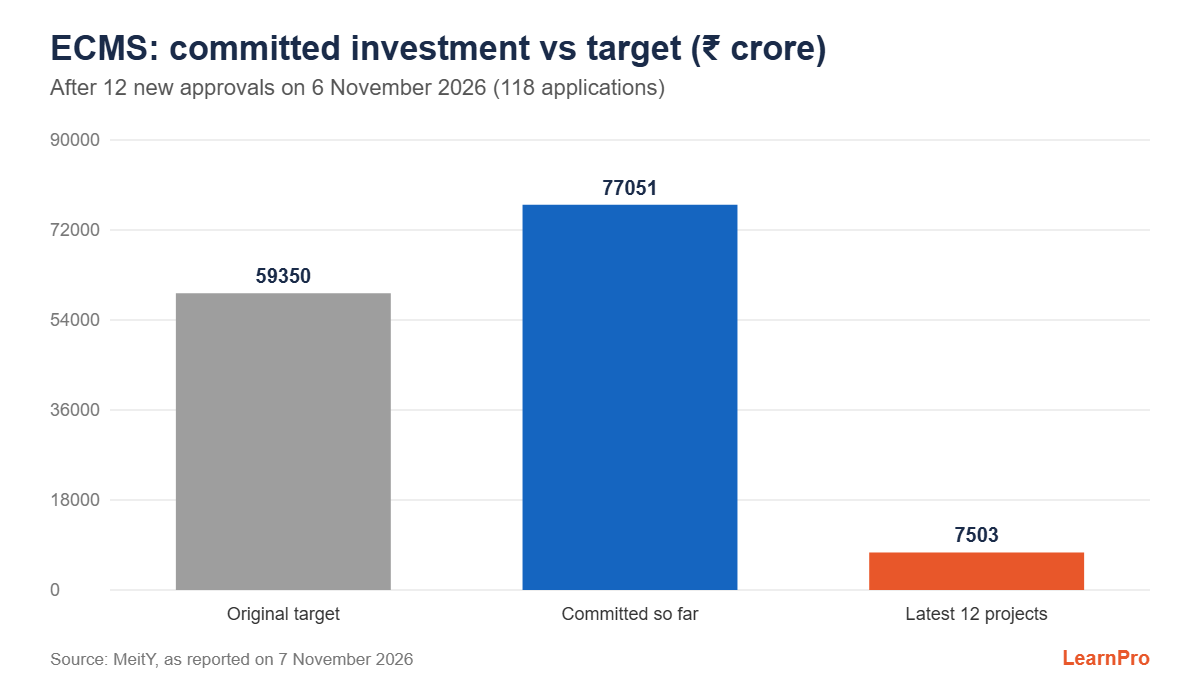
The Ministry of Electronics and Information Technology (MeitY) has approved 12 new projects worth ₹7,503 crore under the Electronics Component Manufacturing Scheme (ECMS). This takes the total to 118 approved applications with committed investment of ₹77,051 crore, almost 30% above the original target of ₹59,350 crore. The largest new project is a ₹3,546-crore copper foil unit in Amreli, Gujarat.
Summary
- The incentives are linked to turnover, and support is paid only after a firm starts production.
- The approvals reflect a move from final assembly towards deeper manufacturing of components and materials.
- Battery cells, copper-clad laminates, PCBs and camera and display modules are among the focus areas.
What is the ECMS?
- Approval: Approved by the Union Cabinet in March 2025 with an outlay of about ₹22,919 crore over six years. It is administered by MeitY.
- Objective: To build a domestic component ecosystem, attract global investment, raise domestic value addition, and link Indian firms to global value chains.
- Coverage:
- Sub-assemblies such as display modules and camera modules.
- Bare components such as multi-layer PCBs, lithium-ion cells for digital applications, and passive components (resistors, capacitors).
- Supply-chain inputs and capital equipment used in electronics manufacturing.
- Incentive types: Turnover-linked, capex-linked, or a hybrid of the two, depending on the segment.
- Employment link: Part of the incentive is tied to meeting employment targets.
Why does India Need Component Manufacturing?
- Low value addition: India is now the second-largest mobile phone maker in the world, but domestic value addition is only about 15–20%. Most components are imported, mainly from China.
- Trade deficit: Electronics is among India’s largest import categories after crude oil and gold.
- Supply-chain resilience: COVID-19 and geopolitical tensions showed the risks of depending on a single source.
- Strategic sectors: Defence, telecom and electric vehicles need secure supply of components.
Related Initiatives
- PLI for Large Scale Electronics Manufacturing (mobile phones) and PLI for IT hardware.
- SPECS: Scheme for Promotion of Manufacturing of Electronic Components and Semiconductors (2020).
- India Semiconductor Mission (₹76,000 crore) for fabs, ATMP/OSAT units and display fabs.
- Modified Electronics Manufacturing Clusters (EMC 2.0) scheme.
Challenges
- High capital cost and long payback periods for making materials such as copper foil, laminates and chemicals.
- Weak R&D and design capability, and reliance on imported technology through joint ventures.
- Competition from established suppliers in China, Taiwan, South Korea and Vietnam that have scale advantages.
- Gaps in infrastructure, power reliability and skilled workers.
Way Forward
- Build cluster-based ecosystems with common testing and certification facilities.
- Link incentives to design and IP creation, not just to capacity.
- Use trade agreements to gain access to inputs while protecting nascent domestic industries.
- Run skilling programmes with industry for precision manufacturing.
Conclusion
The over-subscription of ECMS shows strong investor interest in moving India up the electronics value chain. Real success will be measured by higher domestic value addition and fewer imports, not just by the size of commitments on paper.
Frequently Asked Questions (FAQs)
1. Which ministry administers the ECMS?
The Ministry of Electronics and Information Technology (MeitY).
2. What type of incentive does the ECMS offer?
Turnover-linked, capex-linked and hybrid incentives, paid after production begins.
3. What is the total committed investment after the latest approvals?
₹77,051 crore across 118 approved applications.
Practice Question
Mains: India’s electronics success has been driven by assembly rather than manufacturing. Evaluate how schemes like ECMS can deepen domestic value addition. (150 words)
Sources and further reading
- Bill Bertramcommons.wikimedia.org