
Tags: GS Paper 2 – International Institutions; GS Paper 3 – Environment, Climate Change
For Prelims: COP31, UNFCCC, Paris Agreement Article 9.1, NCQG, Global Goal on Adaptation, Just Transition Work Programme, CBDR-RC, NDC 3.0, Global Stocktake
For Mains: Climate finance gap and equity, India’s negotiating positions, adaptation vs mitigation priorities
Why in News?
Union Environment Minister Bhupender Yadav set out India’s priorities for the UN Climate Change Conference (COP31) in Antalya, Türkiye, from 9 to 20 November 2026. India’s main demands are predictable climate finance, technology transfer and nationally determined approaches to mitigation and adaptation.
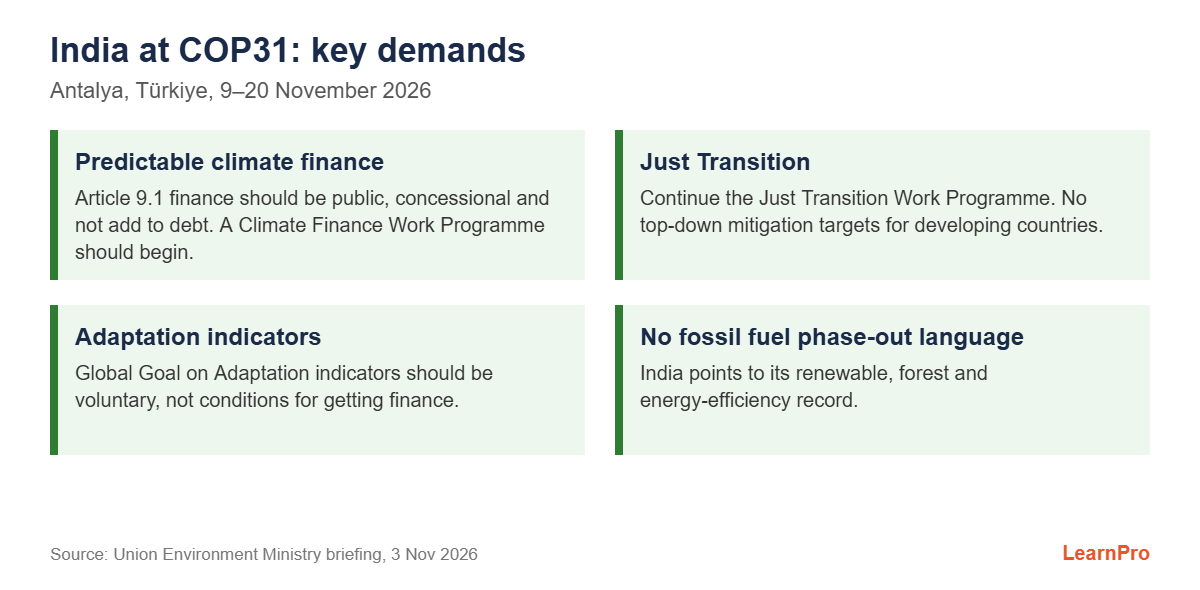
India’s Key Positions
- Climate finance: Finance under Article 9.1 of the Paris Agreement must be “predictable, largely public and concessional” and must not add to the debt of developing countries. India wants a decision to start a Climate Finance Work Programme.
- Just transition: Continue the Just Transition Work Programme and oppose top-down mitigation targets for developing countries.
- Adaptation: Indicators under the Global Goal on Adaptation (GGA) should stay voluntary and should not become conditions for finance. The number of indicators has been cut from nearly a thousand to 59.
- Fossil fuels: India does not support language on ‘phase-out’ or cuts, pointing to its expansion of renewables, forest cover and energy efficiency.
Key Concepts
- Article 9.1, Paris Agreement: Developed countries shall provide financial resources to help developing countries.
- NCQG (New Collective Quantified Goal): Agreed at COP29 (Baku, 2024). It sets at least USD 300 billion a year by 2035 from developed countries and calls for scaling total finance to USD 1.3 trillion. India criticised the goal as inadequate.
- CBDR-RC: Common But Differentiated Responsibilities and Respective Capabilities, a core principle of the UNFCCC.
- Global Stocktake: A five-yearly review of collective progress. The first was completed at COP28 (Dubai, 2023).
- Just Transition: Moving to low-carbon economies fairly, protecting workers and communities that depend on fossil fuels.
India’s Climate Commitments
- Updated NDC (2022): Reduce the emissions intensity of GDP by 45% from 2005 levels by 2030, have 50% of installed power capacity from non-fossil sources by 2030, and create an additional carbon sink of 2.5–3 billion tonnes of CO2e.
- Net zero by 2070, announced at COP26 in Glasgow.
- India reached 50% non-fossil installed capacity in 2025, five years ahead of target.
Why India’s Stand Matters
- Developing countries need trillions of dollars for adaptation and transition, but flows remain far below the need.
- Making finance conditional on adaptation metrics would penalise vulnerable countries.
- India’s per-capita emissions remain well below the global average, which supports its demand for equity and carbon space.
Conclusion
COP31 is expected to focus on how commitments are delivered. India’s push for predictable, public, concessional finance and voluntary adaptation indicators reflects the Global South’s argument that climate action and development must go together.
Frequently Asked Questions (FAQs)
1. Where is COP31 being held?
In Antalya, Türkiye, from 9 to 20 November 2026.
2. Which Article of the Paris Agreement deals with finance from developed countries?
Article 9.
3. What climate finance goal was agreed at COP29?
The NCQG of at least USD 300 billion a year by 2035.
Practice Question
Mains: “Climate finance is the litmus test of global climate justice.” Discuss India’s position at COP31 in this context. (250 words)