
 Forest Services
Background of Bengal: Rise of Autonomy Under Murshid Quli Khan
Bengal’s Shift Away from Mughal Control
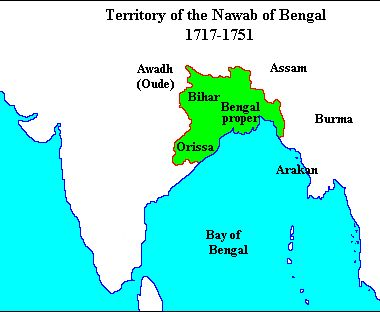
After 1717, Bengal started functioning more independently of the Mughal Empire. This shift began when Murshid Quli Khan became the governor (Subahdar) of Bengal. Unlike earlier times, he was allowed to hold both the posts of nazim (governor) and diwan (revenue officer). This was unusual and broke the traditional Mughal system of dividing power between two officers to prevent misuse or over-centralization.
Also Read about Battle of Buxar 1765 and Treaty of Allahabad
Administrative Power and Revenue Control
With control over both administration and revenue, Murshid Quli Khan was able to centralize authority. While he did not officially break ties with the Mughal Empire, he started running Bengal as an almost independent province. He continued to send regular revenue to the Mughal court, which was financially struggling at the time. In fact, Bengal’s revenue was often the only reliable income for the empire.
Murshid Quli Khan’s Revenue Reforms
Murshid Quli Khan’s strength came from his strong revenue system. He brought major reforms that ensured Bengal remained a surplus-paying region even when the rest of the empire was facing instability.
- Between 1700 and 1722, Bengal’s total revenue collection increased by 20%.
- He conducted detailed land surveys and forced zamindars (landowners) to pay revenue fully and on time.
- He promoted a few large and efficient zamindaris and removed inefficient or disobedient zamindars. Their lands were taken over as khalisa (royal land).
By the time he died in 1727, the 15 biggest zamindars in Bengal were contributing half of the province’s total revenue.
Rise of New Power Groups: Zamindars and Bankers
Alongside zamindars, a new group of rich merchants and bankers also became powerful. These urban elites became important players in Bengal’s politics and economy. Their increasing wealth gave them more influence, and they began playing key roles in trade and state finance
Trade and Political Economy of Bengal (17th–18th Century)
Commercial Prosperity During Murshid Quli Khan’s Rule
Bengal was known for its lucrative trade, even before the rise of British power. During the rule of Murshid Quli Khan, Bengal’s economic position grew stronger due to political stability and increased agricultural output. This created a solid foundation for internal and overseas trade.
- Major Exports: Bengal exported silk, cotton textiles, sugar, oil, and clarified butter.
- Trade Routes:
- Overland: Goods were sent through northern and western Indian trade centers to Persia and Afghanistan.
- Maritime: Through Hughli port, goods reached Southeast Asia, the Persian Gulf, and the Red Sea.
Shift to Maritime Trade in the 18th Century
As political instability grew across north India in the early 18th century, overland trade declined partially, but oceanic trade flourished. European companies—Dutch, French, and English—began to increase their investment in Bengal.
- By the first half of the 18th century, Europe became the main destination for Bengal’s goods.
- This led to significant expansion in the textile industry, especially for European markets.
Bullion Inflow and Economic Integration
Bengal had a favourable balance of trade. European companies brought in large amounts of silver (bullion) to buy Bengal’s products.
- This silver was easily absorbed into Bengal’s cash economy and used for revenue payments to Delhi.
- Bengal’s economy became more liquid and monetised, supporting both trade and administration.
Role of Merchants, Bankers, and Zamindars
Merchant Community and Trade Dominance
Trade in Bengal was led by Hindu, Muslim, and Armenian merchants. Many of them were wealthy and influential.
- Notable Merchants:
- Umi Chand – a Hindu merchant with large influence.
- Khoja Wajid – an Armenian merchant who owned a fleet of ships.
- They had cordial ties with the administration, and the state did not interfere harshly with merchant affairs.
Bankers and State Revenue
As zamindars were under pressure to pay revenue regularly, bankers and financiers became crucial to Bengal’s economy.
- They provided credit, security, and loans at every step of the revenue process.
- In return, they got patronage from the nawabs, which increased their influence in the administration.
Rise of Jagat Seth Banking Family
- The Jagat Seths emerged as the most powerful banking house in Bengal.
- In 1730, they became the treasurers of Bengal and gained control over the mint.
- Their political support later played a major role in the transfer of power from Sarfaraz Khan to Alivardi Khan.
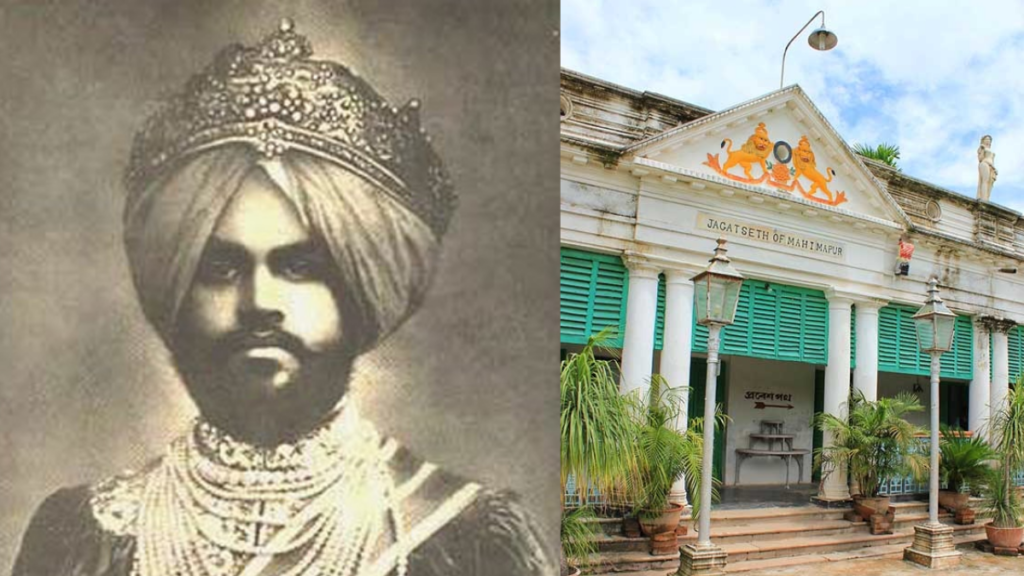
Jagat Seth: India's richest banker with assets worth $1 trillion
New Power Structure in Bengal
By the mid-18th century, Bengal’s governance became cooperative in nature, dominated by three key groups:
| Group | Role |
|---|---|
| Zamindars | Collected land revenue and maintained local influence |
| Merchants | Controlled trade and shipping; maintained strong ties with foreign traders |
| Bankers | Financed state functions, provided liquidity, and handled treasury |
Together, these groups held real power. The nazim (provincial governor) now had to depend on their support. This limited the autonomy of the nawab himself and created a fragile balance of power.
The 1739–40 Coup and Rise of Alivardi Khan
In 1739–40, a significant shift occurred when Sarfaraz Khan, who had inherited the position of nazim from his father Shuja-ud-Din, was overthrown.
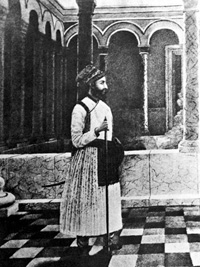
Alivardi khan
- Why the Coup Happened:
- Sarfaraz was seen as inefficient.
- He antagonised the Jagat Seths and lost support of key zamindars and officers.
- With support from the Jagat Seth family and military commanders, Alivardi Khan staged a coup and became the new Nawab of Bengal.
- He later received formal approval from the Mughal emperor, though Bengal was now functioning independently.
Alivardi Khan’s Rule and De Facto Independence
Alivardi Khan's rule (1740–1756) marked a clear break from Mughal control:
- All major appointments were now made without referring to the Mughal emperor.
- Revenue payments to Delhi stopped.
- Although no formal declaration of independence was made, Bengal, along with Bihar and Orissa, was now fully autonomous in practice.
Alivardi Khan’s Relations with European Companies
Alivardi maintained a careful and calculated policy toward European trading companies:
- During the Maratha invasions, he allowed them to build fortifications, such as the Maratha Ditch around Calcutta in 1742 (a 3-mile long moat dug by the British for defense).
- However, he also collected large sums of money from these companies to finance his wars.
- He remained aware of European rivalries in the south (especially British–French conflicts), and tried to prevent such conflict from entering Bengal.
Succession Crisis and Decline of Stability
In 1756, Alivardi Khan died and named his 23-year-old grandson, Siraj-ud-Daulah, as his successor.
- His succession was challenged by:
- Shaukat Jung, Faujdar of Purnea
- Ghaseti Begum, Alivardi’s daughter
- This led to factionalism within the court. The powerful zamindars and merchant groups felt threatened by Siraj’s strong-willed and ambitious nature.
British Intervention: The Conspiracy and the Battle of Plassey 1757
As internal tension increased:
- The English East India Company found an opportunity to interfere in Bengal’s politics.
- The Plassey Conspiracy of 1757 involved several discontented nobles and financiers—including Mir Jafar, Jagat Seths, and others—joining hands with the British to remove Siraj-ud-Daulah.
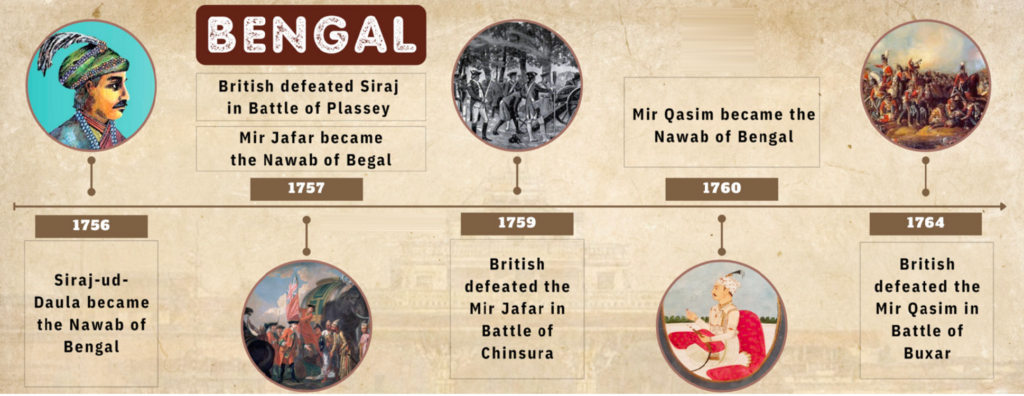
- This led to the Battle of Plassey, where Siraj was defeated and killed, ending the autonomous Nawabi rule in Bengal.
The Conflict Between the English and the Nawabs of Bengal: Siraj and the English
By the early 18th century, the British East India Company had established a strong presence in India through its three main presidencies: Fort St. George in Madras, Fort William in Calcutta, and Bombay Castle in western India. These were independent administrative units governed by a President and a Council appointed by the Court of Directors in London. To expand influence, the British adopted a strategy of forging alliances with Indian rulers, offering them military protection in return for trade privileges and internal concessions. Many Nawabs, faced with threats from rebels or rival claimants, agreed to such arrangements.
By this period, the Company had overcome its commercial competition with the Dutch and Portuguese. The only serious European rival remaining in India was the French East India Company, which had two significant centres of power: Chandernagar in Bengal and Pondicherry on the Carnatic coast. Both were governed under the presidency of Pondicherry.
Bengal's Rising Commercial Importance
The conflict between the Nawabs of Bengal and the British developed primarily because of Bengal’s growing centrality to the Company’s trade. As the 18th century progressed, Bengal began replacing western Indian centres like Bombay, Surat, and Malabar in importance. By this time, goods from Bengal—especially textiles—accounted for nearly 60% of all British imports
from Asia. This immense profitability made Bengal a prime target for greater British control, leading to increased interference in its internal affairs and a direct clash with the authority of the Nawabs.Immediate Causes of the Conflict
The seeds of conflict were sown through several contentious issues that escalated tensions between the British East India Company and the Nawabs of Bengal:
- Misuse of Dastaks: The Mughal Emperor Farrukhsiyar had granted the British East India Company the right to trade in Bengal without paying customs duties (Dastaks) in 1717. However, Company servants began misusing these permits for their private trade, depriving the Nawab's treasury of significant revenue. This practice was a constant source of friction and a direct challenge to the Nawab's authority.
- Fortification of Calcutta: The British began strengthening their fortifications in Calcutta without the Nawab's permission, ostensibly due to the ongoing Anglo-French rivalry. Nawab Siraj-ud-Daulah viewed this as a direct challenge to his sovereignty and a preparation for war.
- Asylum to Krishna Das: The British granted asylum to Krishna Das, a rich merchant and son of Raj Ballabh, who had fled with a large treasure from Dhaka after being accused of embezzlement. Siraj-ud-Daulah demanded his surrender, which the British refused, further infuriating the Nawab.
- Succession Disputes: The British often interfered in the succession disputes of the Bengal Nawabs, supporting candidates favorable to their interests, which further undermined the Nawab's authority and created a climate of mistrust.
Siraj-ud-Daulah and the Escalation
In 1756, Alivardi Khan, the Nawab of Bengal, passed away, and his grandson, Siraj-ud-Daulah, ascended the throne. Siraj-ud-Daulah was a young and assertive ruler who was determined to assert his authority and curb the growing power of the British. He immediately took issue with the British's unauthorized fortifications and their misuse of trade privileges.
When his demands for dismantling fortifications and stopping the misuse of Dastaks were ignored, Siraj-ud-Daulah marched on Calcutta in June 1756. He captured the British factory at Kasimbazar and then proceeded to seize Fort William in Calcutta. This event is infamously associated with the "Black Hole of Calcutta" incident, where a large number of British prisoners were allegedly confined in a small, suffocating dungeon, leading to many deaths. While the exact number of casualties and the circumstances remain debated, the incident served as a powerful rallying cry for the British.
British Retaliation and Conspiracy
News of the fall of Calcutta reached Madras, prompting the British to dispatch a strong force under the command of Robert Clive and Admiral Charles Watson. They recaptured Calcutta in January 1757. Realizing that a direct military confrontation with the Nawab's large army would be risky, Clive resorted to political intrigue.
Clive forged a secret alliance with several disaffected members of Siraj-ud-Daulah's court, including his commander-in-chief Mir Jafar, the rich merchant Jagat Seth, and Omichund. The conspirators agreed to betray Siraj-ud-Daulah during the battle, with Mir Jafar promised the Nawabship of Bengal in return for his support and substantial financial rewards for the Company and its officials.
The Battle of Plassey (June 23, 1757)
The decisive battle took place on June 23, 1757, at Plassey (Palashi) on the banks of the Bhagirathi River, about 150 km north of Calcutta. The British forces, numbering around 3,000 men (mostly sepoys), faced Siraj-ud-Daulah's much larger army of approximately 50,000 soldiers, including cavalry and artillery.
However, the battle was largely a sham. As per the conspiracy, Mir Jafar, along with other commanders like Rai Durlabh and Yar Lutuf Khan, kept their large contingents of troops inactive. Only a small contingent under Mir Madan and Mohanlal fought bravely for the Nawab. Mir Madan was killed, and Siraj-ud-Daulah, advised by the traitors, ordered a retreat. This allowed Clive's forces to launch a decisive attack, routing the Nawab's army with minimal British casualties.
Siraj-ud-Daulah fled the battlefield but was later captured and assassinated on Mir Jafar's orders. Mir Jafar was subsequently installed as the new Nawab of Bengal by the British, becoming a puppet ruler.
Results and Significance of the Battle of Plassey
The Battle of Plassey, though militarily insignificant due to the betrayal, had profound and far-reaching consequences, marking a turning point in Indian history:
- Establishment of British Political Supremacy: Plassey effectively ended the independent rule of the Nawabs of Bengal and established the British East India Company as the dominant political power in Bengal. Mir Jafar became a puppet ruler, completely subservient to the Company's dictates.
- Economic Exploitation of Bengal: The Company gained immense wealth and resources from Bengal. Mir Jafar was forced to pay huge sums as compensation, grant the Company the Zamindari of 24 Parganas, and allow duty-free trade. This marked the beginning of systematic economic exploitation, leading to the drain of wealth from Bengal to Britain.
- Financial Boost for the Company: The revenues from Bengal financed the Company 's military expansion and administrative costs in other parts of India, reducing its reliance on funds from Britain. This financial independence was crucial for its future conquests.
- Decline of Indigenous Industries: The Company's policies favored British goods and raw materials, leading to the decline of Bengal's once-flourishing textile and other indigenous industries. Artisans and weavers faced severe hardship and exploitation.
- Moral Degradation and Corruption: The immense wealth and power acquired by the Company's officials led to widespread corruption, bribery, and moral decay within its ranks, often at the expense of the local population.
- Foundation of the British Empire in India: Plassey was the first major step towards the establishment of the British Empire in India. It provided the Company with a territorial base, vast resources, and a psychological advantage that paved the way for subsequent conquests and the eventual subjugation of the entire subcontinent. It demonstrated the effectiveness of European military tactics combined with political manipulation.
- Shift in European Power Dynamics: The British victory at Plassey also solidified their position against other European powers, particularly the French, in the race for dominance in India.
Conclusion
The Battle of Plassey, often described as a "great betrayal" rather than a great battle, irrevocably altered the course of Indian history. It marked the end of an era of independent Indian rule in Bengal and ushered in a period of systematic British exploitation and political dominance. The wealth plundered from Bengal fueled the industrial revolution in Britain and financed the expansion of the British Empire, laying the foundation for nearly two centuries of colonial rule in India. Plassey stands as a stark reminder of how internal divisions and foreign intervention can lead to the subjugation of a powerful nation.
What was the primary cause of the Battle of Plassey?
The primary cause was the growing conflict between the ambitious Nawab Siraj-ud-Daulah and the British East India Company over trade privileges, fortifications, and political interference. Siraj-ud-Daulah's capture of Calcutta and the Black Hole tragedy further escalated tensions.
Who betrayed Siraj-ud-Daulah at the Battle of Plassey?
Mir Jafar, the commander-in-chief of Siraj-ud-Daulah's army, along with other prominent figures like Jagat Seth, Omichund, and Rai Durlabh, conspired with Robert Clive and betrayed the Nawab during the battle.
What was the immediate outcome of the Battle of Plassey?
Siraj-ud-Daulah was defeated, captured, and assassinated. Mir Jafar was installed as the new Nawab of Bengal, becoming a puppet ruler under the British East India Company.
Why is the Battle of Plassey considered a turning point in Indian history?
It marked the beginning of British political and economic dominance in India. It established the British East India Company as a territorial power, led to the systematic exploitation of Bengal's resources, and paved the way for the eventual British colonization of India.
What was the "Drain of Wealth" theory related to Plassey?
The "Drain of Wealth" theory, popularized by Dadabhai Naoroji, describes the systematic transfer of resources and wealth from India to Britain without adequate economic returns. The Battle of Plassey initiated this process by giving the British control over Bengal's revenues, which were then used to finance British administration, military, and trade, rather than benefiting India.
About LearnPro Editorial Standards
LearnPro editorial content is researched and reviewed by subject matter experts with backgrounds in civil services preparation. Our articles draw from official government sources, NCERT textbooks, standard reference materials, and reputed publications including The Hindu, Indian Express, and PIB.
Content is regularly updated to reflect the latest syllabus changes, exam patterns, and current developments. For corrections or feedback, contact us at admin@learnpro.in.