
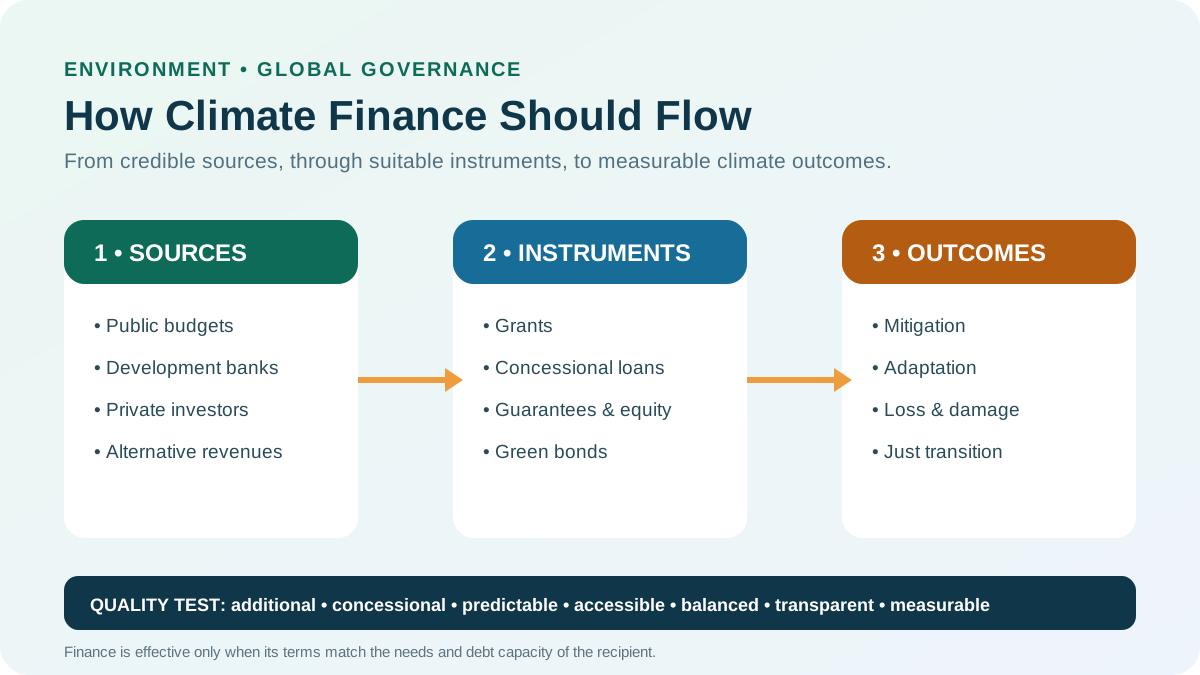
Climate finance is funding used to reduce greenhouse-gas emissions, adapt to climate impacts and address climate-related loss and damage. It can be local, national or international and may come from public budgets, development banks, private investors or alternative sources. The central global dispute is not only how much money is mobilised, but who provides it, on what terms, for which activities and with what accountability.
At COP29 in Baku, countries adopted a new climate-finance goal: developed countries are to take the lead in mobilising at least USD 300 billion per year by 2035 for developing countries. A wider effort seeks to scale finance from all public and private sources to at least USD 1.3 trillion per year by 2035. The gap between the core commitment and the wider ambition explains why climate finance remains a major issue in global negotiations.
What is climate finance?
The UN Framework Convention on Climate Change (UNFCCC) defines climate finance as local, national or transnational financing—drawn from public, private and alternative sources—that supports mitigation and adaptation. In simple terms, it pays for the transition to a low-emission economy and for protection against impacts that can no longer be avoided.
| Purpose | Examples | Typical financing need |
|---|---|---|
| Mitigation | Renewable energy, storage, electric mobility, industrial efficiency and methane reduction | Large upfront capital; projects may later generate revenue |
| Adaptation | Heat-action plans, resilient agriculture, flood protection, water security and climate-resilient health systems | Public and concessional finance because many benefits are social, local and difficult to monetise |
| Loss and damage | Support after irreversible or extreme impacts such as destroyed homes, lost land and damaged livelihoods | Grants and rapid-response finance that do not deepen debt |
| Just transition | Worker reskilling, regional diversification and affordable energy access during structural change | Patient public finance combined with social-protection spending |
Green finance and climate finance overlap but are not identical. Green finance can include biodiversity, pollution control or circular-economy projects even when their primary aim is not climate mitigation or adaptation.
Why do developed countries have a special obligation?
Climate-finance obligations rest on equity and the principle of common but differentiated responsibilities and respective capabilities (CBDR-RC). Developed economies contributed a large share of historical emissions and possess greater financial and technological capacity. Developing countries still need energy, infrastructure and poverty reduction while facing severe climate risks.
- UNFCCC: links action to differentiated responsibility and capability.
- Paris Agreement Article 9: states that developed-country Parties shall provide financial resources to assist developing countries with mitigation and adaptation.
- Article 9.4: calls for scaled-up resources to seek a balance between adaptation and mitigation, considering country-driven strategies and vulnerable countries.
- National ownership: finance should support nationally determined contributions (NDCs) and national adaptation plans rather than impose unrelated priorities.
Equity does not exclude domestic action or private investment. It means international support must be additional, predictable and suitable for countries whose fiscal space is already limited.
From the USD 100-billion goal to the new NCQG
Developed countries had earlier committed to mobilise USD 100 billion annually for developing countries. COP29 replaced that benchmark with the New Collective Quantified Goal on Climate Finance (NCQG).
| Element | COP29 outcome | Important qualification |
|---|---|---|
| Core finance goal | At least USD 300 billion annually by 2035 for developing countries | Developed countries are to take the lead; multiple public, private, bilateral and multilateral sources may count |
| Wider scale-up | Efforts by all actors to reach at least USD 1.3 trillion annually by 2035 | This is a broader mobilisation pathway, not identical to a USD 1.3-trillion public grant obligation |
| Baku-to-Belém Roadmap | A pathway for scaling finance towards USD 1.3 trillion | Includes grants, concessional and non-debt-creating instruments and measures to create fiscal space |
| Time horizon | 2035 | Delayed finance increases future costs and locks in vulnerability |
The distinction between USD 300 billion and USD 1.3 trillion is often misunderstood. The first is the negotiated core goal led by developed countries. The second is the scale of finance that the wider international system should help mobilise from public and private sources. Developing countries argue that the core amount is too small relative to need and that excessive reliance on private capital can leave adaptation and low-income countries behind.
Why is there an adaptation-finance gap?
Mitigation projects such as solar parks may produce predictable revenue. Adaptation projects often avoid future losses rather than generate cash. A heat-health system, mangrove restoration or drought-resilient seed programme creates public value, but investors cannot easily charge every beneficiary.
India’s Economic Survey cited the 2025 Adaptation Gap Report: developing countries may require USD 310–365 billion each year by 2035, while international public adaptation finance was about USD 26 billion. This mismatch shows why a simple “mobilise private capital” formula is inadequate.
- Revenue problem: many adaptation benefits are public goods.
- Small project size: local projects can have high transaction costs.
- Data gaps: investors may lack hazard, exposure and outcome data.
- Currency risk: foreign-currency loans become costlier when local currencies weaken.
- Debt stress: vulnerable countries may borrow after disasters, worsening fiscal pressure.
- Long time horizon: avoided losses may emerge over decades rather than a normal investment cycle.
Sources and instruments of climate finance
| Instrument | Best use | Main risk |
|---|---|---|
| Grants | Vulnerable communities, capacity building, early warning and loss and damage | Limited supply and fragmented access |
| Concessional loans | Infrastructure with social returns but weak commercial returns | Still adds debt if project or currency risks are high |
| Guarantees | Reducing risk to attract private investment | Public sector may absorb losses without adequate additional investment |
| Equity | Innovative firms and scalable clean technologies | Investors seek returns and may avoid poor or high-risk regions |
| Green bonds | Large, clearly defined investment pipelines | Greenwashing or unclear use-of-proceeds reporting |
| Blended finance | Using public or philanthropic capital to improve project risk-return | Weak transparency about subsidy and who captures benefits |
| Carbon markets | Channeling payments to verified emission reductions | Low-integrity credits can overstate climate benefits |
A climate-finance taxonomy can define which activities qualify and reduce greenwashing. See LearnPro’s analysis of the draft framework of India’s climate-finance taxonomy. A taxonomy improves classification; it does not by itself create affordable finance.
Major climate-finance institutions
- Green Climate Fund (GCF): supports mitigation and adaptation projects in developing countries.
- Global Environment Facility (GEF): finances global environmental benefits across several conventions.
- Adaptation Fund: finances concrete adaptation projects and programmes.
- Fund for Responding to Loss and Damage: supports countries particularly vulnerable to climate impacts.
- Multilateral development banks: provide loans, guarantees, technical support and project preparation.
- National and sub-national budgets: fund public transport, resilient infrastructure, agriculture, health and disaster management.
Loss and damage is conceptually different from adaptation: adaptation reduces expected harm, while loss-and-damage finance responds when impacts exceed the ability to adapt. LearnPro’s overview of climate action and the Loss and Damage Fund provides the wider negotiation context.
India’s climate-finance position and domestic strategy
India argues that developed countries must provide new, additional and predictable finance consistent with equity. Loans at market rates should not be presented as equivalent to grants, especially where climate-vulnerable countries face debt stress. India also needs major domestic investment for renewable energy, grids, storage, transport, industry and adaptation.
- Public expenditure: Union, State and local budgets finance resilience, disaster risk reduction and development programmes with climate benefits.
- Sovereign green bonds: raise funds for eligible public green projects.
- SEBI frameworks: regulate listed green-debt securities and sustainability disclosures.
- Priority-sector and development finance: can support distributed renewable energy and climate-resilient livelihoods.
- Carbon Credit Trading Scheme: seeks a domestic framework for verified emission reductions, separate from budgetary climate finance.
- Taxonomy development: can direct capital towards activities aligned with India’s development pathway.
India’s challenge is to mobilise capital without raising energy costs for poor households, creating stranded workers or transferring excessive currency and policy risk to the public. The transition must be low-carbon, resilient and development-centred.
What makes climate finance high quality?
- Additionality: climate finance should not merely relabel existing development aid.
- Concessionality: terms must match a project’s social return and the recipient’s debt capacity.
- Predictability: multi-year flows allow countries to plan infrastructure and adaptation.
- Accessibility: approval procedures should not exclude small States, local bodies or community organisations.
- Balance: adaptation and loss and damage need public finance, not only commercially attractive mitigation.
- Transparency: reporting must distinguish grants, loans, mobilised private finance and the climate-specific share.
- Measurable outcomes: finance should track emissions avoided, people protected, ecosystems restored and distributional effects.
- Just transition: workers, women, Indigenous Peoples and vulnerable communities should participate in project design and share benefits.
UPSC relevance
Climate finance is relevant to GS Paper III under climate change, environment, infrastructure, energy transition and disaster management. It also connects with international relations, North–South equity and multilateral institutions.
Possible Mains question: “The climate-finance debate is as much about the quality and terms of finance as it is about quantity. Examine with reference to the New Collective Quantified Goal.”
Conclusion
Climate finance converts climate promises into power systems, resilient farms, safer cities and recovery after unavoidable damage. The COP29 goals created a new numerical framework, but delivery will depend on grants, concessional resources, reform of development banks, credible private mobilisation and transparent accounting. For India and other developing countries, success means finance that expands climate action without sacrificing development or worsening debt.
Frequently asked questions
What is climate finance in simple words?
Climate finance is money used to reduce emissions, adapt to climate impacts and respond to climate-related loss and damage. It can come from public, private or alternative sources.
What is the COP29 climate-finance goal?
COP29 set a core goal of at least USD 300 billion per year by 2035 for developing countries, led by developed countries, alongside efforts to scale finance from all sources to at least USD 1.3 trillion annually.
Why does adaptation need public finance?
Many adaptation projects create public benefits and avoided losses rather than a direct revenue stream. Grants and concessional finance are therefore essential.
What is the difference between mitigation and adaptation finance?
Mitigation finance reduces or removes greenhouse-gas emissions. Adaptation finance reduces exposure and vulnerability to climate impacts that are occurring or expected.
What does CBDR-RC mean?
Common but differentiated responsibilities and respective capabilities means all countries must act, but responsibilities differ according to historical contribution, capacity and national circumstances.
Official references
- UNFCCC: Introduction to climate finance
- UNFCCC: COP29 finance outcome
- UNFCCC: Baku-to-Belém Roadmap to USD 1.3 trillion





Sources and further reading
- UNFCCC: Introduction to climate financeunfccc.int
- UNFCCC: COP29 finance outcomeunfccc.int
- UNFCCC: Baku-to-Belém Roadmap to USD 1.3 trillionunfccc.int