Migrant voting rights in India present a basic democratic problem: a citizen may remain legally enrolled in a home constituency but be hundreds of kilometres away on polling day. Internal migrants move for work, education, marriage, care and seasonal livelihoods. Many cannot afford to return home merely to cast one vote, while frequent re-registration may not suit temporary or circular migration.
The Constitution provides the foundation for adult suffrage, but the practical ability to vote depends on electoral registration and the polling methods authorised by law. India’s Election Commission proposed a Remote Voting Machine (RVM) for domestic migrants in 2022. The proposal opened an important debate about access, secrecy, verification and public trust; it did not by itself create an immediately available remote-voting right.
What is the problem with migrant voting rights in India?
India’s electoral system links each voter to one constituency and one electoral roll. This protects the principle of one person, one vote, but it assumes that the voter can reach the assigned polling station. A migrant living temporarily at a destination may face several barriers:
- Travel cost: wages and transport expenses can exceed the immediate economic value of returning home.
- Loss of work: informal and daily-wage workers may not receive paid leave.
- Circular migration: a worker may move between home and multiple destinations during the year.
- Housing insecurity: tenants, hostel residents and workers at temporary sites may struggle to document ordinary residence.
- Information gaps: voters may not know when or how to transfer their enrolment.
- Political distance: migrants may retain family, land and community interests in the home constituency even while working elsewhere.
The Election Commission noted that turnout in the 2019 Lok Sabha election was 67.4% and that more than 30 crore registered electors did not vote. It did not claim that all these non-voters were migrants; non-participation has many causes. The relevant point is that mobility is one identifiable barrier requiring a credible solution.
Constitutional and legal framework
| Provision | Meaning for a migrant voter |
|---|---|
| Article 324 | Vests the superintendence, direction and control of elections in the Election Commission of India. |
| Article 326 | Provides for elections to the Lok Sabha and State Assemblies on the basis of adult suffrage, subject to lawful disqualifications. |
| RPA, 1950 — Section 17 | A person cannot be registered in more than one constituency. |
| RPA, 1950 — Section 19 | An eligible citizen aged 18 or above may be registered where the person is ordinarily resident. |
| RPA, 1950 — Section 20 | Explains ordinary residence; merely owning a house is insufficient, and temporary absence does not automatically end ordinary residence. |
| Registration of Electors Rules, 1960 | Provides the procedure and forms for inclusion, correction and transfer in electoral rolls. |
A migrant who becomes ordinarily resident at a destination may seek enrolment there through Form 6. The voter cannot remain enrolled in two constituencies. LearnPro’s guide to electoral-roll preparation and Form 6 explains the administrative process.
However, re-registration is not a complete answer for every migrant. A seasonal worker may stay at the destination for part of the year, return home repeatedly and retain a stronger connection with the home constituency. The law’s case-specific idea of “ordinary residence” is more flexible than permanent ownership, but frequent mobility remains difficult for roll administration.
What can an internal migrant do under the present system?
| Option | When it works | Limitation |
|---|---|---|
| Vote in the home constituency | The person remains registered there and can travel on polling day. | Cost, distance and loss of wages may prevent travel. |
| Transfer enrolment to destination | The destination has become the person’s ordinary residence. | Unsuitable for some temporary, seasonal or circular migrants. |
| Postal or other absentee method | Available to categories specifically authorised under election law and rules. | Migrant status alone does not generally create postal-ballot eligibility. |
| Remote Voting Machine | Could allow a pre-registered migrant to vote for the home constituency from a designated remote booth. | It was proposed for consultation and requires legal, administrative and trust safeguards before rollout. |
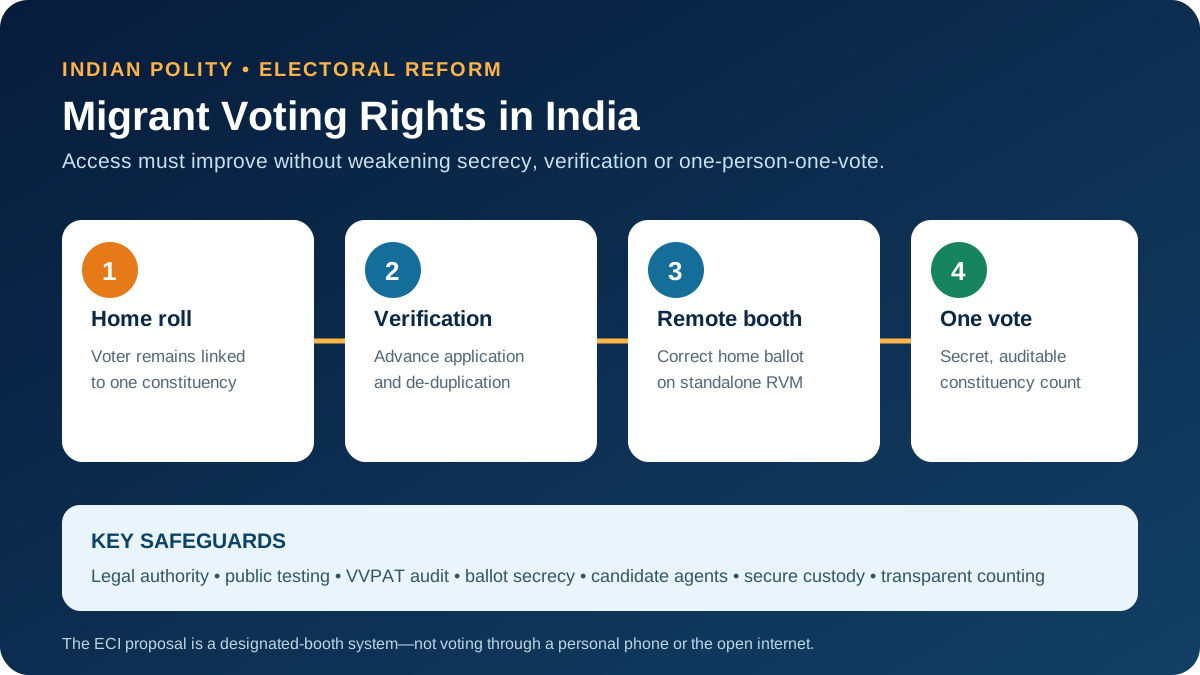
This distinction is crucial: remote voting is not the same as internet voting. The ECI’s proposed system was based on a modified standalone M3 electronic voting machine, not voting from a personal phone or laptop.
How was the proposed Remote Voting Machine designed?
In December 2022, the Election Commission announced that it was ready to pilot remote voting for domestic migrants. The proposed Multi-Constituency Remote Electronic Voting Machine could handle candidates from as many as 72 home constituencies at one designated remote polling location.
- Advance identification: an eligible migrant would need to apply and be verified before polling.
- Designated remote booth: the voter would visit a controlled polling station in the destination area, not vote from anywhere.
- Correct constituency ballot: the system would display the candidates for that voter’s home constituency.
- Secret vote: the vote would be recorded through an EVM-style process with secrecy safeguards.
- Constituency-wise counting: votes would have to be securely mapped and counted for the appropriate home constituency.
The proposal aimed to preserve familiar EVM principles while reducing the need for physical return. Its promise is administrative convenience; its acceptability depends on transparent rules, independent testing and political consensus.
Why is migrant remote voting difficult?
1. Defining a migrant voter
Migration can be permanent, temporary, seasonal, circular, inter-district or inter-state. A workable rule must define who qualifies, how long a person must be away and what evidence is sufficient—without excluding workers in informal housing.
2. Preventing duplicate voting
Once a voter is approved for a remote booth, the home polling station must be reliably marked so the same elector cannot vote twice. This requires accurate roll synchronisation and a clear audit trail.
3. Ballot secrecy and coercion
Migrants can depend on employers, contractors or local intermediaries. Remote centres must prevent organised transport, intimidation, surveillance and vote-buying while protecting secrecy.
4. Campaign equality
A person voting for a distant home constituency must have meaningful access to candidate information. Rules must address campaigning near remote booths, agents for candidates and the distribution of verified ballot information.
5. Trust in technology
Election technology must be explainable to voters, parties and courts. Source systems, mock polls, VVPAT procedures, chain of custody, storage, transport and counting protocols require public scrutiny. LearnPro’s discussion of Election Commission independence and transparent electoral rolls shows why institutional trust is as important as technical design.
6. Legal changes
Rules framed for constituency-based in-person polling must clearly authorise registration for remote voting, the remote polling location, candidate agents, challenged votes, recounts and dispute resolution. Administrative innovation cannot bypass Parliament’s election laws.
A rights-based reform path
- Improve portability first: make Form 6 processing quick, multilingual and usable without demanding documents that the law does not require.
- Map migration patterns: identify high-volume origin–destination corridors without treating every migrant as identical.
- Run limited pilots: test selected corridors with published protocols, mock polls and independent technical review.
- Create auditable safeguards: publish procedures for enrolment, de-duplication, VVPAT, custody and counting.
- Protect political equality: ensure candidates can appoint agents and remote voters receive constituency-specific information.
- Provide non-digital assistance: registration help desks at worksites, campuses and transport hubs can reduce exclusion immediately.
- Measure outcomes: evaluate whether access improves for women, seasonal workers, tenants and informal labour—not only total turnout.
Any reform must balance two constitutional values: inclusion, so mobility does not erase political voice; and electoral integrity, so every voter and party can trust that only eligible votes are counted once and in secret.
UPSC relevance
Migrant voting rights in India connect GS Paper II topics: elections, constitutional bodies, Representation of the People Acts, governance, vulnerable sections and technology in public administration. They also illustrate a broader question in political theory—whether a formal right is meaningful when its exercise carries a prohibitive economic cost.
Possible Mains question: “Remote voting for domestic migrants can deepen electoral inclusion, but technology alone cannot solve the problem. Discuss the legal and institutional safeguards required.”
Conclusion
Internal migrants do not lose citizenship when they move, but mobility can make their vote practically inaccessible. Registration transfer remains available where the destination is the person’s ordinary residence; it does not fit every circular migrant. A carefully designed remote-booth system may reduce this gap, provided it is legally authorised, independently tested and publicly auditable. The goal should not be technology for its own sake, but equal and trusted access to the ballot.
Frequently asked questions
Can a migrant worker vote from another state in India?
A migrant can vote where enrolled. The person may transfer enrolment to a destination that has become the person’s ordinary residence, but there is not a general facility allowing every migrant to vote remotely for the home constituency.
Can a voter be registered in two constituencies?
No. Section 17 of the Representation of the People Act, 1950 prohibits registration in more than one constituency.
What is the Election Commission’s Remote Voting Machine?
It is a proposed modified standalone EVM system intended to let verified domestic migrants vote for their home constituency from a designated remote polling booth. It is not internet voting.
How many constituencies could the proposed RVM handle?
The ECI stated that its proposed Multi-Constituency Remote EVM could handle up to 72 constituencies from one remote polling location.
Which constitutional article provides adult suffrage?
Article 326 provides for elections to the Lok Sabha and State Legislative Assemblies on the basis of adult suffrage, subject to the Constitution and election law.
Official references
- Election Commission of India: proposal to pilot remote voting for domestic migrants
- India Code: Representation of the People Act, 1950