
Brief Context
Context The Ministry of Finance released the Draft Framework of India’s Climate Finance Taxonomy which is aimed to create a unified classification system for climate-aligned investments, ensuring transparency, credibility, and alignment with national and global climate goals. Classification Approach (Three Categories) Mitigation: Projects that reduce or avoid greenhouse gas emissions; Adaptation: Initiatives that enhance resilience to climate impacts; Transition: Measures that enable high-emissi
Source Content
Syllabus: GS2/Government Policy & Intervention; GS3/Environment
Context
- The Ministry of Finance released the Draft Framework of India’s Climate Finance Taxonomy which is aimed to create a unified classification system for climate-aligned investments, ensuring transparency, credibility, and alignment with national and global climate goals.
What Is a Climate Taxonomy?
- A climate taxonomy is a classification system that identifies which economic activities contribute to climate mitigation, adaptation, or transition. It helps:
- Investors assess green credentials of projects;
- Governments channel subsidies and incentives;
- Regulators monitor compliance and prevent greenwashing;
Framework of India’s Climate Finance Taxonomy
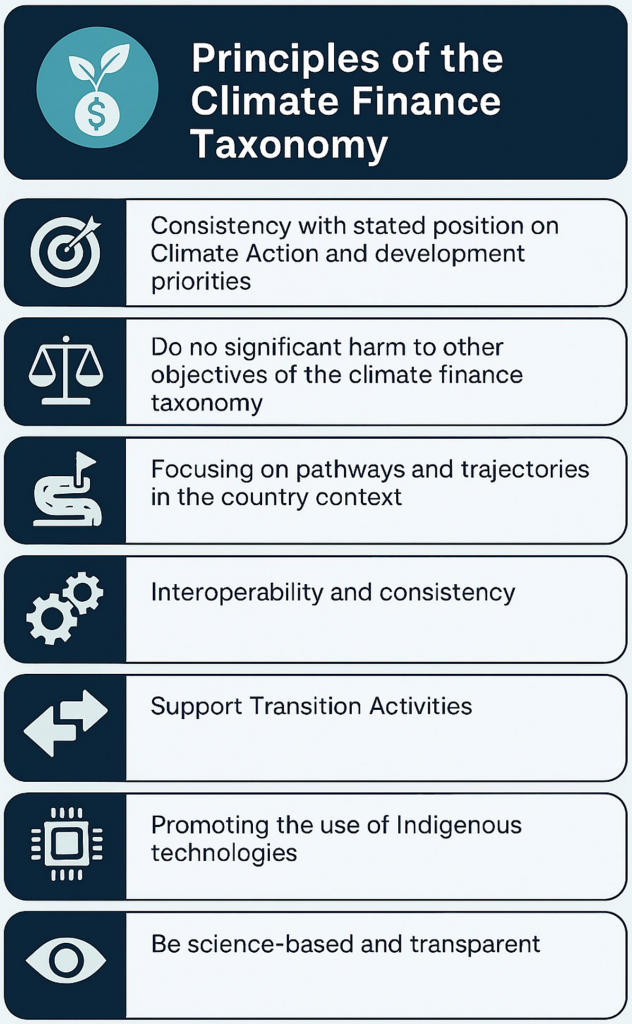
- Objectives: India’s taxonomy is designed to complement instruments like green bonds, the Carbon Credit Trading Scheme, and SEBI’s ESG norms, creating a unified climate finance ecosystem. It aims to:
- define climate-aligned activities across sectors;
- guide public and private investments toward low-carbon and climate-resilient development;
- prevent greenwashing by establishing clear eligibility criteria;
- support India’s Nationally Determined Contributions (NDCs) under the Paris Agreement.
- Sectoral Coverage: Each sector includes specific criteria for mitigation, adaptation, and transition activities.
- Power: Renewable energy, grid modernization, energy storage;
- Mobility: Electric vehicles, public transport, fuel efficiency;
- Buildings: Green construction, energy-efficient retrofits
- Agriculture & Water Security: Climate-smart agriculture, irrigation efficiency, water conservation;
- Hard-to-Abate Sectors: Low-carbon technologies in steel, cement, chemicals
Classification Approach (Three Categories)
- Mitigation: Projects that reduce or avoid greenhouse gas emissions;
- Adaptation: Initiatives that enhance resilience to climate impacts;
- Transition: Measures that enable high-emission sectors to shift toward sustainability;
Key Concerns in India’s Climate Finance Taxonomy Framework
- Lack of Indigenous Context: India’s draft borrows mostly from international models like the EU taxonomy, hindering India’s unique climatic vulnerabilities and development priorities.
- It fails to reflect local realities such as the role of informal sectors, traditional practices, and regional disparities in emissions and climate risks.
- Misplaced Sectoral Focus: High-emission sectors like energy generation, transportation, chemicals, cement, and real estate are underrepresented.
- Meanwhile, low-emission sectors such as agriculture, food, and water security are included without clear justification, raising concerns about misdirected climate finance.
- Absence of Clear Metrics and Criteria: The taxonomy lacks scientific, data-backed rationale for selecting sectors and defining thresholds for emissions reduction.
- Terms like ‘climate-friendly technologies’ and ‘public consultation’ are vague and undefined, limiting transparency and accountability.
- Weak Governance Architecture: There is no defined institutional mechanism for implementation, review, or enforcement — especially problematic given India’s federal structure.
- The framework does not specify how state governments, local bodies, or civil society will be involved in decision-making.
- Ignoring Equity and Justice: Vulnerable communities — such as small farmers, low-income households, and indigenous groups — are not prioritized in climate finance allocation.
- The draft overlooks social safeguards like labor rights, human rights, and equitable access to finance.
- Overemphasis on High-Tech Solutions: The taxonomy promotes advanced technologies while sidelining low-cost, indigenous, and community-based climate solutions.
- This risks excluding MSMEs and informal sectors that lack access to capital and technical expertise.
- No Timeline Alignment with India’s NDCs: The draft fails to establish sector-specific timelines or transition pathways, despite referencing India’s Net Zero by 2070 and NDC targets.
- It does not differentiate responsibilities across states or sectors based on their emissions contributions.
Recommendations for Improvement
- Legal Alignment: The taxonomy needs to harmonize with domestic laws like the
- j, and international frameworks such as the Paris Agreement (Article 6.4).
- Content Clarity: Definitions should be technically precise and accessible to MSMEs, informal sectors, and non-experts.
- Quantitative thresholds (e.g., GHG reduction targets) need to be updated with empirical data.
- Other recommendations include:
- Re-centering the taxonomy on high-emission sectors;
- Defining measurable, science-based metrics;
- Establishing a robust governance and review mechanism;
- Integrating equity, social safeguards, and indigenous knowledge;
- Creating staggered compliance pathways for MSMEs and vulnerable groups;
Sources and further reading
- agriculturenextias.com
- Source: THthehindu.com