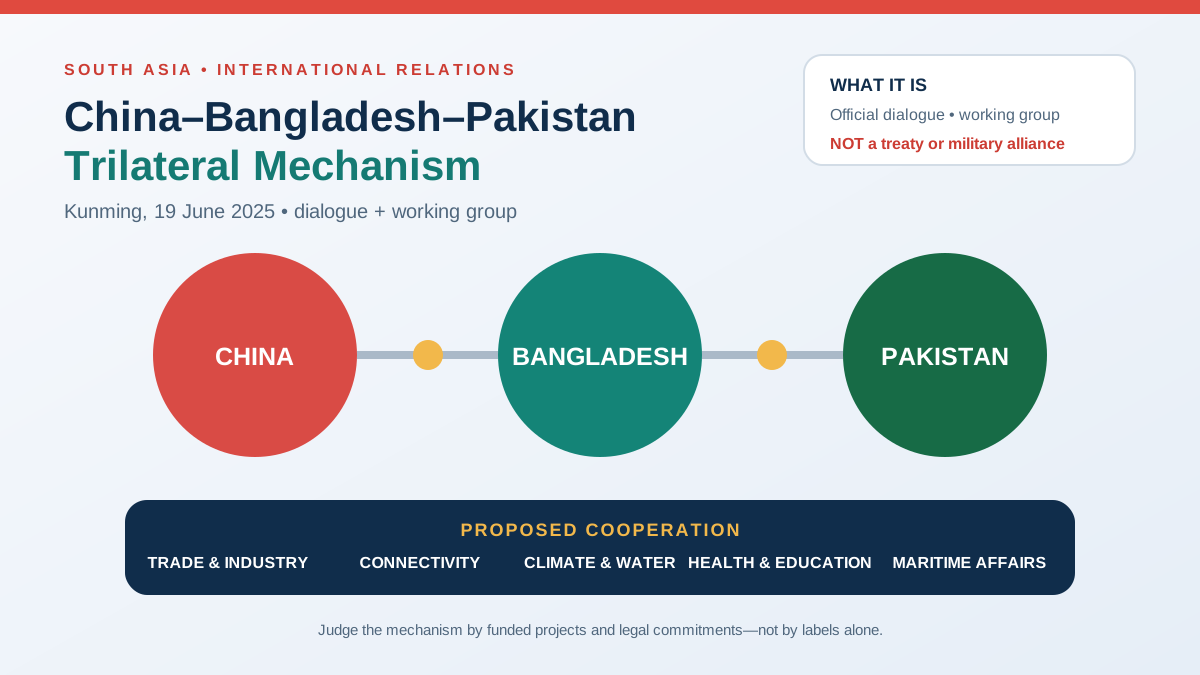
The China–Bangladesh–Pakistan trilateral mechanism began with a senior-officials meeting in Kunming, China, on 19 June 2025. The three countries discussed economic and development cooperation and agreed to create a working group to follow up on possible projects.
The meeting attracted attention in India because it brought together China and two of India’s immediate neighbours. However, the evidence must be read carefully. Official statements described an open, development-focused mechanism; Bangladesh’s foreign-affairs adviser later said it was an informal official-level discussion, not a political or military alliance and not directed against a third country.
What happened at the Kunming meeting?
The meeting took place on the sidelines of the ninth China–South Asia Exposition and the sixth China–South Asia Cooperation Forum. It was attended by:
- Sun Weidong, China’s Vice Foreign Minister;
- Ruhul Alam Siddique, Bangladesh’s Acting Foreign Secretary; and
- Imran Ahmed Siddiqui, Pakistan’s Additional Secretary for Asia-Pacific, while Pakistan Foreign Secretary Amna Baloch joined the first phase by video.
According to the Chinese and Pakistani official readouts, the parties supported good-neighbourliness, equality, mutual trust, openness, inclusiveness and shared development. They agreed to explore projects and establish a joint working group for follow-up.
Agreed areas of cooperation
The official lists overlap but are not identical. Taken together, they cover a wide development agenda:
| Cluster | Areas mentioned | Possible practical form |
|---|---|---|
| Economy | Industry, trade and investment, digital economy | Business forums, standards, supply-chain links and investment facilitation |
| Connectivity | Regional connectivity and green infrastructure | Transport, logistics and energy projects subject to separate agreements |
| Food and water | Agriculture, water resources and climate change | Research, training, resilient farming and water-management exchanges |
| Maritime | Maritime affairs and marine sciences | Ocean research, blue-economy cooperation and professional exchanges |
| Human development | Health, education and human resources | Scholarships, training, medical links and institutional partnerships |
| People-to-people ties | Culture, youth and think tanks | Academic dialogue, cultural exchange and policy research |
A list of sectors is an agenda, not proof that each project has funding, legal approval or implementation. Every infrastructure, trade or data-sharing initiative would still require its own terms, finance, safeguards and domestic clearances.
Mechanism, dialogue, grouping and alliance: what is the difference?
| Term | What it normally means | Does the Kunming outcome establish it? |
|---|---|---|
| Dialogue | Officials meet and exchange views | Yes |
| Cooperation mechanism | A recurring channel with a follow-up process | Yes, at an early stage |
| Economic bloc | Formal trade preferences, rules or institutions | No |
| Military alliance | Collective defence or security obligations | No |
| Supranational organisation | Independent bodies with delegated authority | No |
China’s official statement said the cooperation was not directed at any third party. Bangladesh’s Foreign Affairs Adviser Touhid Hossain also rejected the claim that an alliance was being formed. Strategic consequences may still develop, but analysis should not replace the documented institutional position.
Why did China convene the trilateral mechanism?
China has large economic relationships with both countries. Pakistan is its long-standing strategic partner and hosts the China–Pakistan Economic Corridor (CPEC). Bangladesh participates in the Belt and Road Initiative and seeks infrastructure, manufacturing, energy and market access.
The mechanism can serve several Chinese objectives:
- Regional convening power: Beijing can shape issue-based cooperation beyond bilateral projects.
- BRI coordination: shared standards and logistics may connect separate investment corridors.
- Yunnan’s gateway role: Kunming links China’s southwest with South and Southeast Asia.
- Global South diplomacy: the format is presented as development cooperation among non-Western partners.
- Institutional presence: a working group can turn occasional meetings into a repeatable channel.
For background on the larger Chinese framework, use LearnPro’s International Relations notes on BRI and CPEC.
Why did Bangladesh participate?
Bangladesh’s geography and development needs encourage multi-vector diplomacy. It depends on close economic and physical links with India, while China is a major source of imports, infrastructure finance and defence equipment. Dhaka also sought to rebuild exchanges with Pakistan after a long period of limited engagement.
Possible benefits for Bangladesh include:
- more investment and manufacturing opportunities;
- diversified trade and transport connections;
- agricultural and climate-resilience cooperation;
- healthcare, education and training links; and
- greater bargaining space among larger regional powers.
Participation does not erase Bangladesh’s deep structural ties with India. The two countries share a long land border, rivers, power links, rail and road connectivity, cultural ties and dense trade. A detailed balance is available in LearnPro’s India–Bangladesh relations analysis.
Why is Pakistan interested?
Pakistan benefits from a platform that connects its China partnership with another large South Asian economy. It can use the mechanism to pursue trade, investment, agriculture, digital cooperation and diplomatic engagement with Bangladesh. The format may also reduce Islamabad’s regional isolation at a time when SAARC remains inactive.
Yet geography imposes limits. India lies between Pakistan and Bangladesh, so any overland corridor would require Indian participation or a costly alternative route. Historical memory of the 1971 war also makes Bangladesh–Pakistan relations politically sensitive.
What are the implications for India?
1. Greater Chinese institutional influence
China is not only financing projects; it is creating platforms in India’s neighbourhood. Repeated working-level meetings can shape standards, project pipelines and diplomatic habits.
2. Pressure on India’s neighbourhood policy
India cannot assume that geography and historical ties will automatically preserve influence. Neighbours compare delivery speed, financing terms, market access and political treatment.
3. Connectivity competition
Chinese-backed connectivity may compete with or complement BBIN and BIMSTEC projects. India should evaluate each proposal by route, financing, security and economic viability rather than reject every project by label.
4. Maritime and Bay of Bengal concerns
Cooperation in marine sciences or ports can be economically useful, but India will watch for dual-use infrastructure, military access, hydrographic data and changes in naval presence. The 2025 readout did not announce a military component.
5. Regional institution gap
The mechanism highlights the cost of weak South Asian institutions. SAARC has been stalled, while BIMSTEC excludes Pakistan and China. Issue-based mini-lateral formats fill the space left by inactive broader forums.
LearnPro’s note on the role of BIMSTEC as an active regional platform explains this institutional shift.
Opportunities and risks
| Potential opportunity | Corresponding risk |
|---|---|
| More trade and investment | Unequal market access, debt stress or opaque contracts |
| Regional infrastructure | Commercially weak projects or strategic dependence |
| Digital cooperation | Data-governance, cyber-security and vendor-lock-in concerns |
| Water and climate research | Unequal data sharing and absence of affected riparian states |
| Marine science | Dual-use mapping or security sensitivity |
| New diplomatic channel | Fragmentation of regional institutions |
How should India respond?
- Strengthen bilateral delivery: complete connectivity, energy and trade commitments with Bangladesh on time.
- Reduce friction: manage border incidents, visas, river disputes and public rhetoric through regular dialogue.
- Offer viable finance: projects must be transparent, locally useful and faster to implement.
- Revitalise regionalism: make BIMSTEC and BBIN deliver practical transport, power and disaster-response outcomes.
- Separate economics from security: welcome genuinely public-benefit projects while scrutinising dual-use risks.
- Respect strategic autonomy: neighbours will diversify partnerships; coercive responses can accelerate that trend.
- Track outcomes, not headlines: judge the mechanism by funded projects, institutional meetings and legal commitments.
UPSC relevance
The China–Bangladesh–Pakistan trilateral mechanism belongs primarily to GS Paper II: India and its neighbourhood, regional groupings, China’s role in South Asia, India–Bangladesh relations and the limits of SAARC. It also connects to GS Paper III through connectivity, ports, digital infrastructure and maritime security.
Possible Mains question: The growth of mini-lateral mechanisms in South Asia reflects both development demand and institutional weakness. Analyse the China–Bangladesh–Pakistan trilateral mechanism and suggest an appropriate Indian response.
Conclusion
The Kunming meeting was politically significant but institutionally modest. It created a development-oriented dialogue and a proposed working group; it did not create an alliance or treaty. For India, the correct response is neither complacency nor alarmism. The durable answer is better regional delivery, respectful diplomacy, competitive economic options and careful scrutiny of projects that may acquire strategic features.
Frequently asked questions
What is the China–Bangladesh–Pakistan trilateral mechanism?
It is a senior-officials cooperation channel launched at Kunming on 19 June 2025. The participants discussed development sectors and agreed to create a working group for follow-up.
Is it a military alliance against India?
No military or collective-defence pact was announced. China said the mechanism was not directed at a third party, and Bangladesh’s foreign-affairs adviser denied that an alliance was being formed.
Which areas were identified for cooperation?
They included industry, trade, investment, connectivity, agriculture, water, climate, health, education, digital economy, green infrastructure, maritime affairs, culture, youth and think-tank exchanges.
Why is the mechanism important for India?
It shows China building new institutional channels with India’s neighbours. It may affect connectivity, investment, diplomatic influence and, depending on future projects, Bay of Bengal security.
How should India respond?
India should improve project delivery and bilateral trust with Bangladesh, strengthen BIMSTEC and BBIN, offer transparent financing and assess specific security risks without treating every economic engagement as hostile.
Official references
- Chinese Ministry of Foreign Affairs: Kunming trilateral meeting
- Pakistan Ministry of Foreign Affairs: inaugural trilateral mechanism
- Bangladesh Sangbad Sangstha: clarification by Bangladesh’s Foreign Affairs Adviser