Snowflake yeast multicellularity offers a clear example of how biology and physics can work together during evolution. A 2025 Science Advances study found that large laboratory-evolved yeast clusters generate fluid currents through their own metabolism. These currents move nutrients through and around the cluster, helping it continue exponential growth even at sizes that should be limited by diffusion alone.
The finding is often described too loosely as “multicellular life without mutations.” That is incorrect. The snowflake form itself arose through genetic change and selection: daughter yeast cells remain attached after division and form branching clusters. The new result is narrower and more interesting—the clusters did not first need to evolve a genetically encoded circulatory or pumping system. An emergent physical process temporarily solved part of the nutrient-transport problem.
What is snowflake yeast?
Ordinary baker’s yeast, Saccharomyces cerevisiae, is usually unicellular. In long-running laboratory evolution experiments, researchers selected yeast for rapid settling. Some lineages evolved a simple multicellular form because cells failed to separate completely after reproduction. The attached cells form branched structures that resemble snowflakes.
These clusters are useful models of early multicellularity because they allow scientists to observe how a population of cells can acquire group-level properties such as larger size, a life cycle and division of labour. They are not replicas of the first multicellular organisms, but they make specific evolutionary questions testable.
The work also connects with India’s wider biotechnology ecosystem. See LearnPro’s guides to the National Biofoundry Network and India’s bioeconomy and BioE3 policy.
Why large size creates a nutrient problem
A single cell exchanges nutrients and wastes directly with its surroundings. As a cluster becomes larger, cells near the centre lie farther from the external medium. Two related constraints appear:
- Diffusion is slow over long distances: the time required for a molecule to diffuse rises approximately with the square of distance.
- Surface area does not keep pace with volume: a larger body contains more nutrient-consuming cells per unit of exposed surface.
Modern plants and animals address this through roots, vessels, blood, hearts, gills or cilia. Early multicellular clusters had none of these specialised systems. The central question was therefore: how could a simple cluster become large enough for natural selection to later refine complex transport machinery?
What the researchers studied
Nishant Narayanasamy and colleagues from the National Centre for Biological Sciences, International Centre for Theoretical Sciences, Georgia Institute of Technology and associated institutions studied experimentally evolved macroscopic snowflake yeast. Their methods combined time-lapse growth measurements, optical and scanning-electron microscopy, tracer-particle tracking and controlled changes in the growth medium.
The researchers compared cluster growth and surrounding flow under different conditions, including liquid and agar media, different glucose concentrations, altered cluster sizes and an inverted chamber. The public research dataset contains growth time series, particle tracks and flow-field measurements used in the study.
How metabolism creates fluid flow
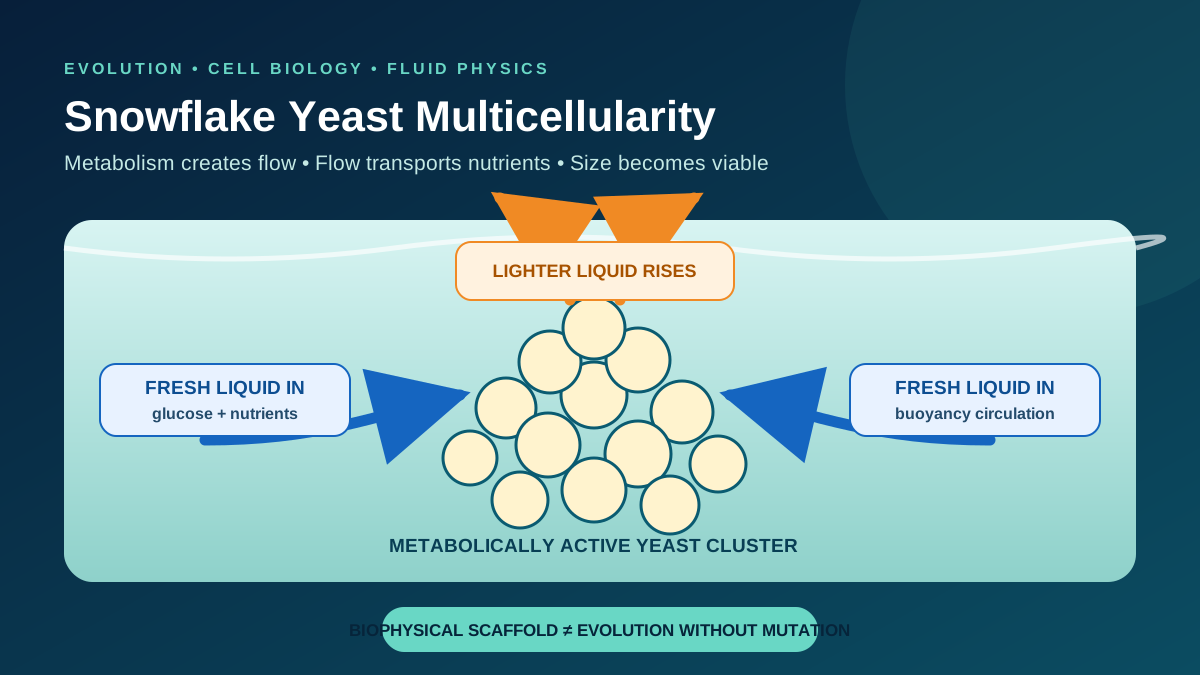
The mechanism can be understood as a five-step chain:
- Yeast consumes glucose from the nutrient medium.
- Its metabolism produces substances, including ethanol and carbon dioxide, that change the local composition of the liquid.
- The metabolically altered liquid becomes less dense than the surrounding nutrient-rich liquid.
- The lighter liquid rises because of buoyancy.
- Fresh, denser liquid is drawn toward the cluster, creating a sustained circulation that transports nutrients faster than diffusion alone.
This is advection: a dissolved substance is carried by the bulk motion of fluid. The yeast cluster does not have a heart or vascular network, and individual cells do not coordinate a pumping action. The circulation emerges from the interaction among metabolism, density and gravity.
Evidence that supports the mechanism
| Test or observation | Result | What it indicates |
|---|---|---|
| Tracer-particle imaging | Particles revealed organised currents around growing clusters | The surrounding liquid was moving, not merely diffusing |
| Liquid versus agar | Macroscopic clusters sustained rapid growth in liquid; restricting fluid motion constrained the effect | Flow, rather than metabolism alone, aided nutrient transport |
| Glucose concentration | Flow depended on adequate metabolic fuel | The current was linked to yeast metabolism |
| Inverted chamber | Flow direction changed with orientation relative to gravity | Buoyancy was the driving force |
| Cluster size | Strong large-scale flows appeared beyond a size threshold | The effect is a collective property of a sufficiently large cluster |
| Fragmentation | Small broken pieces lost the strong flow; reaggregated material restored it | Geometry and scale, not just cell identity, matter |
The authors report that the resulting currents transported nutrients at speeds comparable to flows generated by cilia in some living multicellular organisms. This allowed the yeast clusters to grow exponentially at macroscopic size despite theoretical diffusion limits.
Diffusion and advection: the key distinction
| Feature | Diffusion | Advection |
|---|---|---|
| Driving process | Random molecular motion along a concentration gradient | Bulk movement of the surrounding fluid |
| Best suited to | Short transport distances | Moving material over larger distances |
| In the yeast study | Insufficient by itself at macroscopic scale | Generated by metabolism-linked density differences |
| Specialised organ needed? | No | No—the flow emerged physically in this experiment |
What “biophysical scaffold” means
The researchers describe the fluid current as a biophysical scaffold. A scaffold is not the final biological innovation. It is a physical process that makes a new phenotype viable long enough for later evolution to act on it.
In this case, metabolism-driven flow could let a simple cluster reach large size before it had evolved dedicated nutrient-transport structures. Once large multicellular forms survive and reproduce, natural selection can favour genetic changes that improve adhesion, shape, cell differentiation or internal transport. Physics therefore changes the set of evolutionary possibilities; it does not replace heredity, mutation or selection.
This principle is relevant to biodiversity, synthetic biology and modern biotechnology: biological form is shaped not only by genes, but also by mechanics, geometry, fluid flow and the physical environment in which genes operate.
What the study does not prove
- It does not show that the first multicellular life evolved by this exact route.
- It does not show that mutations are unnecessary for multicellularity.
- It does not turn yeast clusters into complex plants or animals.
- It does not show that fluid flow replaces genetically encoded transport systems at every scale.
- It demonstrates one experimentally supported mechanism that can relax a major early constraint.
This distinction matters in science reporting. A strong conclusion must match the experiment: emergent flow enabled large growth in an evolved laboratory yeast system that lacked specialised multicellular transport adaptations.
Scientific significance and possible applications
The immediate value of the study is conceptual. It links evolutionary biology, active matter and fluid physics. It also suggests questions for applied research:
- Can self-generated flows improve nutrient delivery in engineered microbial communities?
- Could bioreactor geometry make useful metabolic flows stronger or more stable?
- How do physical transport processes affect biofilms, fermentation and tissue-like cell aggregates?
- When does a temporary physical scaffold create selection pressure for a permanent biological transport system?
These are research directions, not established commercial outcomes. Any application would require separate testing for stability, safety, yield and scale.
UPSC relevance
The topic is useful for UPSC and State PSC Science and Technology preparation because it links several syllabus concepts:
- evolution: mutation, selection, multicellularity and emergent traits;
- cell biology: yeast reproduction and cell adhesion;
- physics in biology: diffusion, advection, density and buoyancy;
- biotechnology: laboratory evolution and microbial systems; and
- Indian research: collaboration involving NCBS and ICTS-TIFR.
A balanced Mains answer should explain the mechanism, state the evidence and add the limitation that a laboratory model does not by itself reconstruct the historical origin of multicellular life.
Conclusion
Snowflake yeast multicellularity shows how a simple physical effect can open an evolutionary pathway. Once a sufficiently large yeast cluster metabolises glucose in liquid, density differences generate buoyancy-driven currents. Those currents carry nutrients and reduce the transport barrier created by large size. The study’s lesson is not “evolution without mutation”; it is that genes, selection and physical law jointly determine what living systems can become.
Frequently asked questions
What is snowflake yeast multicellularity?
It is a laboratory model in which daughter yeast cells remain attached after division and form branched, snowflake-like multicellular clusters.
How did fluid physics help the yeast clusters grow?
Yeast metabolism altered the density of nearby liquid. The lighter liquid rose, drawing fresh nutrient-rich liquid toward the cluster and creating advective transport beyond diffusion alone.
Did multicellular yeast evolve without mutations?
No. Genetic change and selection produced the attached-cell snowflake phenotype. The study showed that a nutrient-transport benefit could emerge physically before a specialised, genetically encoded transport system evolved.
What is a biophysical scaffold?
It is a physical process that temporarily supports a biological function and makes a new phenotype possible before evolution produces a dedicated biological adaptation.
Why is the study relevant for UPSC?
It connects evolution, cell biology, biotechnology, diffusion, advection and Indian scientific research, making it useful for Science and Technology answers in UPSC and State PSC examinations.
Primary and institutional references
- Science Advances: Metabolically driven flows enable exponential growth in macroscopic multicellular yeast
- NCBS publication record and abstract
- Dryad: public research dataset and methods summary