
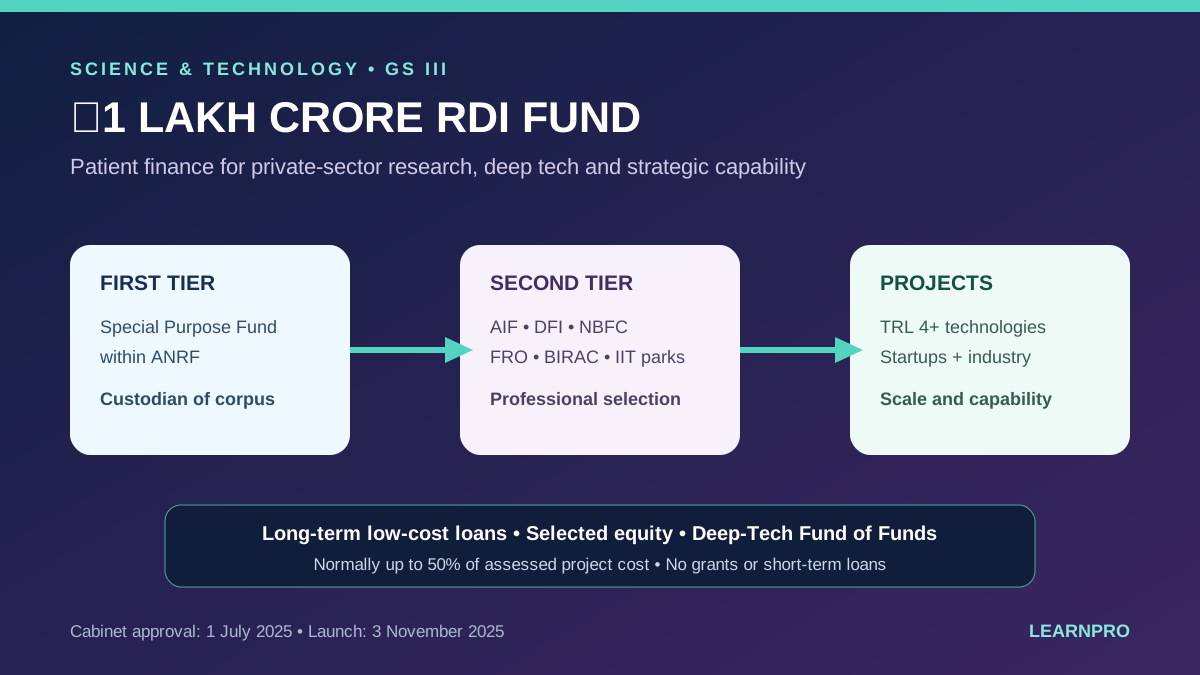
RDI Scheme India is a ₹1 lakh crore financing initiative designed to increase private-sector investment in research, development and innovation. The Union Cabinet approved the Research, Development and Innovation Scheme on 1 July 2025, and the Prime Minister launched the RDI Fund at the Emerging Science, Technology and Innovation Conclave on 3 November 2025.
The scheme targets a persistent gap in India’s innovation system: public laboratories and universities perform important research, but private investment in high-risk, long-gestation technology remains limited. RDI financing focuses on higher-readiness projects, critical technology acquisition and deep-tech funds rather than basic-research grants.
Key facts at a glance
| Feature | Position |
|---|---|
| Total outlay | ₹1 lakh crore over six years |
| FY 2025–26 provision | ₹20,000 crore |
| Nodal department | Department of Science and Technology |
| Fund custodian | Special Purpose Fund within the Anusandhan National Research Foundation |
| Target stage | Transformative projects generally at Technology Readiness Level 4 and above |
| Normal support ceiling | Up to 50% of assessed project cost, with approved exceptions |
| Main instruments | Long-term low- or nil-interest loans, selected equity and contributions to deep-tech funds |
| Excluded instruments | Grants and short-term loans |
Why does India need the RDI Fund?
Deep technologies often face a “valley of death” between laboratory proof and commercial scale. They require specialised equipment, patient engineering, testing, certification and repeated redesign. Venture capital may seek faster exits, commercial banks may lack collateral, and ordinary government grants may be too small for scale-up.
The RDI Fund tries to supply patient risk capital where strategic value is high but commercial uncertainty remains. It also aims to crowd in private capital rather than finance 100% of normal business expansion.
Priority technology areas
- energy security, transition and climate action;
- quantum technologies, robotics and space;
- artificial intelligence, including applications in agriculture, health and education;
- biotechnology, biomanufacturing and synthetic biology;
- pharmaceuticals and medical devices;
- digital economy and digital agriculture;
- advanced materials, manufacturing, electronics and semiconductors; and
- other technologies important for economic security, public interest or self-reliance.
The scheme may also support acquisition of critical technologies and a dedicated Deep-Tech Fund of Funds. This can help Indian firms buy, adapt and improve technologies where starting from zero would take too long, but public support should still create domestic capability rather than permanent import dependence.
What is Technology Readiness Level 4?
Technology Readiness Levels (TRLs) describe the journey from scientific principle to operating system. At TRL 4, components have generally been validated in a laboratory setting. Higher levels move through relevant-environment demonstration, prototype and actual operational deployment.
| Stage | Indicative activity | Best-suited support |
|---|---|---|
| TRL 1–3 | Basic principle, concept and early proof | Research grants, universities and laboratories |
| TRL 4–6 | Validation and prototype in laboratory/relevant environment | Patient RDI finance plus technical milestones |
| TRL 7–9 | System demonstration, qualification and market deployment | Equity, loans, procurement and commercial capital |
TRL is useful but not sufficient. A project can have a working prototype while lacking manufacturability, safety approval, intellectual-property freedom, customers or affordable unit economics.
How the two-tier funding structure works
- First tier—Special Purpose Fund: the SPF within ANRF is the custodian of the ₹1 lakh crore corpus.
- Second tier—professional managers: selected AIFs, development finance institutions, NBFCs, focused research organisations, BIRAC, IIT Research Parks or other approved entities evaluate and finance projects.
- Arm’s-length selection: investment committees with financial, business and technical expertise recommend projects within an authorised mandate.
- Enterprise finance: eligible firms receive long-term loans, equity or fund-based support linked to project milestones.
- Repayment or return: financial recycling can support future projects, unlike a pure grant programme.
The fund does not invite companies to send proposals directly to DST. Applications and disbursements must follow the notified second-level channels and their calls.
Governance architecture
The ANRF Executive Council provides strategic direction. An Empowered Group of Secretaries chaired by the Cabinet Secretary can approve changes in scheme scope, sectors, project categories and second-level fund managers, but does not select individual projects. Second-level managers make project decisions within their mandates.
This design can reduce departmental micromanagement, but it also creates a principal-agent challenge. Public money is delegated to multiple intermediaries, so conflict-of-interest rules, transparent selection, technical due diligence and portfolio reporting are essential.
How the scheme differs from ANRF grants
| Dimension | Research grant | RDI finance |
|---|---|---|
| Primary recipient | Researchers and institutions | Private enterprises, startups, industries and eligible innovation vehicles |
| Stage | Discovery and early research | Generally TRL 4+ and commercialisation pathway |
| Instrument | Non-repayable grant | Long-term loan, equity or fund contribution |
| Success measure | Knowledge, publications, capacity and proof | Technology, IP, production, market adoption and strategic capability |
Potential benefits
- fills the financing gap between laboratory proof and commercial scale;
- builds Indian intellectual property and manufacturing capability;
- supports strategic technologies with long development cycles;
- attracts private co-investment through risk sharing;
- creates specialised fund-manager expertise in deep tech; and
- reduces import vulnerability in critical sectors.
The programme complements the wider innovation ecosystem. LearnPro’s related analysis covers the India startup ecosystem and manufacturing policy and technology capability.
Risks and design challenges
- Adverse selection: firms may seek public finance for weak projects that private investors rejected for good reasons.
- Socialising risk: government may bear losses while successful firms retain most gains.
- Manager incentives: fund managers may favour safer late-stage companies instead of genuinely transformative technology.
- Technology hype: labels such as AI or quantum can substitute for evidence.
- Concentration: large firms and major cities may absorb finance while smaller regions and new founders remain excluded.
- Foreign dependency: licensed technology may not create domestic design or manufacturing capability.
- Long evaluation horizon: deep-tech impact cannot be judged only through annual disbursement targets.
Accountability framework
- publish manager selection criteria, mandates, fees and conflict disclosures;
- use independent technical review and milestone-based disbursement;
- track private capital crowded in, not only public money sanctioned;
- measure patents, domestic value addition, regulatory approvals, exports and import substitution;
- disclose write-offs and restructuring at portfolio level;
- include national-security, environmental and ethical safeguards; and
- evaluate additionality against a credible counterfactual.
UPSC and State PSC relevance
RDI Scheme India is relevant to GS Paper III under science and technology, indigenisation, infrastructure finance, startups and economic growth. The most important analytical point is that the scheme uses repayable or return-seeking finance for TRL 4+ commercialisation, while grants remain necessary for basic and early-stage research.
Mains practice question: India’s innovation gap lies partly between publicly funded research and private commercialisation. Examine how the RDI Fund addresses this gap and the governance risks it must manage.
Conclusion
The RDI Fund is large enough to change India’s deep-tech financing market if it backs technically sound projects that private finance alone cannot support. Its performance should be judged by additional private R&D, domestic capability and globally competitive products—not by rapid disbursement. Patient capital must be matched by patient, transparent evaluation.
Frequently asked questions
What is the total outlay of the RDI Scheme?
The scheme has a total outlay of ₹1 lakh crore over six years, including ₹20,000 crore for FY 2025–26.
Does the RDI Fund provide grants?
No. It uses long-term low- or nil-interest loans, selected equity and contributions to deep-tech or RDI-oriented funds.
Which projects are targeted?
Transformative private-sector projects generally at TRL 4 and above, critical technology acquisition and deep-tech investment vehicles.
Who manages the RDI corpus?
A Special Purpose Fund within ANRF is the custodian, while approved second-level fund managers evaluate and finance projects.
How much project cost can normally be financed?
Up to 50% of assessed project cost, with relaxation possible in exceptional or strategic cases approved through the scheme’s governance process.
Primary references and official guidance
- Official RDI Fund portal
- DST: RDI Scheme objectives and financing
- RDI Fund: two-tier funding mechanism
- RDI Fund: instruments and financing ceiling
- DST: ANRF Executive Council operationalisation decisions





Sources and further reading
- Official RDI Fund portalrdifund.anrf.gov.in
- DST: RDI Scheme objectives and financingdst.gov.in
- RDI Fund: two-tier funding mechanismrdifund.anrf.gov.in
- RDI Fund: instruments and financing ceilingrdifund.anrf.gov.in
- DST: ANRF Executive Council operationalisation decisionsdst.gov.in