
Source: The Hindu, 8 November 2026 (RBI data)
For Prelims: Demonetisation 2016, Reserve Bank of India, Section 26(2) of the RBI Act 1934, Specified Bank Notes (Cessation of Liabilities) Act 2017, Currency with the public, Unified Payments Interface (UPI), Fake Indian Currency Notes (FICN).
For Mains: Monetary policy and currency management, black money and the parallel economy, digital payments and financial inclusion, evaluation of public policy.
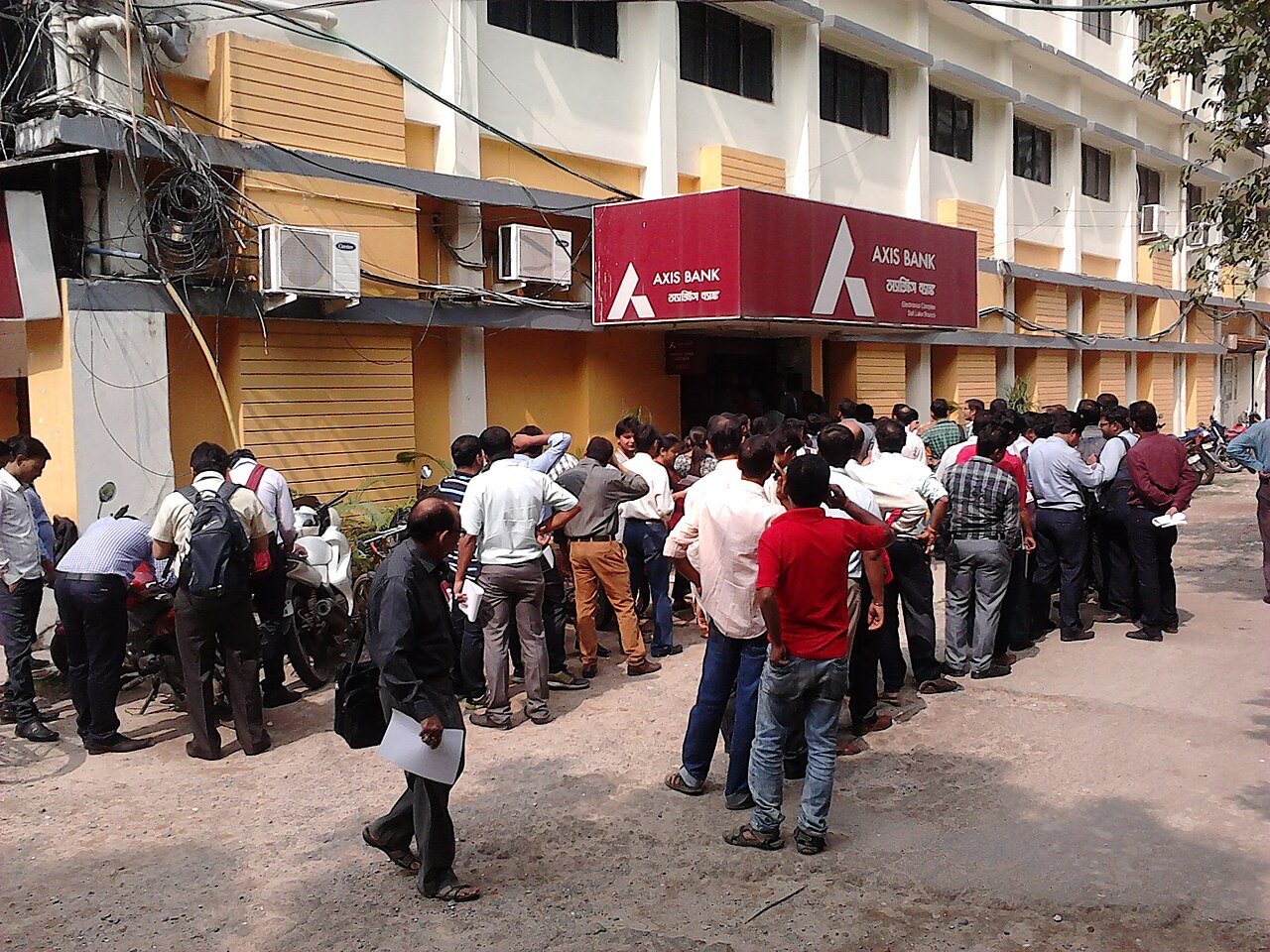
Table of Contents
Why in News?
November 8, 2026 marks ten years since demonetisation, when ₹500 and ₹1,000 notes – about 86% of the currency in circulation by value – ceased to be legal tender overnight. Reserve Bank of India (RBI) data show that while digital payments have grown sharply, the move had little lasting impact on the amount of cash in the economy, and detection of fake ₹500 notes has risen.
What did the 2016 Demonetisation Involve?
- Announcement: On 8 November 2016, the Prime Minister announced that the old ₹500 and ₹1,000 notes (Specified Bank Notes) would cease to be legal tender from midnight.
- Legal basis: Notification under Section 26(2) of the RBI Act, 1934, on the recommendation of the RBI Central Board. The Specified Bank Notes (Cessation of Liabilities) Act, 2017 later ended the government’s and RBI’s liability on these notes.
- New notes: New ₹500 and ₹2,000 notes were introduced. The RBI began withdrawing the ₹2,000 note from circulation in May 2023.
- Return of notes: As per the RBI’s Annual Report 2017-18, about 99.3% of the demonetised notes by value (₹15.31 lakh crore of ₹15.41 lakh crore) came back into the banking system.
- Judicial view: In Vivek Narayan Sharma vs Union of India (January 2023), a Constitution Bench of the Supreme Court upheld the decision by a 4:1 majority, with Justice B.V. Nagarathna dissenting on the process followed.
Stated Objectives vs Outcomes after 10 Years
| Stated objective | What the data show (2026) | Assessment |
|---|---|---|
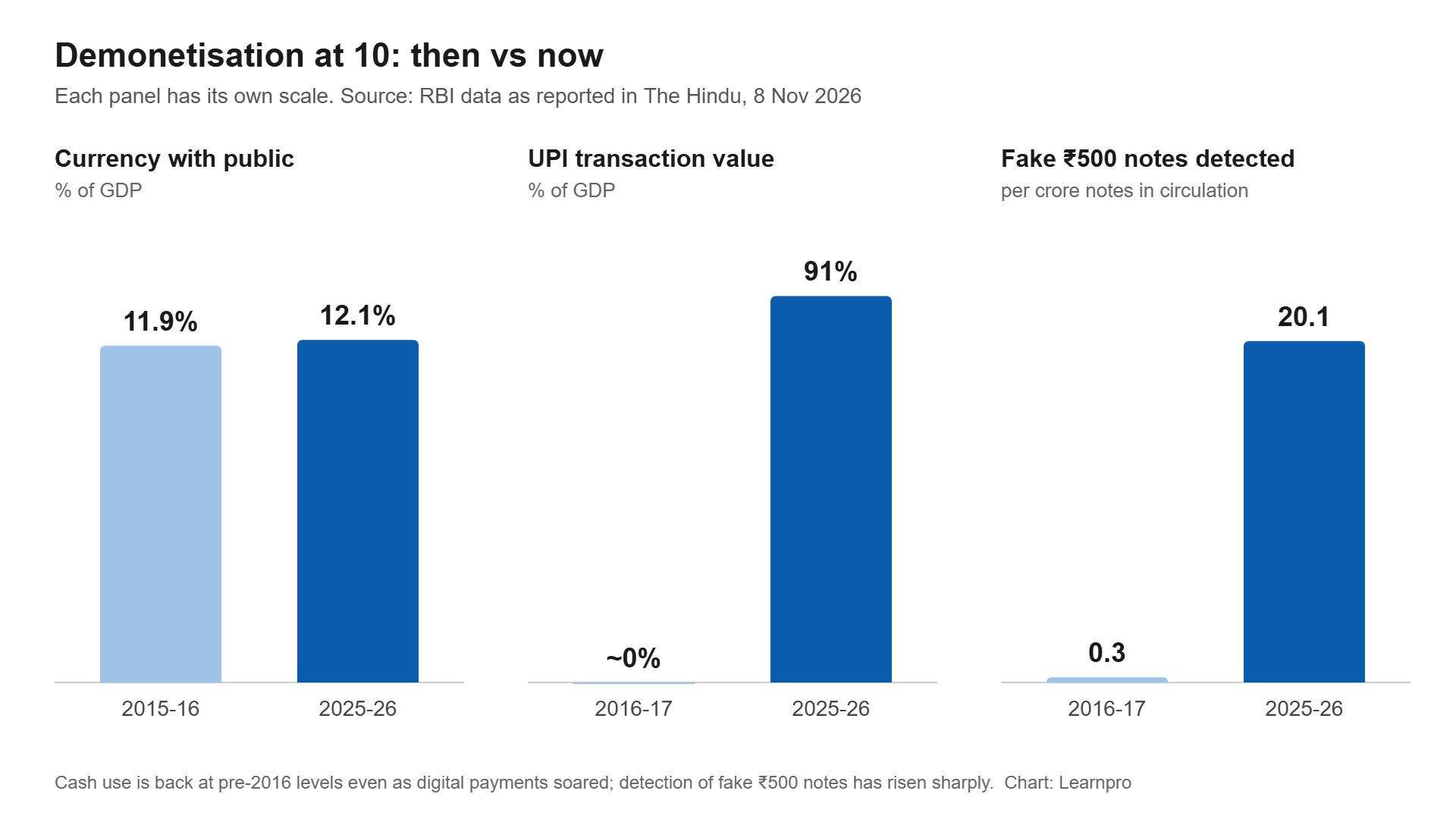
| Move towards a less-cash economy | Currency with the public was 11.9% of GDP in 2015-16 and is 12.1% of GDP as of March 2026. | Largely unmet |
| Promote digital payments | Value of UPI transactions rose from almost zero in 2016-17 to nearly 91% of GDP in 2025-26. | Achieved (also driven by UPI design, smartphones, cheap data and the pandemic) |
| Curb counterfeit currency | Detection of fake ₹500 notes rose from 0.3 per crore notes in 2016-17 to 20.1 per crore in 2025-26; fake ₹2,000 detections rose after its withdrawal began. | Unclear – may reflect more counterfeiting or better detection |
| Eliminate black money | Almost all demonetised currency returned to banks. | Limited – black money is held mostly in assets, not cash |
Positive Outcomes
- Digital payments boom: Demonetisation acted as a trigger for the adoption of UPI, now one of the world’s largest real-time payment systems.
- Formalisation: More deposits entered the banking system, and the move was followed by a widening of the income tax base and a push towards GST compliance.
- Data trail: Large cash deposits created a trail for tax authorities to scrutinise.
Concerns and Costs
- Short-term economic disruption: The cash crunch hurt the informal sector, small traders, farmers and daily-wage workers, who rely mainly on cash.
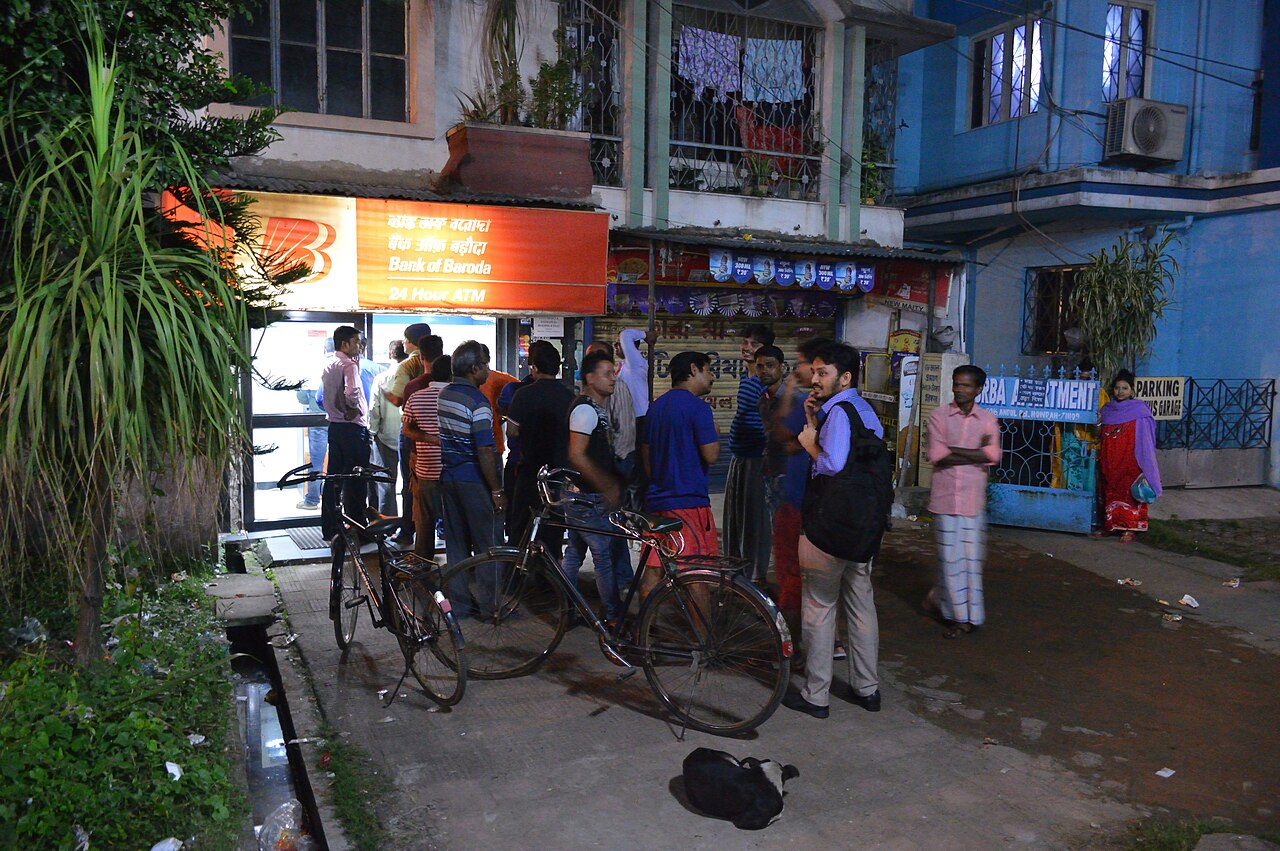
- Human cost: Long queues at banks and ATMs for weeks after the announcement.
- Cost of printing: The RBI incurred heavy expenditure on printing new notes and logistics.
- Cash demand persists: Cash remains the preferred store of value and medium of exchange for many households, especially in rural India.
- Process concerns: Questions over the extent of consultation with the RBI Board were raised in the Supreme Court’s minority opinion.
Way Forward
- Targeted action on black money: Focus on benami property, real estate, shell companies and cross-border flows rather than on currency alone.
- Better anti-counterfeiting: Upgrade security features periodically and strengthen intelligence on FICN networks.
- Safe digital payments: Address the rise in digital frauds, strengthen cyber security and grievance redress.
- Inclusive transition: Bridge the digital divide so that the elderly, rural and less-literate users are not left out.
- Evidence-based policy: Large economic decisions should be preceded by impact assessment and followed by transparent evaluation.
Conclusion
A decade later, demonetisation’s legacy is mixed. It accelerated India’s digital payments revolution, but its core goals of reducing cash, eliminating black money and ending counterfeiting remain largely unmet. Its lesson is that structural problems like black money need sustained institutional reform rather than one-time shocks.
UPSC Previous Year Questions (PYQs)
UPSC Prelims 2017
Q. Which of the following is a most likely consequence of implementing the ‘Unified Payments Interface (UPI)?
- Mobile wallets with not be necessary for online payments.
- Digital currency will totally replace the physical currency in about two decades.
- FDI inflows will drastically increase.
- Direct transfer of subsidies to poor people will become very effective.
Show answer
Answer: (a) — See full explanation
UPSC Prelims 2018
Q. With reference to digital payments, consider the following statements: 1. BHIM app allows the user to tranfer money to anyone with a UPI-enabled bank account. 2. While a chip-pin debit card has four factors authentication, BHIM app has only two factors of authentication. Which of the statements given above is/are correct?
- 1 only
- 2 only
- Both 1 and 2
- Neither 1 nor 2
Show answer
Answer: (a) — See full explanation
UPSC Prelims 2021
Q. Which one of the following effects of creation of black money in India has been the main cause of worry to the Government of India?
- Diversion of resources to the purchase of real estate and investment in luxury housing
- Investment in unproductive activities and purchase of previous stones, jewellery, gold, etc.
- Large donations to political parties and growth of regionalism
- Loss of revenue to the State Exchequer due to tax evasion
Show answer
Answer: (d) — See full explanation
Prelims Practice Question
Q. With reference to the demonetisation of 2016, consider the following statements:
- The notification was issued under Section 26(2) of the Reserve Bank of India Act, 1934.
- The Supreme Court unanimously upheld the decision in 2023.
- Currency with the public as a share of GDP in 2025-26 is higher than in 2015-16.
Which of the statements given above is/are correct?
(a) 1 only
(b) 1 and 3 only
(c) 2 and 3 only
(d) 1, 2 and 3
Answer: (b) — The verdict was 4:1, not unanimous.
Mains Practice Question
Q. Ten years after demonetisation, evaluate the extent to which it achieved its stated objectives. What lessons does it hold for designing major economic policy interventions? (250 words)
Frequently Asked Questions (FAQs)
When was demonetisation announced?
On 8 November 2016, when ₹500 and ₹1,000 notes – about 86% of currency by value – ceased to be legal tender.
Under which law was demonetisation notified?
Under Section 26(2) of the RBI Act, 1934. The Specified Bank Notes (Cessation of Liabilities) Act, 2017 later ended liability on the old notes.
How much of the demonetised currency came back?
About 99.3% by value (₹15.31 lakh crore of ₹15.41 lakh crore), as per the RBI’s Annual Report 2017-18.
What did the Supreme Court decide on demonetisation?
In January 2023, a Constitution Bench upheld it by a 4:1 majority in Vivek Narayan Sharma vs Union of India. Justice B.V. Nagarathna dissented.
Related Reads on LearnPro
- UPI Merchant Discount Rate: NPCI Tells Supreme Court
- GST Collections Rise 23% in October 2026
- Justice B.V. Nagarathna: India’s First Woman Chief Justice in 2027