
Tags: GS Paper 2 – Government Policies, Welfare Schemes, Transparency and Accountability; GS Paper 3 – Rural Employment
For Prelims: VB-G RAM G, MGNREGA 2005, social audit, Gram Sabha, grievance redressal officer, Ombudsperson, Ministry of Rural Development
For Mains: Accountability mechanisms in rural employment programmes, grievance redress and social audits, transition from MGNREGA to VB-G RAM G
Why in News?
The Ministry of Rural Development has notified the Grievance Redressal Rules under the Viksit Bharat Guarantee for Rozgar and Ajeevika Mission (Gramin), or VB-G RAM G, the rural employment programme that replaced MGNREGA earlier this year. Several provisions in the draft rules of May 2026, some of which were part of the MGNREGA framework, have been dropped.
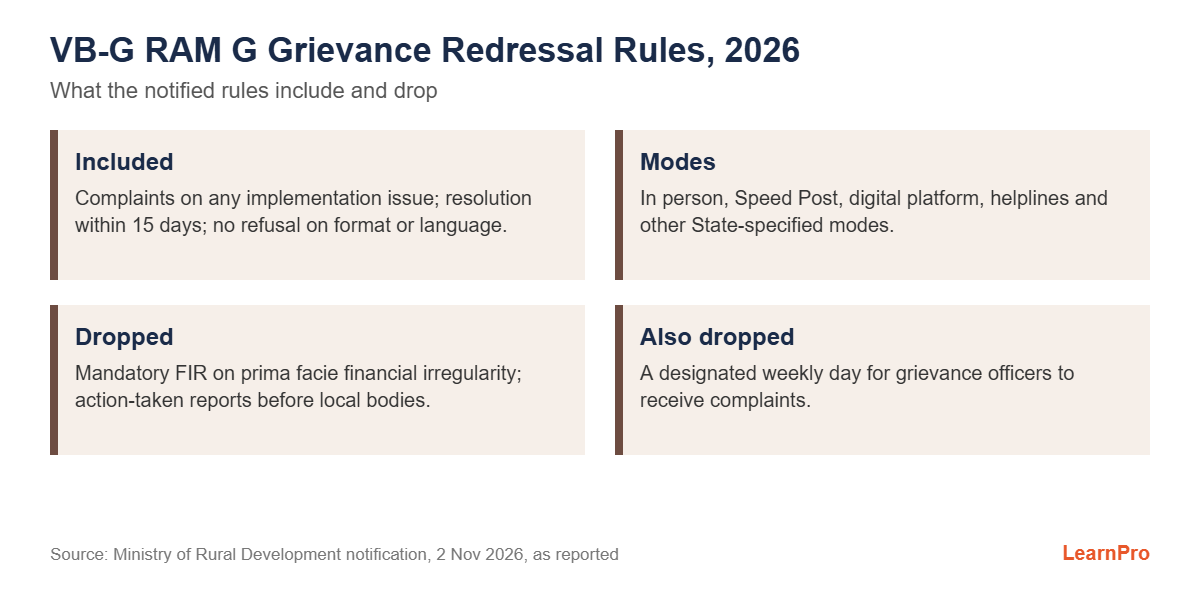
Key Features of the Rules
- Complaints may be filed on any matter related to implementation, and must be resolved within 15 days.
- They can be filed in person before the Grievance Redressal Officer, by Speed Post, on a central digital platform, or through State helplines.
- No complaint can be refused on grounds of format, language or procedural defects.
- Physical complaints received at Gram Panchayat, Block or District level must be entered on the digital platform.
What has been Dropped?
- Mandatory registration of an FIR when there is prima facie evidence of financial irregularities.
- Placing action-taken reports before local body meetings for review.
- A designated day each week for officials to hear complaints.
Background: From MGNREGA to VB-G RAM G
- MGNREGA (2005): A rights-based law guaranteeing 100 days of wage employment a year to every rural household whose adults volunteer for unskilled manual work. It is demand-driven and included an unemployment allowance and mandatory social audits (Section 17).
- VB-G RAM G (enacted in 2025): Replaced MGNREGA. It raised the guarantee to 125 days, changed cost-sharing between the Centre and States, and links works to Viksit Bharat priorities and local plans.
- Concerns raised during the transition: The move from a demand-driven to an allocation-based model, the higher financial burden on States, and the dilution of local accountability.
Why does Grievance Redress Matter?
- Workers depend on timely wages. Delayed payments, fake job cards and ‘ghost’ works have been persistent problems.
- Rajasthan’s social audits and the work of the Mazdoor Kisan Shakti Sangathan showed the value of transparency and local review.
- The Supreme Court in Swaraj Abhiyan (2016) stressed timely wage payment and compensation for delays.
Concerns
- Without a mandatory FIR, cases of corruption may end with administrative action alone.
- Removing local-body review weakens the role of panchayats and the Gram Sabha in oversight.
- Digital-first systems may exclude workers who are not literate or lack connectivity.
Way Forward
- Restore Gram Sabha review of grievances and action-taken reports.
- Have an independent Ombudsperson in every district with powers to recommend FIRs.
- Link grievance data with social audit findings and publish them in real time.
Conclusion
A guarantee of work is only as strong as its enforcement. The new rules make filing complaints easier, but weakening criminal accountability and community oversight could reduce trust in the programme.
Frequently Asked Questions (FAQs)
1. Which scheme did VB-G RAM G replace?
MGNREGA (Mahatma Gandhi National Rural Employment Guarantee Act, 2005).
2. What is the time limit for resolving grievances under the new rules?
15 days.
3. Which section of MGNREGA mandated social audits?
Section 17.
Practice Question
Mains: Accountability mechanisms are the backbone of rights-based welfare programmes. Evaluate the grievance redressal framework under VB-G RAM G. (150 words)