
Tags: GS Paper 2 – Government Schemes, Centre–State Relations; GS Paper 3 – Water Resources
For Prelims: Jal Jeevan Mission, Har Ghar Jal, Functional Household Tap Connection, 55 lpcd, Ministry of Jal Shakti, Pani Samiti, JJM extension to 2028
For Mains: Drinking water security in rural India, quality and sustainability of piped water, State capacity and funding
Why in News?
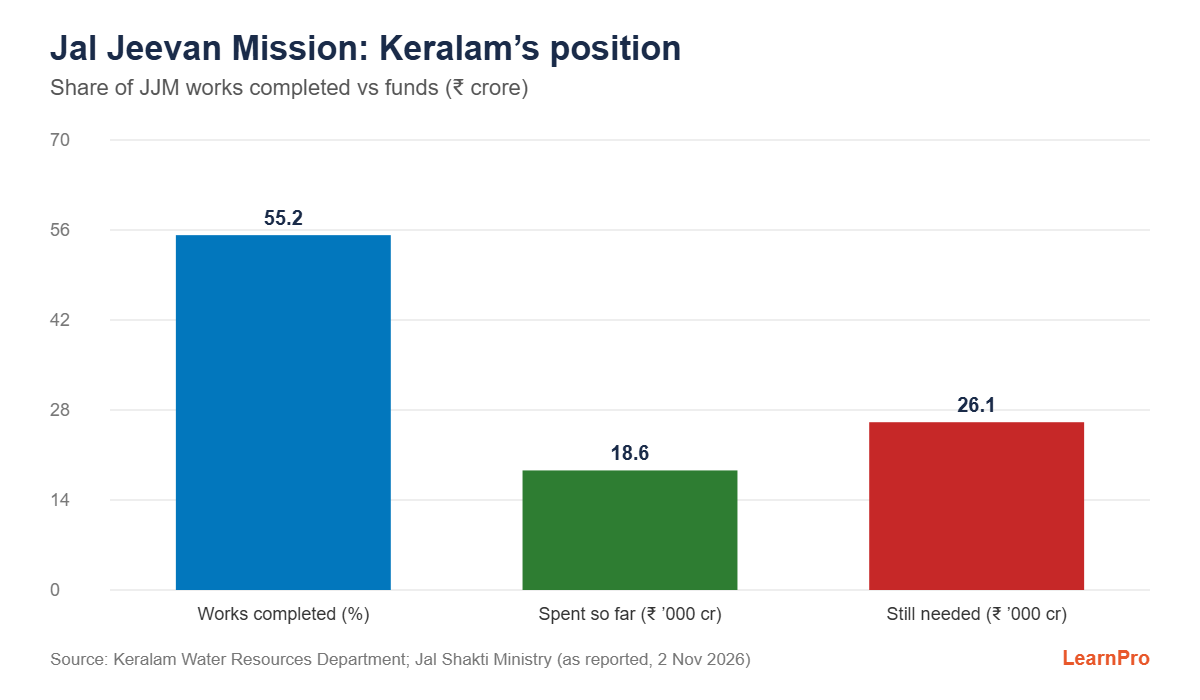
Keralam is at the bottom of the national list for implementing the Jal Jeevan Mission (JJM), with only about 55.24% of works completed. It needs ₹26,074.17 crore more in Central and State funds to finish the remaining works. So far it has spent ₹18,640.62 crore, and it expects to finish all works by December 2028.
About Jal Jeevan Mission
- Launched: August 2019 by the Ministry of Jal Shakti.
- Goal: A Functional Household Tap Connection (FHTC) for every rural household, supplying 55 litres per capita per day (lpcd) of drinking water of the prescribed quality (BIS 10500) on a regular, long-term basis.
- Coverage: At launch, only about 3.2 crore rural households (about 17%) had tap water. The figure has since risen to about 80% nationally.
- Funding: Centre and States share costs 50:50 in general, 90:10 in Himalayan and North-Eastern States, and 100% Central funding in UTs without legislatures.
- Community role: Village Water and Sanitation Committees (Pani Samitis) plan and maintain the systems. Women are trained to test water quality using field test kits.
- The deadline, originally 2024, has been extended to 2028.
Why is Keralam Lagging?
- Geography: Hilly terrain and scattered settlements (Idukki, Wayanad, Pathanamthitta) make piped networks costly.
- Existing sources: High dependence on private open wells means less demand for, and willingness to pay for, piped water.
- Costs: High cost per connection because of the need for bulk water sources and treatment.
- Finance: Delays in releasing the State’s matching share and Central funds.
- Seven districts are still below the halfway mark.
National Challenges in JJM
- Functionality: Surveys show some connections do not deliver enough water regularly.
- Sustainability of sources: Groundwater depletion means the source itself needs to be secured.
- Quality: Contamination by arsenic, fluoride and nitrates in many districts.
- Maintenance: Gram panchayats lack funds and trained staff for operation and maintenance.
Way Forward
- Use multi-village schemes with bulk surface water sources, and solar-powered pumps in remote areas.
- Recharge wells and integrate them into the supply system.
- Collect user charges and maintain systems through local communities.
- Measure success by verified water supply (quantity, quality and regularity), not just by the number of taps.
Frequently Asked Questions (FAQs)
1. How much water per person does JJM aim to supply?
55 litres per capita per day.
2. What is the Centre–State funding ratio for most States?
50:50.
3. Which ministry implements JJM?
The Ministry of Jal Shakti.