
Tags: GS Paper 3 – Infrastructure: Energy; Environment
For Prelims: Viability Gap Funding, Battery Energy Storage System (BESS), Pumped Storage Plant, GWh vs GW, round-the-clock renewable power, PLI for ACC batteries, 500 GW non-fossil target
For Mains: Need for energy storage in renewable integration, financing of clean energy infrastructure, domestic battery manufacturing
Why in News?
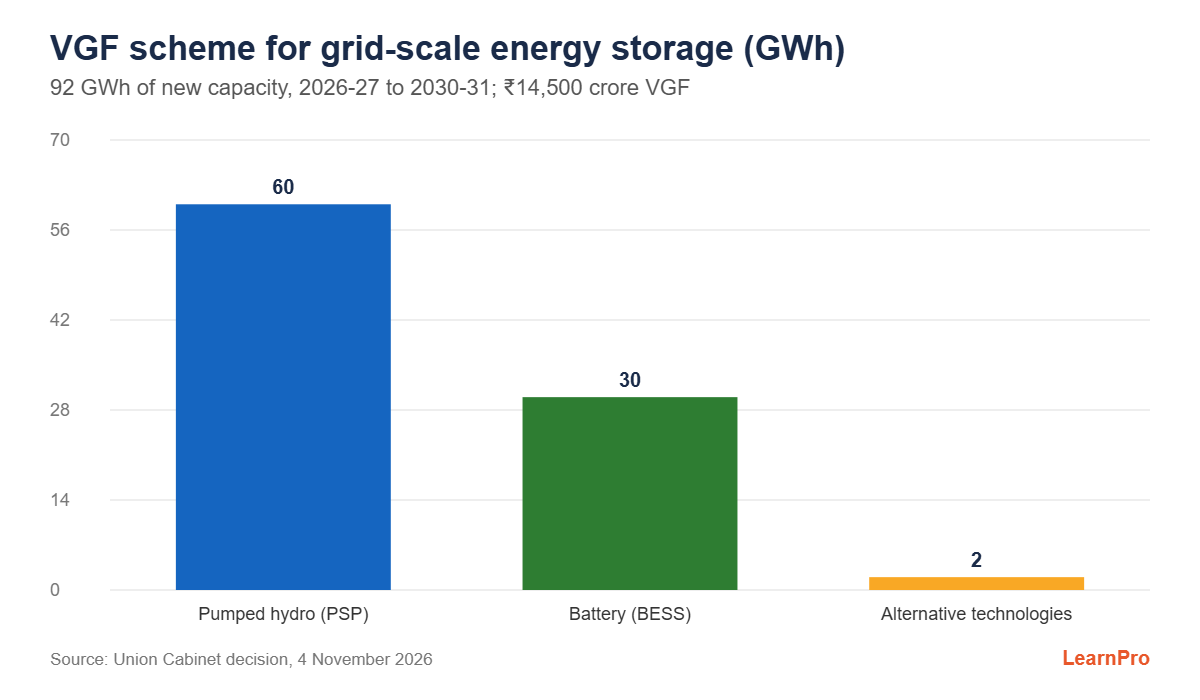
The Union Cabinet has approved a ₹14,500 crore Viability Gap Funding (VGF) scheme for grid-scale energy storage for 2026-27 to 2030-31. It will support 92 GWh of new storage capacity with a total estimated investment of about ₹97,600 crore.
Summary
- Capacity mix: 60 GWh of pumped storage plants (PSP), 30 GWh of battery energy storage systems (BESS) and 2 GWh of alternative storage technologies.
- This is equal to about 170% of India’s current grid-scale storage capacity. It will help meet the projected need of 411 GWh by 2031-32.
- Capacity will be awarded through tariff-based competitive bidding. Both public and private distribution companies are eligible.
- The scheme is also expected to boost domestic BESS manufacturing.
What is Viability Gap Funding?
- A one-time or staged capital grant from the government for infrastructure projects that are economically justified but not financially viable on their own.
- It lowers the tariff needed to make a project bankable. VGF schemes have been used for PPP projects since 2006, and for BESS since 2023 and 2025.
Why does India Need Energy Storage?
- Intermittent renewables: Solar power peaks at midday, while demand peaks in the evening. Storage shifts power to when it is needed.
- Target: 500 GW of non-fossil capacity by 2030, and net zero by 2070.
- Grid stability: Storage provides frequency regulation, reserves and support during peak demand.
- Less curtailment: Avoids wasting surplus solar and wind power.
- Round-the-clock (RTC) power: Allows firm, dispatchable renewable supply.
Pumped Hydro vs Battery Storage
| Feature | Pumped storage (PSP) | Battery (BESS) |
|---|---|---|
| How it works | Pumps water uphill when power is cheap and releases it through turbines at peak time | Stores electricity chemically, mostly in lithium-ion cells |
| Duration | Long (6–10+ hours) | Short to medium (2–4 hours) |
| Life | 40–60 years | 10–15 years |
| Build time | Long (4–7 years); needs specific terrain | Quick (12–18 months); can be sited flexibly |
| Concerns | Land, ecology and displacement | Imported critical minerals, recycling |
Challenges
- Heavy dependence on imports for lithium-ion cells and critical minerals (lithium, nickel, cobalt).
- Environmental clearances and land acquisition for PSPs.
- Weak discom finances and unclear market rules for storage services.
Related Initiatives
- PLI for Advanced Chemistry Cell (ACC) batteries: 50 GWh of manufacturing capacity.
- National Critical Mineral Mission (2025), and Energy Storage Obligations for discoms.
- Waiver of inter-State transmission (ISTS) charges for eligible storage projects.
Conclusion
Storage is the missing link in India’s clean energy transition. By supporting both long-duration pumped hydro and fast-deploying batteries, the scheme aims to keep renewable power dependable and affordable.
Frequently Asked Questions (FAQs)
1. What is the difference between GW and GWh?
GW measures power capacity (rate of supply), while GWh measures energy (capacity multiplied by duration).
2. How much storage capacity will the scheme support?
92 GWh: 60 GWh PSP, 30 GWh BESS and 2 GWh of other technologies.
3. What is the estimated grid storage requirement by 2031-32?
411 GWh.
Practice Question
Mains: Energy storage is critical for India’s renewable energy transition. Discuss the role of pumped hydro and battery storage, and the challenges in scaling them. (250 words)
Sources and further reading
- Kecko from Eastern Switzerlandcommons.wikimedia.org