
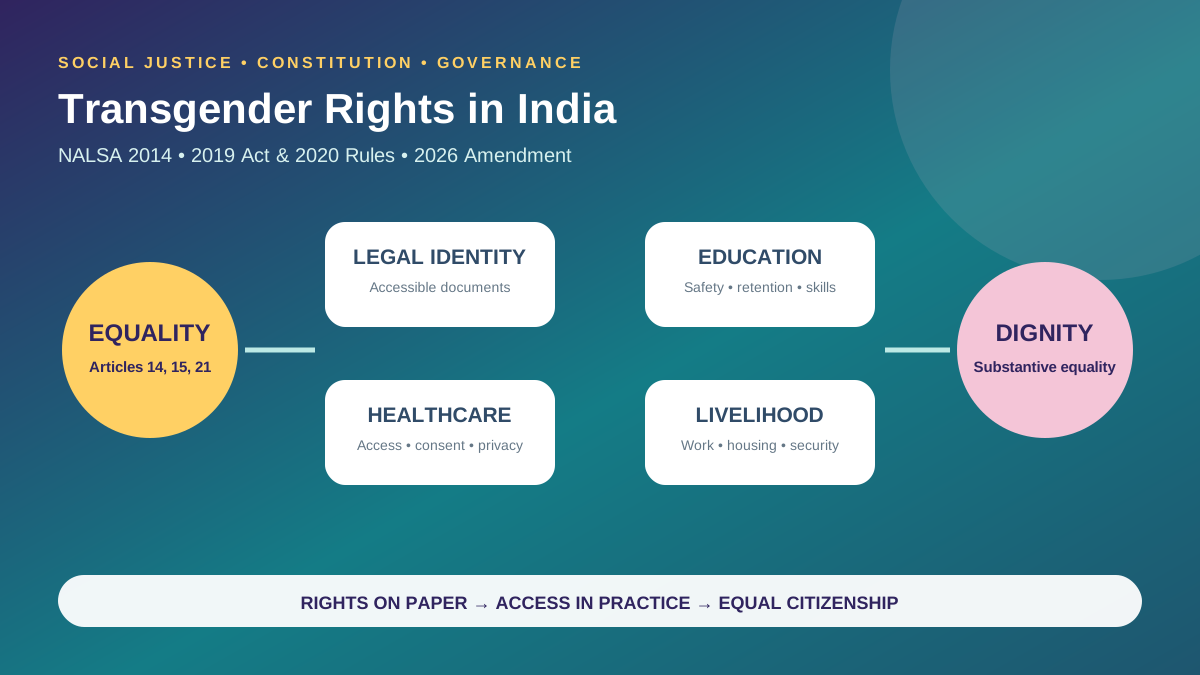
Transgender rights in India arise from constitutional equality, dignity and personal autonomy. The legal framework is shaped by the Supreme Court’s NALSA judgment (2014), the Transgender Persons (Protection of Rights) Act, 2019 and Rules, 2020, and the Transgender Persons (Protection of Rights) Amendment Act, 2026.
The issue returned to global debate after the United States federal government issued an executive order in January 2025 directing federal agencies to recognise two sexes in official policy. India’s constitutional and statutory position must be analysed independently: a foreign executive order does not change Indian law.
Key terms: sex, gender identity and sexual orientation
| Term | Simple meaning | Important distinction |
|---|---|---|
| Sex characteristics | Physical traits such as reproductive anatomy, chromosomes and hormones | These do not by themselves describe a person’s gender identity |
| Gender identity | A person’s deeply felt internal sense of gender | NALSA treated self-defined gender identity as integral to personality, dignity and freedom |
| Gender expression | How a person presents gender through appearance, speech or conduct | Expression is not identical to identity |
| Sexual orientation | The pattern of emotional, romantic or sexual attraction | Orientation concerns attraction; transgender identity concerns gender |
| Intersex variation | Innate sex characteristics that do not fit typical male or female norms | Intersex and transgender are distinct concepts, though Indian legislation may specify covered categories |
Using these terms accurately matters. A transgender person can have any sexual orientation. Treating “transgender” and “homosexual” as synonyms is legally and conceptually wrong.
Constitutional foundation of transgender rights
- Article 14: equality before law and equal protection of laws apply to every person.
- Articles 15 and 16: prohibit discrimination on specified grounds and support equal opportunity. NALSA interpreted discrimination “on the ground of sex” to include gender identity.
- Article 19(1)(a): protects expression, including the outward expression of one’s self-identified gender, subject to constitutional limits.
- Article 21: protects life, dignity, privacy, autonomy and personal liberty.
- Directive Principles: Articles 38, 41 and 46 support reduction of inequality, public assistance and protection of disadvantaged groups.
NALSA v. Union of India, 2014
In National Legal Services Authority v. Union of India, the Supreme Court recognised hijras and transgender persons as a “third gender” for legal protection and held that transgender persons have the right to decide their self-identified gender. The Court connected gender identity with dignity, freedom and equality.
The judgment directed the Union and states to treat transgender persons as socially and educationally backward for affirmative-action purposes, address healthcare needs, create public awareness and remove social stigma. Its constitutional core is that identity is not a favour granted by the state; government procedures must respect fundamental rights.
Transgender Persons Act, 2019
The 2019 Act created a nationwide statutory framework. Its original definition covered a person whose gender did not match the gender assigned at birth and included trans men, trans women, persons with intersex variations, genderqueer persons and socio-cultural identities such as kinner, hijra, aravani and jogta.
Protection against discrimination
The Act prohibits discrimination in important fields, including:
- education and access to educational institutions;
- employment and occupation;
- healthcare;
- access to public goods, services and facilities;
- the right to movement and to occupy property; and
- public or private office and establishments.
Establishments must comply with the Act and appoint a complaint officer. The law also protects the right of residence, although court-approved institutional arrangements may apply where continued family residence is not possible.
Identity certificate under the 2019 framework
The Act and 2020 Rules established an application to the District Magistrate for a certificate of transgender identity. Under the Rules’ original process, an affidavit supported a section 6 certificate; a separate section 7 process applied after medical intervention for recognition as male or female.
The National Portal for Transgender Persons was created to facilitate applications and identity cards. Documentation is important because mismatched records can block banking, education, employment, voting, healthcare and welfare access.
What changed through the 2026 Amendment Act?
The 2026 Amendment Act received presidential assent on 30 March 2026. Its Gazette text says it will commence on a date separately notified by the Central Government. Therefore, UPSC answers should distinguish passage, assent and commencement and verify the latest Gazette notification before stating that every provision is operational.
| Issue | 2019 framework | 2026 amendment |
|---|---|---|
| Definition | Gender not matching gender assigned at birth, with listed inclusive categories | Recasts the definition through specified categories and excludes sexual orientation or self-perceived sexual identity alone |
| Self-perceived identity | Section 4(2) expressly recognised a right to self-perceived gender identity | Omits section 4(2) |
| Certificate process | Application to District Magistrate under the Act and Rules | Adds consideration of a designated medical board’s recommendation |
| Documents | Certificate enabled change of name and gender in official documents under the Rules | Specifies a right to change the first name based on the identity certificate |
| Penalties | General penalty framework for specified offences | Introduces differentiated provisions for forms of harm, as set out in the amended text |
The central constitutional debate is whether a medical-board requirement and removal of the express self-perception clause can be reconciled with NALSA’s recognition of self-determined identity. A balanced answer should state both the legislature’s stated goal of clearer identification and the concern that medical gatekeeping may burden dignity, privacy and autonomy.
Read LearnPro’s detailed legislative explainer on the Transgender Persons Amendment Act 2026 and the background article on the 2019 transgender-rights law.
Welfare and rehabilitation framework
SMILE scheme
SMILE—Support for Marginalized Individuals for Livelihood and Enterprise—includes a sub-scheme for the comprehensive rehabilitation and welfare of transgender persons. It supports healthcare, counselling, education, skill development, economic linkages and coordinated implementation with states, local bodies and community organisations.
Garima Greh
Garima Greh provides residential support for transgender persons facing homelessness or family rejection. A shelter should be a bridge to independent living, not a substitute for equal access to housing, work and community life.
National Council for Transgender Persons
The statutory Council advises the Union government, reviews policies and programmes, monitors impact and supports coordination and grievance redress. Its effectiveness depends on regular meetings, meaningful community representation and published follow-up.
Scale of exclusion in India
The 2011 Census recorded approximately 4.88 lakh persons in the “other” gender category. At a 2025 NHRC conference, the reported literacy rate for this population was 56.07%, alongside barriers in formal employment, healthcare and identity documentation. These figures are useful but incomplete: social stigma and census design can cause undercounting.
Legal recognition alone does not remove exclusion. The implementation chain is:
Identity document → education and skills → non-discriminatory recruitment → safe workplace → income and housing → health and social security.
A failure at any stage can push a person back into informal, unsafe or exploitative work.
Persistent implementation gaps
- Documentation: delay, inconsistent district practice and mismatched records impede services.
- Education: bullying, unsafe sanitation and family rejection increase dropout risk.
- Employment: formal anti-discrimination rules are weak without recruitment, skilling and workplace accountability.
- Healthcare: respectful primary care, mental-health support and evidence-based specialised care remain uneven.
- Housing: discrimination and lack of secure income reinforce homelessness.
- Policing and prisons: search, detention, placement and access to facilities require rights-based protocols.
- Data: poor disaggregated data makes budgeting and outcome evaluation difficult.
India and the United States: a limited comparison
The January 2025 US executive order directed the federal executive branch to use sex-based definitions in government policy. It affects US federal administration and has generated continuing legal and political disputes. India’s position arises from a different Constitution, Supreme Court jurisprudence and parliamentary legislation.
The useful comparative lesson is institutional: rights can be shaped by courts, legislatures and executives in different ways. An Indian answer should not import an American policy claim as if it were binding law or scientific consensus in India.
Way forward
- Align procedure with dignity: identity-certification rules should be accessible, time-bound, private and constitutionally defensible.
- Clarify the 2026 transition: publish commencement, rules and treatment of existing certificates in plain language.
- Make anti-discrimination enforceable: define complaint timelines, remedies and institutional accountability.
- Improve inclusive education: prevent bullying, provide safe facilities and train teachers and counsellors.
- Expand livelihood access: link skills to verified placements, credit, procurement and workplace retention.
- Strengthen healthcare: integrate respectful services into public health systems with informed consent and privacy.
- Use community-led monitoring: include transgender persons in design, audits and grievance review.
UPSC relevance
Transgender rights in India link GS Paper II topics on fundamental rights, vulnerable sections, welfare schemes and the judiciary. For Prelims, remember NALSA (2014), the 2019 Act, Rules 2020, SMILE, Garima Greh and the National Council. For Mains, analyse the tension between formal recognition and implementation, and between administrative verification and personal autonomy.
Mains practice: “Recognition of identity is necessary but insufficient for substantive equality of transgender persons.” Discuss with reference to NALSA, legislation and implementation gaps.
Conclusion
A transforming society is measured not by symbolic recognition alone but by whether people can study, work, obtain healthcare, rent a home and approach public institutions without humiliation. India has constitutional principles, a statutory framework and welfare programmes. The unresolved task is to make identity procedures consistent with dignity and convert paper rights into everyday equality.
Frequently asked questions
What did the NALSA judgment recognise?
The Supreme Court recognised transgender persons’ constitutional rights, legal recognition of third gender and the right to decide self-identified gender, linking identity with equality, dignity and freedom.
What does the Transgender Persons Act 2019 prohibit?
It prohibits discrimination in education, employment, healthcare, access to services and facilities, movement, property and participation in public or private establishments.
What did the 2026 Amendment Act change?
It recast the statutory definition, omitted the express self-perceived identity clause and added a medical-board recommendation to the certification process, among other changes.
Are gender identity and sexual orientation the same?
No. Gender identity concerns a person’s sense of gender; sexual orientation concerns attraction. A transgender person can have any sexual orientation.
What is the SMILE scheme?
It is a Union government umbrella scheme that includes comprehensive rehabilitation and welfare measures for transgender persons, including health, counselling, education, skills and economic linkages.
Official references
- Supreme Court: NALSA v. Union of India
- Transgender Persons (Protection of Rights) Rules, 2020
- Gazette: Transgender Persons Amendment Act, 2026
- Ministry of Social Justice: SMILE scheme
- NHRC conference on rights of transgender persons, 2025





Sources and further reading
- Supreme Court: NALSA v. Union of Indiaapi.sci.gov.in
- Transgender Persons (Protection of Rights) Rules, 2020transgender.dosje.gov.in
- Gazette: Transgender Persons Amendment Act, 2026egazette.gov.in
- Ministry of Social Justice: SMILE schemesocialjustice.gov.in
- NHRC conference on rights of transgender persons, 2025pib.gov.in