
India–EU relations in 2026 have moved beyond periodic diplomatic outreach into a more operational partnership covering trade, technology, security, climate and mobility. The decisive change came at the 16th India–EU Summit on 27 January 2026, when the two sides concluded negotiations on a Free Trade Agreement (FTA), signed a Security and Defence Partnership, and adopted the Towards 2030 Joint Comprehensive Strategic Agenda.
The third meeting of the India–EU Trade and Technology Council (TTC), held in Brussels on 15 July 2026, added implementation projects in artificial intelligence, semiconductors, quantum technologies, 6G, electric-vehicle charging, clean technology and resilient supply chains. For UPSC, the relationship is an important example of India’s multi-alignment and strategic autonomy.
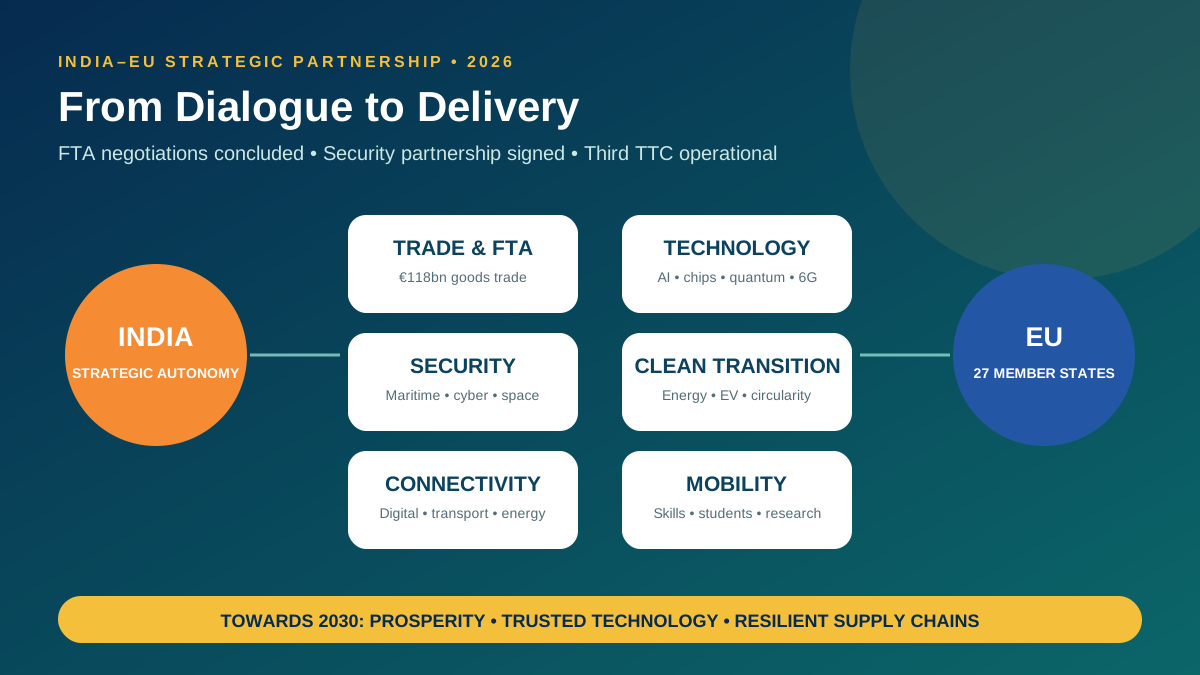
Europe and the European Union are not the same
Europe is a continent. The European Union is a political and economic union of 27 member states. India therefore engages Europe at two levels:
- India–EU level: summits, FTA negotiations, TTC, connectivity, climate, mobility and regulatory cooperation.
- Bilateral level: separate partnerships with France, Germany, Italy, the Netherlands and other states, as well as non-EU European countries such as the United Kingdom, Norway and Switzerland.
France’s defence and space partnership with India, for example, is not an EU programme. Similarly, the India–EFTA Trade and Economic Partnership Agreement involves Iceland, Liechtenstein, Norway and Switzerland—not the EU. This distinction prevents a common error in international-relations answers.
Evolution of India–EU relations
| Year | Milestone | Significance |
|---|---|---|
| 1962 | India established diplomatic relations with the European Economic Community | One of the earliest developing-country relationships with European integration |
| 2000 | First India–EU Summit | Created regular leaders’ dialogue |
| 2004 | Strategic Partnership launched | Expanded cooperation beyond trade |
| 2020 | India–EU Strategic Partnership: Roadmap to 2025 | Set sector-wise priorities |
| 2021 | Connectivity Partnership | Linked digital, transport, energy and people-to-people connectivity |
| 2022 | FTA talks relaunched; TTC announced | Reopened the economic track and created a technology forum |
| 2023 | First TTC ministerial meeting | Organised work under three specialised groups |
| 2026 | 16th Summit and third TTC | FTA negotiations concluded; defence partnership signed; implementation projects launched |
Why the 2026 summit is a turning point
Earlier cooperation was broad but often slow. The January 2026 summit supplied a clearer political mandate and three practical frameworks:
- Economic framework: successful conclusion of FTA negotiations and a commitment to deepen investment and value chains.
- Security framework: a signed partnership covering maritime security, defence technology, cyber and hybrid threats, space and counterterrorism.
- Delivery framework: the Towards 2030 agenda for technology, climate, connectivity, mobility, education and global governance.
The summit also recognised that security in Europe and the Indo-Pacific is interconnected. This matters to India because disruptions in one region affect energy, food, shipping, technology and finance elsewhere.
India–EU trade and investment: key data
| Indicator | Latest official figure | What it shows |
|---|---|---|
| Goods trade, 2025 | More than €118 billion | EU imports from India €69.5 billion; EU exports €48.9 billion |
| India’s goods trade share | EU accounted for 11.6% | EU was India’s second-largest goods trading partner in 2025 |
| Goods trade growth | 84% over a decade | EU imports from India rose faster than EU exports |
| Services trade, 2025 | More than €67 billion, provisional | Telecom, computing, business and transport services are important |
| EU FDI stock in India, 2024 | More than €132 billion | Over 6,000 European companies directly support about 3 million jobs |
The structure is complementary: India offers a large market, skilled labour, digital capacity and manufacturing potential; Europe offers capital, advanced technology, high-value demand and regulatory influence.
What is the status of the India–EU FTA?
Negotiations on the FTA were successfully concluded on 27 January 2026. “Negotiations concluded” should not automatically be written as “the agreement is in force.” Legal review, signature, approval or ratification procedures and an agreed commencement date are separate steps.
The FTA is also distinct from the separately negotiated Investment Protection Agreement and Geographical Indications Agreement. Keeping the three tracks separate is essential for an accurate answer.
The proposed trade deal is expected to reduce or eliminate tariffs on a large share of trade, improve market access and make supply chains more predictable. Sensitive questions remain around agriculture, automobiles, wine and spirits, services mobility, public procurement, intellectual property, sustainability rules and regulatory standards.
For background, connect this topic with LearnPro’s analysis of the India–EU defence and security pact.
Trade and Technology Council: from dialogue to projects
The TTC was announced in 2022 and held its first ministerial meeting in 2023. It works through three groups:
- Strategic technologies, digital governance and connectivity;
- Green and clean-energy technologies; and
- Trade, investment and resilient value chains.
At the third TTC meeting on 15 July 2026, the partners agreed to start formal negotiations on India’s association with Horizon Europe, aiming to conclude the process before the end of 2026. They also announced:
- the first India–EU Innovation Hub for electric-vehicle charging technology and testing;
- a deep-tech clean-technology Startup Partnership;
- stronger cooperation in semiconductors, high-performance computing, quantum technology, AI and 6G;
- work on resilient value chains for agri-food products, active pharmaceutical ingredients and clean-energy technology; and
- an upgrade of the TTC framework to be finalised by the end of 2026.
The TTC is valuable because it connects policy, research and business. Its success should be measured by joint research, interoperable standards, startup market access, secure supply chains and commercial deployment—not by the number of meetings.
Security and Defence Partnership
The partnership signed in January 2026 is a framework for cooperation, not a military alliance. It covers:
- maritime security and safer sea lanes;
- defence industry and technology cooperation;
- cyber and hybrid threats, including malicious digital activity and disinformation;
- space security and awareness;
- counterterrorism and transnational crime; and
- crisis-management exchanges and exercises.
This EU-level framework complements, rather than replaces, bilateral defence relations. LearnPro’s India–France strategic partnership explains how a member-state relationship can go further in operational defence, nuclear and space cooperation.
Climate, connectivity and mobility
Clean transition
India and the EU cooperate through the Clean Energy and Climate Partnership on renewables, energy resilience, circular economy, biodiversity and water. The opportunity is to combine India’s scale with European finance and technology. Friction arises where climate regulation affects market access—especially carbon accounting, due-diligence rules and the EU’s Carbon Border Adjustment Mechanism.
Connectivity
The 2021 Connectivity Partnership promotes transparent, sustainable and rules-based links in transport, energy and digital infrastructure. It can support diversified supply chains and projects connecting Europe, West Asia and the Indo-Pacific.
People-to-people ties
The comprehensive mobility framework supports safe and regular movement of skilled workers, students, researchers and seasonal workers, while addressing irregular migration. This can help Europe’s skill shortages and expand opportunities for Indian professionals, but requires recognition of qualifications, social-security coordination and predictable visa rules.
Why India needs a stronger European partnership
- Economic diversification: wider access to a high-income market reduces excessive dependence on any one geography.
- Technology: collaboration can strengthen semiconductors, clean tech, research, standards and trusted digital systems.
- Strategic autonomy: multiple partnerships widen India’s options without creating an alliance obligation.
- Indo-Pacific stability: the EU has economic, regulatory and maritime interests in the region.
- Reformed multilateralism: both sides support effective institutions, though their positions do not always coincide.
Why the EU needs India
- a fast-growing market and potential manufacturing base;
- a democratic partner with substantial Indo-Pacific weight;
- digital public infrastructure and a large technology workforce;
- diversification of critical supply chains; and
- cooperation on climate, maritime security and global governance.
Major challenges in India–EU relations
- Implementation gap: summit declarations need budgets, timelines and institutional ownership.
- Regulatory differences: data, privacy, product standards, sustainability and digital rules can become trade barriers.
- Market-access sensitivities: agriculture, services, mobility and industrial tariffs remain politically difficult.
- Geopolitical differences: India and many EU states assess Russia, sanctions and some security crises differently.
- Climate equity: India stresses development space and differentiated responsibility, while European rules increasingly affect imports.
- Fragmented European engagement: EU institutions and individual member states have different legal powers and priorities.
These differences do not make partnership impossible. They require issue-based negotiation and recognition that strategic partnership does not mean identical foreign policies.
Way forward
- Complete the FTA pathway: publish clear legal and implementation milestones while continuing separate investment-protection and GI negotiations.
- Give the TTC measurable targets: track joint projects, research funding, startup access and value-chain outcomes.
- Build regulatory bridges: improve mutual understanding of standards, digital trust and carbon measurement.
- Use layered diplomacy: coordinate India–EU frameworks with bilateral strengths of France, Germany and other partners.
- Translate mobility into access: simplify qualification recognition and expand academic and research pathways.
- Operationalise security cooperation: conduct practical maritime, cyber and crisis-management activity while preserving strategic autonomy.
UPSC relevance
India–EU relations 2026 fit GS Paper II topics on bilateral, regional and global groupings affecting India’s interests. Prelims candidates should distinguish the EU from Europe and EFTA, and separate the FTA, investment-protection and GI tracks. In Mains, use the relationship to explain multi-alignment, economic security, regulatory diplomacy and strategic autonomy.
Mains practice: “India–EU relations are changing from a values-based dialogue into a delivery-oriented partnership.” Discuss with reference to the 2026 summit and Trade and Technology Council.
Conclusion
The June 2025 diplomatic outreach helped prepare the ground, but the 2026 summit and third TTC are the more important developments. An FTA conclusion, a defence framework and technology projects give India–EU relations greater strategic depth. The next test is implementation: lowering real trade barriers, producing joint technology, building resilient supply chains and managing differences without diluting India’s strategic autonomy.
Frequently asked questions
What changed in India–EU relations in 2026?
The 16th summit concluded FTA negotiations, signed a Security and Defence Partnership and adopted a strategic agenda towards 2030. The third TTC then launched concrete technology and supply-chain initiatives.
Is the India–EU FTA already in force?
The negotiations were concluded on 27 January 2026. Entry into force depends on subsequent legal and institutional procedures and should not be assumed merely from the conclusion of negotiations.
What are the three India–EU TTC working groups?
They cover strategic technologies and digital connectivity; green and clean-energy technologies; and trade, investment and resilient value chains.
Is the India–EU Security and Defence Partnership a military alliance?
No. It is a cooperation framework covering maritime, cyber, space, counterterrorism, defence-industry and crisis-management issues.
Why are India–EU relations important for UPSC?
They connect strategic autonomy, trade agreements, technology governance, climate diplomacy, Indo-Pacific security and India’s engagement with regional organisations.
Official references
- European Council: 16th EU–India Summit, 27 January 2026
- EU–India trade facts and figures
- European Commission: third India–EU TTC outcomes
- MEA: joint statement on the third India–EU TTC





Sources and further reading
- European Council: 16th EU–India Summit, 27 January 2026consilium.europa.eu
- EU–India trade facts and figuresconsilium.europa.eu
- European Commission: third India–EU TTC outcomesdigital-strategy.ec.europa.eu
- MEA: joint statement on the third India–EU TTCmea.gov.in