The AITIGA review is an effort by India and the ten ASEAN member states to update the ASEAN–India Trade in Goods Agreement. The original pact was signed in 2009 and entered into force in 2010. It reduced tariffs on a large share of merchandise trade, but changes in supply chains, product standards, customs systems and trade patterns have made several provisions outdated.
The latest official position is important. India hosted the 13th AITIGA Joint Committee meeting from 6 to 10 July 2026. The Joint Committee directed its sub-committees to expedite outstanding chapters through time-bound work. The review had therefore not been concluded as of 10 July 2026; tariff changes and new legal commitments remain under negotiation.
What is AITIGA?
AITIGA stands for the ASEAN–India Trade in Goods Agreement. It is one part of the broader ASEAN–India economic framework.
| Instrument | Signed | In force | Main coverage |
|---|---|---|---|
| ASEAN–India Trade in Goods Agreement | 2009 | 2010 | Tariffs, origin rules, customs and goods-related disciplines |
| ASEAN–India Trade in Services Agreement | 2014 | 2015 | Market access, national treatment and services regulation |
| ASEAN–India Investment Agreement | 2014 | 2015 | Treatment and protection of investment |
AITIGA is not a single uniform tariff schedule. India and each ASEAN party have schedules and implementation commitments. It is also not the same as a bilateral India–Vietnam or India–Thailand FTA; preferential goods trade with those countries operates through the ASEAN–India framework.
For the strategic setting, read LearnPro’s analysis of India’s Act East policy and the 22nd India–ASEAN Summit.
Why is the agreement under review?
India and ASEAN agreed to review AITIGA to make it simpler, more user-friendly and trade-facilitative. India also wants the agreement to produce more balanced and sustainable outcomes. Five concerns explain the demand for an update.
1. Uneven use of tariff preferences
A lower tariff helps only when firms know the rule, can obtain a certificate of origin and can meet product-specific conditions. Small businesses may avoid the preference if compliance cost exceeds the tariff saving. Review therefore needs both sensible tariff commitments and easier utilisation.
2. Rules-of-origin risks
Rules of origin determine whether a good genuinely qualifies as originating in an FTA partner. Weak rules or poor verification can permit minimal processing or routing through a member country to obtain a lower duty. India’s concern is often described as possible third-country circumvention, but allegations must be tested through product-level evidence and the agreement’s verification process.
3. Non-tariff barriers
Tariffs may fall while exports still face sanitary rules, technical standards, testing requirements, licensing delays or opaque customs procedures. Some measures protect health and safety legitimately; others can become unnecessary trade obstacles. The review must improve transparency without weakening valid regulation.
4. Changed supply chains
Electronics, machinery, chemicals and other goods now move through complex regional value chains. The original agreement used tariff classifications and administrative processes designed more than fifteen years ago. Digital certificates, data exchange and modern customs risk management can reduce delay and fraud.
5. India’s goods trade imbalance
India has repeatedly sought a more balanced trading relationship with ASEAN. A deficit alone does not prove an FTA is harmful: it may reflect energy imports, investment goods, competitiveness, exchange rates and domestic demand. The correct assessment is product-specific—whether imports are efficient inputs, whether exports face avoidable barriers and whether domestic firms can move into higher-value production.
Latest AITIGA review status in July 2026
According to the Ministry of Commerce and Industry, the 13th Joint Committee meeting was held in New Delhi during 6–10 July 2026. All ten ASEAN members participated. Meetings were also held for three of the eight sub-committees:
- Customs Procedures and Trade Facilitation;
- National Treatment and Market Access; and
- Rules of Origin.
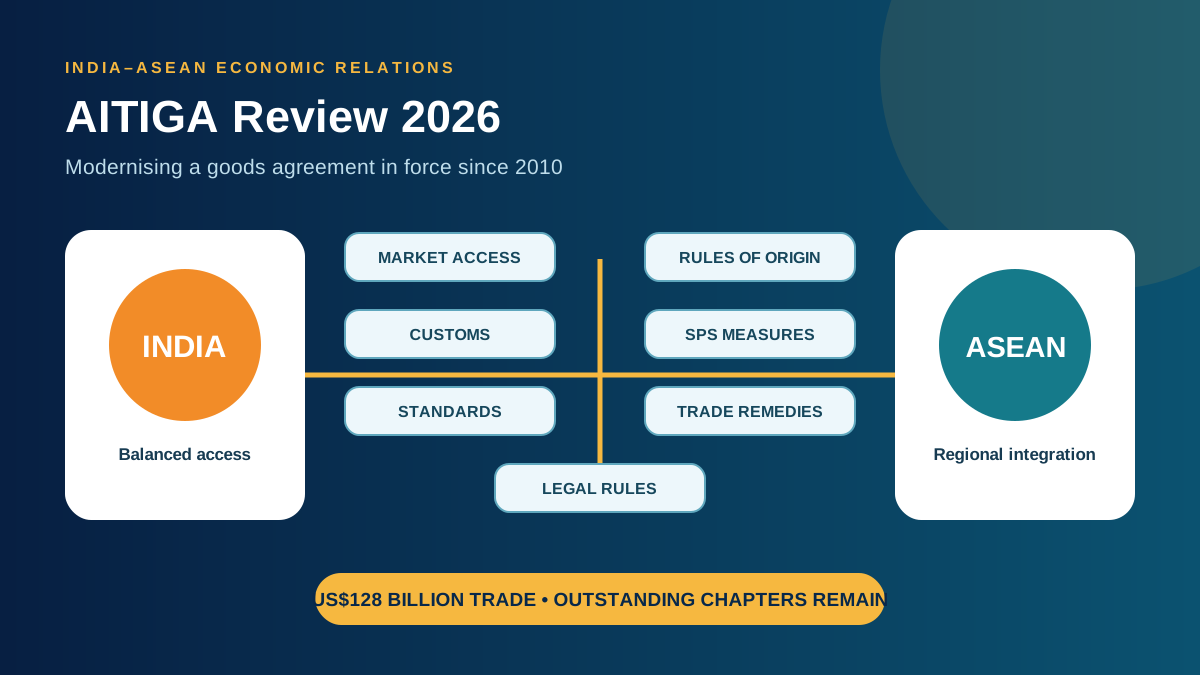
The Joint Committee asked the sub-committees to finalise outstanding chapters quickly and assigned time-bound deliverables. This follows earlier rounds covering the broader architecture. The full set of negotiating areas includes:
- National Treatment and Market Access;
- Rules of Origin;
- Customs Procedures and Trade Facilitation;
- Sanitary and Phytosanitary Measures;
- Standards, Technical Regulations and Conformity Assessment;
- Trade Remedies; and
- Legal and Institutional Issues.
Official releases state that eight sub-committees sit under the Joint Committee; the seven areas above are the ones expressly named in the public account of the 10th meeting.
Official data released at the July meeting put India–ASEAN bilateral trade at US$128 billion in 2025–26, about 11% of India’s global trade. The earlier 10th Joint Committee meeting reported US$123 billion for 2024–25. These totals show scale, but they do not reveal the distribution of gains by product, firm or country.
What each negotiating chapter does
| Chapter | Core question | Indian policy interest |
|---|---|---|
| Market access | Which products receive lower tariffs, and on what timeline? | Better export access while protecting genuinely sensitive sectors |
| Rules of origin | How much local or regional production is needed? | Prevent simple transshipment without blocking legitimate value chains |
| Customs facilitation | How are goods cleared and certificates verified? | Digital, predictable and faster border processes |
| SPS measures | How are food, plant and animal risks managed? | Science-based rules and timely approval of agricultural exports |
| Technical standards | How are testing and conformity recognised? | Reduce duplicate testing while maintaining safety |
| Trade remedies | How can injury from dumping, subsidies or import surges be addressed? | Preserve WTO-consistent safeguards and investigations |
| Legal provisions | How are obligations administered and disputes handled? | Clear procedures, review mechanisms and enforceability |
Rules of origin and the transshipment issue
Preferential tariffs should apply to goods produced substantially within the FTA area, not merely shipped through it. A modern origin system may combine:
- regional value content: a minimum share of qualifying value created within the parties;
- change in tariff classification: imported inputs must be transformed into a different product category;
- product-specific rules: sensitive products may need tailored conditions;
- verification: customs authorities can request information from the exporting party; and
- cumulation: qualifying inputs from more than one party can count toward origin.
Stricter is not always better. Excessively complex rules raise compliance costs and can make the preference unusable. The objective should be credible and verifiable origin with proportionate documentation. LearnPro’s India export strategy and global value-chain guide explains why origin proof and value addition matter.
Potential gains from a successful review
- Export diversification: improved access for pharmaceuticals, engineering goods, agriculture, food products and other competitive sectors.
- Lower transaction cost: digital certificates, clearer customs rules and faster verification.
- Resilient supply chains: reliable trade rules can support investment across India and Southeast Asia.
- MSME participation: simpler origin and documentation rules can help smaller exporters use preferences.
- Strategic integration: a workable trade pact gives economic substance to the Act East policy and Indo-Pacific engagement.
Risks and trade-offs
Negotiators must balance consumer gains, competitive inputs and export opportunity against adjustment costs in vulnerable sectors. Key risks include:
- tariff concessions without reciprocal removal of practical export barriers;
- origin rules that are either too weak to prevent circumvention or too complex for genuine firms;
- sudden import competition for small producers without transition support;
- using national trade-deficit numbers instead of detailed product-level evidence; and
- treating trade policy as a substitute for domestic logistics, quality, productivity and scale reforms.
A review can improve rules, but it cannot by itself solve India’s competitiveness constraints. Ports, standards laboratories, credit, technology, logistics and firm capability determine whether market access becomes actual exports.
Way forward for India
- Negotiate with product-level evidence: identify tariff peaks, export barriers, import dependence and domestic injury separately.
- Modernise origin verification: use secure digital certificates, risk-based checks and customs cooperation.
- Seek regulatory transparency: require notification, enquiry points and predictable timelines for SPS and technical approvals.
- Protect legitimate policy space: retain WTO-consistent anti-dumping, countervailing and safeguard tools.
- Help MSMEs use the agreement: publish simple product-specific guidance and reduce duplicate paperwork.
- Pair the FTA with domestic reform: improve logistics, testing capacity, export finance and quality compliance.
- Publish an ex-post assessment: measure utilisation, trade creation, diversion, consumer benefit and sectoral adjustment after implementation.
UPSC relevance
The AITIGA review links GS-II international relations with GS-III trade and economy. For Prelims, remember the ASEAN members and distinguish the goods, services and investment agreements. For Mains, analyse it through four lenses: market access, rules of origin, non-tariff measures and domestic competitiveness.
A balanced answer should avoid two extremes: “all imports are harmful” and “all tariff cuts automatically create welfare.” The outcome depends on trade creation, diversion, value-chain integration, adjustment cost and the ability of Indian firms to use new access.
Conclusion
The India–ASEAN trade pact review is not simply a demand for more protection or more liberalisation. Its purpose is to make a fifteen-year-old goods agreement more usable, verifiable and balanced. The July 2026 Joint Committee meeting advanced negotiations but did not announce a concluded text. India’s best outcome would combine credible origin rules and reciprocal market access with faster customs processes and stronger domestic export capacity.
Frequently asked questions
What is the AITIGA review?
It is the negotiation to update the ASEAN–India Trade in Goods Agreement so that it is simpler, more trade-facilitative and better suited to current supply chains and business needs.
Has the AITIGA review been completed?
No. The 13th Joint Committee met in New Delhi in July 2026 and directed sub-committees to expedite outstanding chapters. A final reviewed text had not been announced as of 10 July 2026.
When did AITIGA enter into force?
The ASEAN–India Trade in Goods Agreement was signed in 2009 and entered into force in 2010.
Why are rules of origin important in AITIGA?
They determine whether a product has sufficient production or value addition within the FTA parties to receive a preferential tariff and help prevent simple transshipment.
How large is India–ASEAN trade?
India’s Ministry of Commerce reported bilateral India–ASEAN trade of US$128 billion in 2025–26, around 11% of India’s global trade.
Official references
- PIB: 13th AITIGA Joint Committee meeting, July 2026
- ASEAN: India economic relations and key agreements
- Department of Commerce Annual Report 2025–26