Why in News
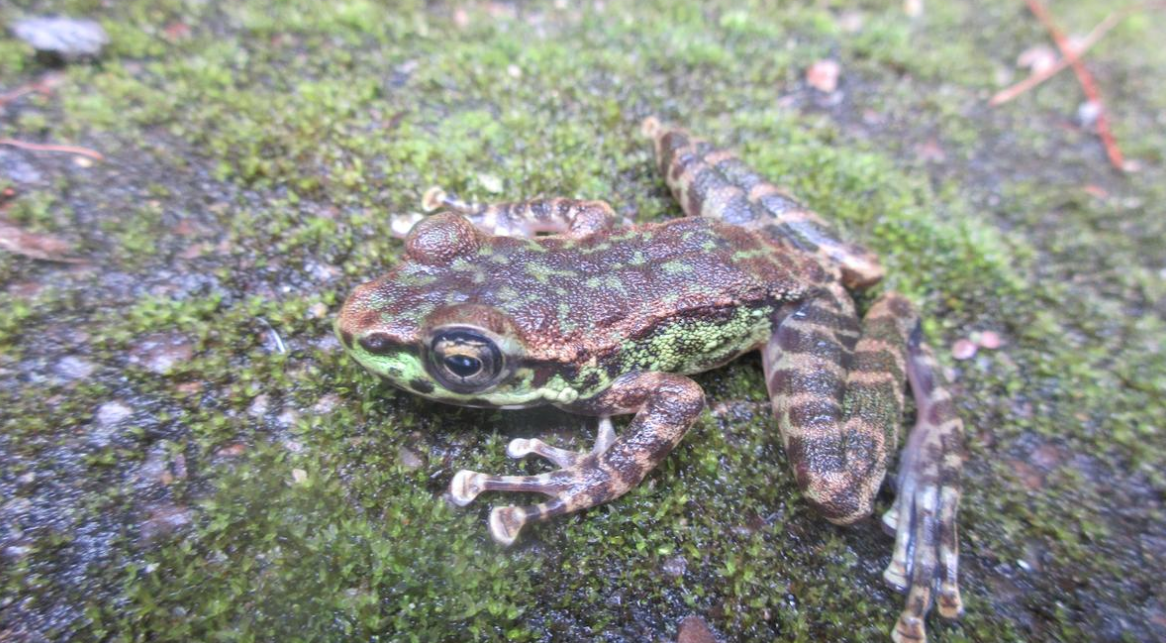
Scientists described Amolops shillong, the Shillong cascade frog, from fast-flowing streams and urban forest patches in the Mawlai area of Shillong. The species was documented from specimens collected during 2022 and 2023 and published in the Records of the Zoological Survey of India.
What Happened
Scientists described Amolops shillong, the Shillong cascade frog, from fast-flowing streams and urban forest patches in the Mawlai area of Shillong. The species was documented from specimens collected during 2022 and 2023 and published in the Records of the Zoological Survey of India. In May 2025, researchers from the Zoological Survey of India (ZSI), Kolkata, along with collaborators from other institutions, discovered a new species of frog named 'Amolops shillong', also known as the Shillong Cascade Frog, in the urban forest landscape of Shillong, East Khasi Hills district, Meghalaya.
The species was found at an average elevation of 4,990 feet, and the discovery was officially published in the Records of the Zoological Survey of India journal. The species description is based on three specimens collected between 2022 and 2023—two males from Umthlong and one female from Umrynjah, both localities situated in the Mawlai area of Shillong. Amolops shillong belongs to the Amolops indoburmanensis species complex—a group of frogs that appear similar in appearance but are genetically distinct. It is genetically most closely related to Amolops siju, which was discovered in 2023 from Siju Cave in South Garo Hills, Meghalaya.
This new species is distinguishable by its body size, skin texture, and body proportions and Its natural habitat includes fast-flowing streams and urban forest patches in Shillong. India is home to 20 known Amolops species, of which 16 are endemic. Notably, nine species, including Amolops shillong, have been discovered in the last two decades—mainly in Northeast India, reflecting the region’s rich biodiversity.
Background
Meghalaya lies within the biologically rich hills of Northeast India, a region linked to the Indo-Burma biodiversity hotspot. High rainfall, limestone caves, subtropical forests, fast-flowing streams and sharp altitudinal variation create many small and isolated habitats. Such habitat diversity promotes endemism, meaning that a species may be restricted to a very small geographical area. Scientific discoveries become meaningful only after formal taxonomic work. Researchers compare morphology, habitat, behaviour and, increasingly, DNA sequences; deposit specimens in recognised collections; and publish the description in a peer-reviewed journal. A new-species report should therefore be distinguished from an unverified sighting or a social-media claim.
Key Features and Important Details
- Date / period – 30 May-6 June 2025
- Theme – Environment & Biodiversity
- Core Meghalaya link – Shillong Cascade Frog Amolops shillong Described from Urban Forest Streams
- Verification result – Verified from peer-reviewed publication
Significance for Meghalaya
The development is important for Meghalaya because it reinforces the state's status as a centre of biological diversity and scientific discovery. It also shows why small habitats – a cave stream, an urban forest patch, a hillside shrub zone or a community-managed forest – can have national conservation value. Documentation should lead to habitat assessment, local awareness and carefully designed conservation rather than collection pressure or unregulated tourism.
National and Constitutional Context
Connect the species or ecosystem with taxonomy, endemicity, biodiversity hotspots, conservation methods, protected-area categories and the responsible scientific institution. Learn the scientific name exactly. From an examination perspective, biodiversity news should be connected with habitat protection, the Wildlife (Protection) Act, 1972, ex-situ and in-situ conservation, biodiversity hotspots, community reserves, sacred groves and the role of institutions such as the Zoological Survey of India, Botanical Survey of India and research universities.
Challenges and Way Forward
The main challenge is to protect habitats while allowing local livelihoods and development. Meghalaya needs stronger field monitoring, community participation, scientific documentation and timely action against habitat loss and pollution.
Important Facts for Prelims
- Date / period – 30 May-6 June 2025
- Theme – Environment & Biodiversity
- Core Meghalaya link – Shillong Cascade Frog Amolops shillong Described from Urban Forest Streams
- Verification result – Verified from peer-reviewed publication
Mains Relevance
Connect the species or ecosystem with taxonomy, endemicity, biodiversity hotspots, conservation methods, protected-area categories and the responsible scientific institution. Learn the scientific name exactly. From an examination perspective, biodiversity news should be connected with habitat protection, the Wildlife (Protection) Act, 1972, ex-situ and in-situ conservation, biodiversity hotspots, community reserves, sacred groves and the role of institutions such as the Zoological Survey of India, Botanical Survey of India and research universities.
Practice Questions
Practice MCQ
Question: With reference to Shillong Cascade Frog Amolops shillong Described from Urban Forest Streams, consider the following statements:
- It is directly connected with Meghalaya.
- Its wider relevance can be linked with the category mentioned in this article.
Which of the statements given above is/are correct?
(a) 1 only (b) 2 only (c) Both 1 and 2 (d) Neither 1 nor 2
Answer: (c) Both 1 and 2.
Mains Question
Explain the importance of Shillong Cascade Frog Amolops shillong Described from Urban Forest Streams for Meghalaya. Discuss the main implementation challenges and suggest a practical way forward.