
Brief Context
Context The Election Commission of India (ECI) has asked for the electoral rolls for Bihar to be prepared afresh. About All electors must submit an enumeration form, and those registered after 2003 have to additionally provide documentation establishing their citizenship. This special intensive revision (SIV) of rolls will eventually cover all states and Union Territories.
Source Content
Syllabus: GS2/Polity and Governance
Context
- The Election Commission of India (ECI) has asked for the electoral rolls for Bihar to be prepared afresh.
About
- All electors must submit an enumeration form, and those registered after 2003 have to additionally provide documentation establishing their citizenship.
- This special intensive revision (SIV) of rolls will eventually cover all states and Union Territories.
- Reasons for the SIV: Rapid urbanisation, frequent migration, young citizens becoming eligible to vote, non-reporting of deaths and inclusion of the names of foreign illegal immigrants have necessitated the conduct.
- The booth level officers (BLOs) will make house to house verification of voters.
- The last intensive revision for Bihar was conducted by the Commission in 2003.
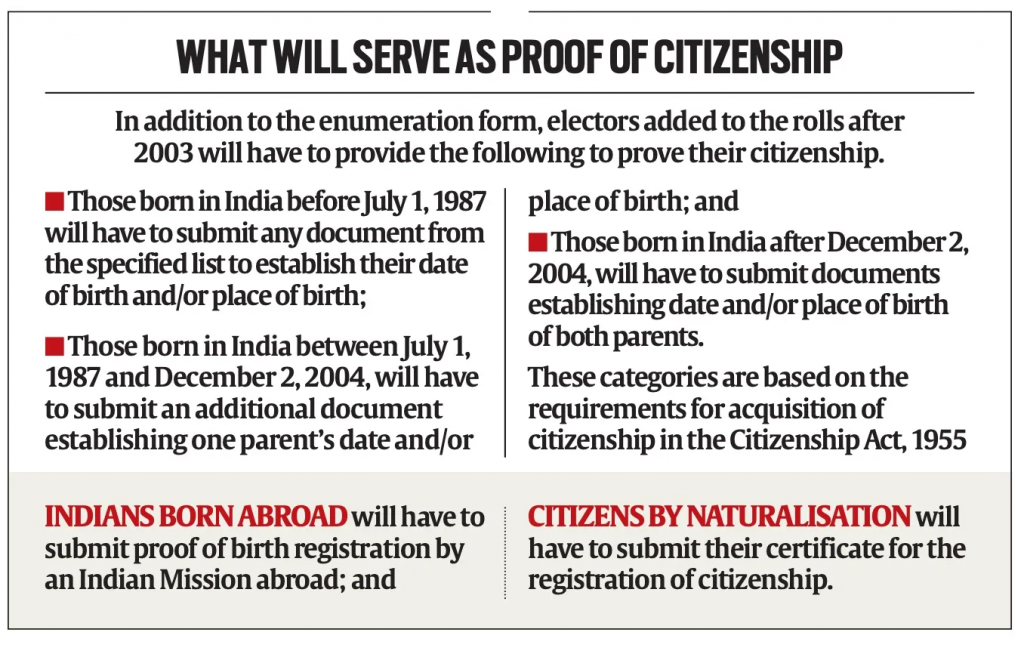
Provision in RPA
- As per the Section 21(3) of The Representation of the People Act, 1950 the Election Commission “may at any time… direct a special revision of the electoral roll for any constituency or part of a constituency in such manner as it may think fit”.
- The revision of rolls can be carried out “either intensively or summarily or partly intensively and partly summarily, as the (ECI) may direct”.
- In an intensive revision, the electoral roll is prepared afresh and in a summary revision, the roll is amended.
- Intensive revisions have been carried out in 1952-56, 1957, 1961, 1965, 1966, 1983-84, 1987-89, 1992, 1993, 1995, 2002, 2003 and 2004.
Eligibility to be a Registered Voter in India
- Article 326 of the Constitution stipulates that: every person who is a citizen of India & who is not less than 18 years of age on the qualifying date & is not otherwise disqualified under any law shall be entitled to be registered in the electoral roll.
- Section 16 of the Representation of the People Act, 1950 disqualifies a person from being registered on an electoral roll if:
- they are not a citizen of India,
- are of unsound mind, as declared by a competent court, or
- are disqualified under any law relating to corrupt practices or offences in connection with elections.
Procedure for Voter Registration
- The Election Commission of India (ECI) mandates new voters to apply using Form 6.
- Applicants must submit:
- Self-attested proof of age and address (such as utility bills, passport, etc.)
- A declaration of Indian citizenship, which they must personally sign.
- Proof of citizenship (such as passport or birth certificate) is not strictly required unless the ERO suspects the applicant’s credentials.
- Electoral Registration Officers (EROs) and Booth Level Officers (BLOs) are responsible for verifying the applications. The process includes:
- Verification of documents,
- Hearings for claims and objections,
- Acceptance or rejection of the application.
- Section 31 of the RP Act, 1950 penalizes false declarations in voter applications.
| About Election Commission of India (ECI) – The ECI is an autonomous and permanent constitutional body responsible for organising free and fair elections in the Union and States of India. – The Constitution grants the ECI with the power of direction, superintendence, and control of elections to Parliament, state legislatures, the office of president of India and the office of vice-president of India. – The ECI does not deal with the elections to the urban bodies such as Municipalities and Panchayats in the states and hence, a separate State Election Commission is in place. |
Source: IE
Sources and further reading
- IEindianexpress.com