
Maharashtra’s three-language policy became a major education and federalism debate after the State first proposed Hindi as a third language from Classes 1 to 5, revised the arrangement, and then withdrew both Government Resolutions (GRs). A committee chaired by educationist and economist Narendra Jadhav submitted a fresh report in February 2026. As of July 2026, the report’s recommendations had not been publicly disclosed or adopted as final policy.
The controversy is not a simple contest between Marathi and Hindi. It raises questions about child development, parental choice, linguistic diversity, administrative capacity and the flexibility promised by the National Education Policy (NEP) 2020.
Why is the Maharashtra three-language policy in the news?
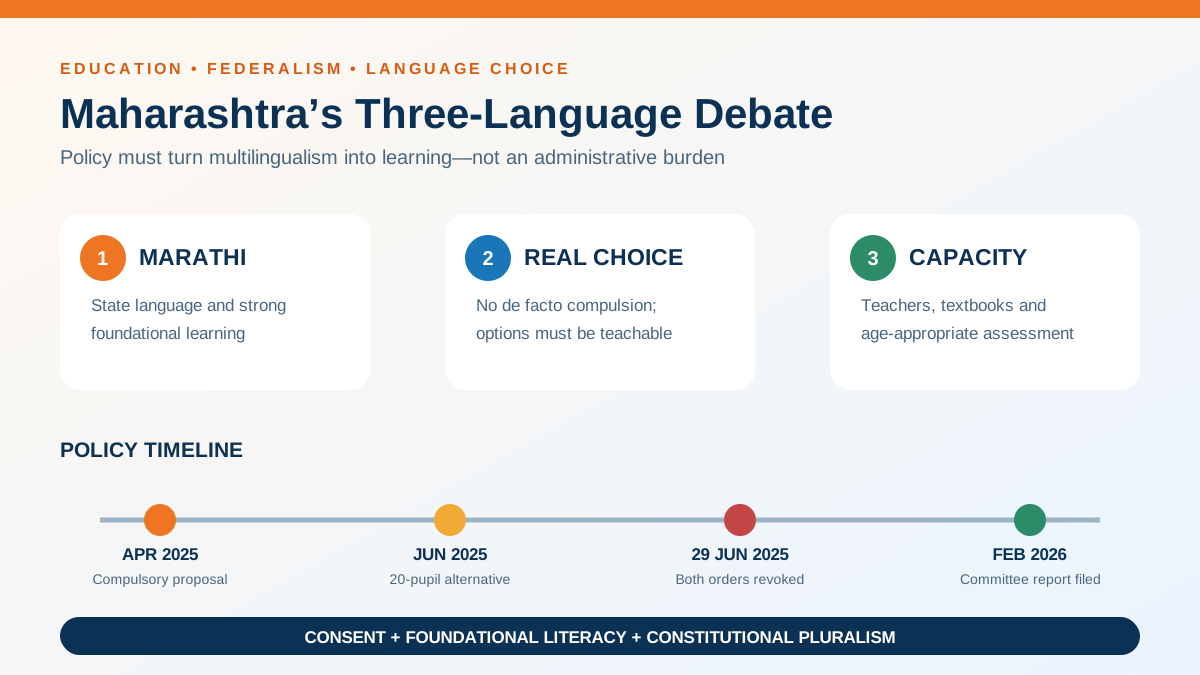
On 16 April 2025, Maharashtra issued a GR connected with implementation of the State Curriculum Framework. It treated Hindi as a compulsory third language for pupils in Classes 1 to 5 in Marathi- and English-medium State Board schools. Opposition followed from educationists, language groups and political parties.
A revised GR dated 17 June 2025 described Hindi as the general third-language option but allowed another Indian language where at least 20 pupils in the same class at a school requested it. Critics argued that the threshold made the supposed choice difficult to exercise in small schools.
On 29 June 2025, the State government cancelled both GRs and announced a committee under Dr Narendra Jadhav to recommend how, when and with what choices a three-language formula should operate. The committee conducted consultations and submitted its report in February 2026. The Chief Minister said it would be considered by the Cabinet; its contents were not immediately released.
| Date | Decision | Policy significance |
|---|---|---|
| 16 April 2025 | Hindi proposed as compulsory third language in Classes 1–5 for Marathi- and English-medium schools | Triggered concern over compulsion and age-appropriate learning |
| 17 June 2025 | Another Indian language permitted if a 20-pupil threshold was met | Created formal choice, but raised feasibility questions |
| 29 June 2025 | Both GRs revoked; Jadhav committee announced | Returned the issue to consultation and policy review |
| February 2026 | Committee report submitted to the State | Recommendations await a publicly notified government decision |
What does NEP 2020 actually say?
NEP 2020 supports multilingualism but does not prescribe Hindi as a compulsory language for every State. It says the three-language formula will continue with constitutional safeguards and greater flexibility. No language is to be imposed on any State, and the languages learned by a child will be choices of the State, region and student, provided at least two of the three are languages native to India.
The policy also states that, wherever possible, the medium of instruction until at least Grade 5—and preferably Grade 8 and beyond—should be the home language, mother tongue, local language or regional language. This is a recommendation, not a self-executing statute. States still need curriculum, teachers, textbooks, timetables and assessment systems.
Read LearnPro’s related explanation of mother-tongue education under NEP 2020.
Three-language formula: policy versus implementation
| Principle | Potential benefit | Implementation risk |
|---|---|---|
| Mother-tongue foundation | Better comprehension, participation and connection with home | Shortage of materials and trained teachers in every home language |
| Additional Indian language | Mobility, cultural exchange and national integration | A default language can become de facto compulsion |
| English learning | Higher education and wider economic opportunity | Early language overload may reduce foundational learning time |
| Student choice | Respects linguistic diversity | Choice is hollow without sufficient enrolment, teachers and textbooks |
Constitutional position on language and education
- Education is in the Concurrent List: Parliament and State legislatures can both legislate, while school administration is largely carried out by States.
- Article 29: protects the right of citizens with a distinct language, script or culture to conserve it.
- Article 30: protects the right of religious and linguistic minorities to establish and administer educational institutions.
- Article 350A: asks States and local authorities to endeavour to provide adequate facilities for instruction in the mother tongue at the primary stage for children belonging to linguistic minority groups.
- Articles 345–347: deal with official languages of States and recognition of languages spoken by sections of a State’s population.
- Article 351: directs the Union to promote the development of Hindi; it does not erase protections for other languages or itself create a school-language mandate.
- Eighth Schedule: recognises 22 languages, showing the Constitution’s multilingual character.
India has no constitutionally declared national language. Hindi is an official language of the Union, while English continues for official purposes under law. “Official language”, “national language”, “medium of instruction” and “language studied as a subject” are different legal and educational concepts.
For broader context, see LearnPro’s guide to the constitutional provisions on official language.
Arguments supporting a three-language approach
- Multilingual ability: children can communicate across regions and access more literature and knowledge.
- National integration: learning another Indian language may encourage cultural understanding without requiring linguistic uniformity.
- Cognitive benefits: well-designed multilingual education can build language awareness and flexible thinking.
- Mobility: additional languages can assist students who later study or work in another State.
- NEP alignment: a flexible formula can support both local identity and wider opportunity.
Why did the Maharashtra proposal face opposition?
- Perceived Hindi imposition: making one language compulsory or the default appeared inconsistent with NEP’s assurance of flexibility.
- Very early introduction: critics questioned whether three languages from Class 1 would burden children before foundational literacy was secure.
- Unequal choice: a 20-pupil condition could deny alternatives in small, rural or linguistically mixed schools.
- Teacher availability: offering several languages requires qualified teachers, textbooks and predictable funding.
- Marathi identity: language is linked to culture, public employment and State formation, making sudden changes politically sensitive.
- Consultation deficit: policy introduced through GRs was criticised for insufficient prior engagement with parents, teachers and language experts.
Educational evidence and the foundational-stage question
Children do not become confused merely because they encounter more than one language. The real issue is how languages are introduced. Oral exposure, play and stories differ from simultaneous high-stakes literacy and examination in three scripts. A child may speak one language at home, hear another locally and study through a third at school.
A sound policy should therefore separate:
- the medium of instruction used to teach concepts;
- languages learned mainly for oral communication;
- the grade at which reading and writing begin in each script; and
- the grade at which a language becomes an assessed subject.
Without this distinction, the slogan “three languages” tells parents little about the actual classroom burden.
Federalism and language choice
India’s language settlement depends on accommodation. The Union may frame national education goals, but States have different linguistic histories and school systems. Tamil Nadu follows a two-language policy, while other States use different combinations under the three-language formula. Uniformity is therefore neither constitutionally automatic nor administratively realistic.
At the same time, a State should protect children from linguistic minorities. Marathi’s central place in Maharashtra can coexist with Urdu, Gujarati, Kannada, Telugu, tribal languages and other home languages. Federalism must operate inside the State as well as between the Union and States.
A practical policy design for Maharashtra
- Publish the committee report: public reasoning is essential before a fresh Cabinet or GR decision.
- Protect Marathi without imposing another language: clearly define compulsory, optional and medium-of-instruction categories.
- Prioritise foundational literacy: phase oral and written learning according to child-development evidence.
- Make choice real: use school clusters, hybrid teaching and shared language teachers instead of an inflexible enrolment threshold.
- Map demand and capacity: publish district-level data on home languages, teacher vacancies and textbook availability.
- Pilot before scaling: test schedules and learning outcomes in diverse urban, rural and tribal districts.
- Consult stakeholders: include teachers, parents, child-development experts and linguistic minorities.
- Review learning outcomes: measure comprehension and foundational literacy, not only course completion.
UPSC and State PSC relevance
The Maharashtra three-language policy links GS Paper II topics—federalism, education policy, constitutional rights and governance—with society and identity. A balanced Mains answer should avoid reducing the issue to party politics. Explain NEP flexibility, the 2025 policy sequence, the 2026 committee report, constitutional safeguards, classroom capacity and a consultative way forward.
Mains practice: “A three-language formula succeeds only when language choice is educationally sound, administratively feasible and genuinely voluntary.” Discuss with reference to the Maharashtra debate.
Conclusion
Maharashtra did not permanently reject multilingual education; it withdrew two disputed implementation orders and sought a fresh framework. The next decision should not treat a numerical formula as an education policy. It must specify what children learn, when they learn it, who will teach it and how meaningful choice will be protected. Multilingualism works best through capacity and consent, not administrative compulsion.
Frequently asked questions
Did Maharashtra cancel the three-language policy?
The State revoked its April and June 2025 Government Resolutions. It then formed the Narendra Jadhav committee to recommend a fresh approach; the committee submitted its report in February 2026.
Does NEP 2020 make Hindi compulsory?
No. NEP 2020 supports a flexible three-language formula, says no language will be imposed on any State and requires at least two of the three chosen languages to be native to India.
What was controversial about the June 2025 GR?
Hindi remained the general third-language option, while another Indian language required demand from at least 20 pupils in the same class and school. Critics said this made alternatives impractical.
What does Article 350A provide?
It asks every State and local authority to endeavour to provide adequate facilities for mother-tongue instruction at the primary stage for children belonging to linguistic minority groups.
Has the Jadhav committee report become policy?
No publicly notified adoption was identified as of July 2026. Submission of a committee report and a final Cabinet or government decision are separate stages.
Official references
- Ministry of Education: National Education Policy 2020
- Akashvani: withdrawal of the April and June 2025 resolutions
- Akashvani: Jadhav committee report submitted
- Legislative Department: Constitution of India





Sources and further reading
- Ministry of Education: National Education Policy 2020education.gov.in
- Akashvani: withdrawal of the April and June 2025 resolutionsnewsonair.gov.in
- Akashvani: Jadhav committee report submittednewsonair.gov.in
- Legislative Department: Constitution of Indialegislative.gov.in