ECI delisting political parties became a major electoral-reform issue in 2025 when the Election Commission of India (ECI) began removing inactive Registered Unrecognised Political Parties (RUPPs) from its maintained list. The exercise started with verification of 345 parties that had not contested an ECI-conducted election for six continuous years and whose registered offices could not be located.
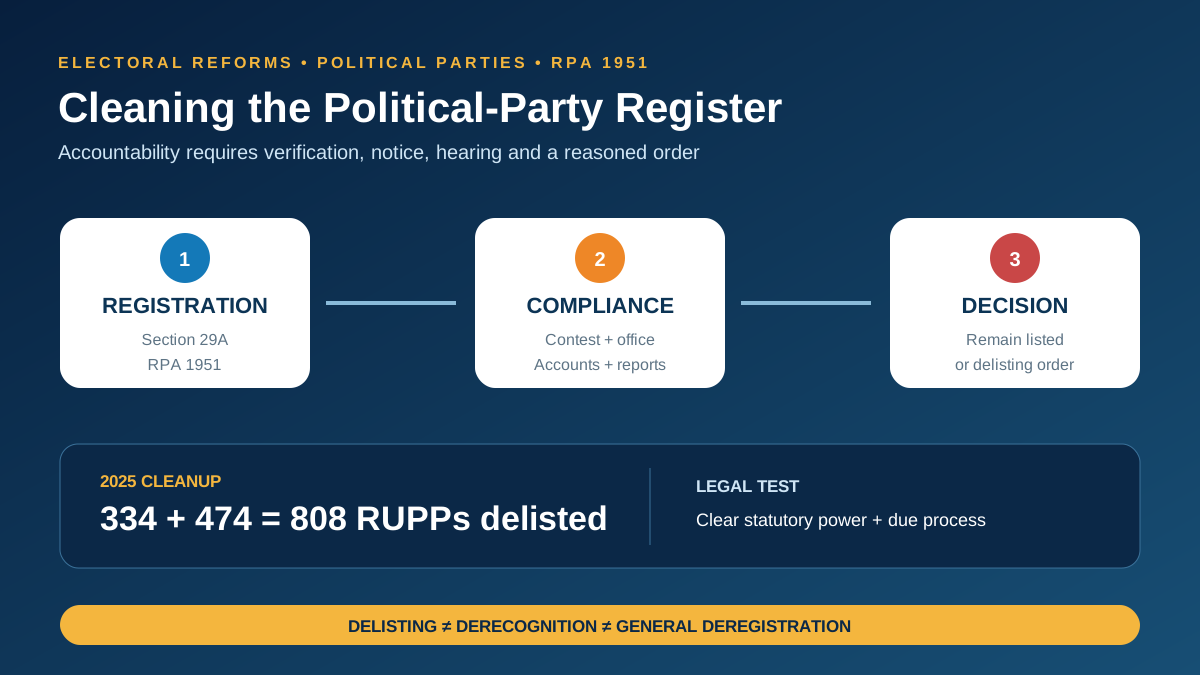
After notices, hearings and reports from State and Union Territory Chief Electoral Officers, the ECI delisted 334 RUPPs on 9 August 2025. A second order delisted 474 more on 18 September 2025. Thus, 808 RUPPs were removed from the list in two phases, reducing the reported number of RUPPs from 2,854 before the first phase to 2,046 after the second.
Why were political parties delisted?
The ECI stated that its political-party registration guidelines require a party to contest an election within six years to remain on the list of registered parties. The 2025 exercise targeted parties that had not contested any election conducted by the ECI continuously since 2019. Physical verification also found that many could not be located at their registered addresses.
The sequence is important. The Commission did not simply remove all 345 parties identified in June. State and Union Territory Chief Electoral Officers issued show-cause notices, held hearings and sent reports. Based on those reports, 334 were delisted in the first phase; the remaining cases were returned for reverification.
| Stage | Number | What happened |
|---|---|---|
| June 2025 verification | 345 RUPPs | Proceedings initiated for six years of non-contestation and untraceable offices |
| First phase | 334 RUPPs | Delisted by ECI order dated 9 August 2025 |
| Second phase | 474 RUPPs | Delisted on 18 September 2025 for continuous non-contestation |
| Total in two phases | 808 RUPPs | Reported RUPP count reduced to 2,046 |
| Separate compliance action | 359 RUPPs | Identified for delayed audited accounts and/or election-expenditure reports |
The 359 compliance cases were a separate process. They should not be added to the 808 as if every identified party had already been delisted.
What is a Registered Unrecognised Political Party?
A political association becomes a registered political party by applying under Section 29A of the Representation of the People Act, 1951. Registration does not automatically make it a national or State party. Recognition is earned by meeting vote-share and seat criteria under the Election Symbols (Reservation and Allotment) Order, 1968.
An RUPP is generally a party registered under Section 29A that:
- has not yet satisfied the conditions for recognition as a State or national party;
- may be newly registered and yet to contest a general election;
- has contested elections but failed to obtain the required votes or seats; or
- has lost earlier recognition after failing to maintain the prescribed electoral performance.
“Unrecognised” therefore does not mean illegal. Many RUPPs are genuine small or regional organisations. The regulatory problem arises when registered entities become inactive, untraceable or non-compliant while retaining access to statutory benefits.
Registration, recognition, derecognition and delisting
| Term | Meaning | Legal basis or consequence |
|---|---|---|
| Registration | Entry as a political party with the ECI | Section 29A, RPA 1951 |
| Recognition | Status as a State or national party after meeting electoral criteria | Symbols Order, 1968; reserved symbol and related benefits |
| Derecognition | Loss of State or national party status | Party may remain registered but becomes unrecognised |
| Delisting | Removal from the ECI’s maintained list of registered parties for specified non-compliance | Affects registration-linked benefits and status; subject to procedural and judicial scrutiny |
| Deregistration | Cancellation of the underlying registration | General statutory power is disputed and narrowly limited by Supreme Court precedent |
This vocabulary matters in UPSC answers. A recognised party can lose recognition without its Section 29A registration disappearing. Conversely, removal of an inactive RUPP from the Commission’s list raises a deeper question about the ECI’s power to cancel or undo a quasi-judicial registration order.
Legal framework for political-party registration
Article 324 of the Constitution
Article 324 vests the superintendence, direction and control of elections in the ECI. This is a broad constitutional responsibility, but it does not allow the Commission to disregard an enacted law. Where Parliament has occupied a field, the ECI’s action must operate consistently with that law.
Section 29A of the Representation of the People Act, 1951
An association seeking registration must apply to the ECI. Its memorandum or rules must affirm allegiance to the Constitution and to the principles of socialism, secularism and democracy, and uphold India’s sovereignty, unity and integrity. The party must communicate later changes in its name, head office, office-bearers, address or other material particulars under Section 29A(9).
Financial reporting provisions
- Section 29B: permits political parties to accept contributions subject to statutory restrictions.
- Section 29C: requires reporting of specified contributions to the ECI.
- Income-tax law: tax exemption under Section 13A of the Income-tax Act is conditional on record-keeping, audit and return requirements.
- Election expenditure: parties contesting an election must file expenditure statements under ECI directions within the prescribed period.
Delisting can therefore affect practical benefits relating to political contributions, income-tax treatment and election symbols, even when the precise legal character of the action is contested.
What did the Supreme Court say about deregistration?
In Indian National Congress (I) v. Institute of Social Welfare (2002), the Supreme Court held that the ECI acts quasi-judicially while registering a party under Section 29A. Because the RPA does not confer a general power of review, the Commission cannot ordinarily cancel registration merely because a party is later alleged to have violated constitutional provisions or breached its undertaking.
The Court recognised limited situations in which registration could be undone:
- fraud or forgery was used to obtain registration;
- the party changes its constitution or informs the ECI in a manner that removes the basis required by Section 29A(5); or
- a comparable ground requires no factual inquiry—for example, the party is declared unlawful under the Unlawful Activities (Prevention) Act or a similar law.
The 2025 delisting orders have therefore generated litigation over the distinction between maintaining an administrative list and exercising a power equivalent to deregistration. Some affected parties argued that non-contestation is not one of the Supreme Court’s limited exceptions. Courts have considered interim challenges, making it unsafe to present the legal issue as finally settled.
Why does cleaning the RUPP list matter?
- Electoral integrity: a current list helps voters, candidates and administrators distinguish active parties from dormant entities.
- Financial transparency: inactive parties should not become channels for unaccounted donations or tax abuse.
- Symbol management: a large dormant registry complicates allotment of names and common symbols.
- Public accountability: parties seek public power and should maintain verifiable offices, office-bearers and financial records.
- Administrative accuracy: notices and election communication cannot reach parties with false or obsolete addresses.
These concerns are genuine, but “ghost party” should not become a substitute for evidence. Non-contestation may result from lack of funds, local-level participation, internal disputes or delayed electoral plans. Due process is necessary because delisting has civil and political consequences.
Procedural safeguards in the 2025 exercise
A defensible cleanup process requires:
- objective screening using election-participation and compliance records;
- physical and documentary verification by the relevant Chief Electoral Officer;
- individual show-cause notice stating the alleged failures;
- a meaningful hearing and time to produce records;
- a reasoned recommendation from the State or Union Territory CEO;
- a speaking order by the ECI rather than mechanical removal; and
- review or appeal opportunity and access to judicial remedies.
In the August 2025 phase, the ECI allowed an aggrieved party to approach the Commission within 30 days. That safeguard is useful, but the larger question of statutory power still requires clear legislation or authoritative judicial settlement.
Benefits enjoyed by registered parties
Registration creates more than a label. Depending on compliance and the election concerned, a registered party may receive:
- eligibility to seek a common symbol under the Symbols Order;
- recognition as a political party for receiving lawful contributions;
- income-tax exemption when statutory conditions are satisfied;
- access to electoral rolls and certain campaign facilities under ECI rules;
- the ability to nominate star campaigners, with numbers depending on recognition status; and
- a pathway to State or national recognition through electoral performance.
Benefits should be described carefully: registration alone does not grant a permanently reserved symbol, automatic tax exemption regardless of compliance, or the same privileges as a recognised national party.
Broader accountability gap
India regulates political parties less comprehensively than many public institutions even though parties select candidates, form governments and influence legislation. Important gaps include weak enforcement of internal elections, delayed financial disclosures, limited donor transparency and the absence of an express, carefully bounded deregistration provision.
The issue connects with LearnPro’s analysis of electoral trusts and political-funding transparency and the discussion on institutional accountability within political parties.
Reforms required
- Amend the RPA: Parliament should expressly define proportionate grounds and procedure for suspension, delisting and deregistration.
- Use graded penalties: late filing, repeated default, false information and complete inactivity should not automatically receive the same sanction.
- Create a public compliance dashboard: display office verification, audited accounts, contribution reports, expenditure statements and organisational elections.
- Protect small parties: compliance formats should be digital and simple without weakening disclosure requirements.
- Ensure independent appeal: serious sanctions should have a clear review route and time-bound judicial remedy.
- Define local-election participation: rules should clarify how participation in panchayat, municipal and autonomous-council elections affects inactivity assessment.
- Coordinate with tax authorities: information exchange should target actual abuse, not presume wrongdoing from small size alone.
UPSC and State PSC relevance
ECI delisting political parties is relevant to GS Paper II topics such as constitutional bodies, the Representation of the People Act, electoral reforms and transparency. For Prelims, distinguish Section 29A registration from recognition under the Symbols Order. In Mains, discuss the tension between electoral integrity and freedom of association under Article 19(1)(c), along with due process and the statutory limits identified by the Supreme Court.
Mains practice: “The cleanup of dormant political parties is necessary, but administrative guidelines cannot substitute for a clear statutory deregistration framework.” Examine.
Conclusion
The 2025 exercise corrected an inflated and partly inactive party registry: 808 RUPPs were delisted in two phases after verification. Yet cleaner records and stronger accountability must rest on clear law, reasoned orders and fair hearings. Parliament should close the legal gap by defining graded powers that allow the ECI to act against sham entities without giving it an unlimited power over political association.
Frequently asked questions
How many political parties did the ECI delist in 2025?
The ECI delisted 334 RUPPs in August and 474 in September, making 808 across the two phases.
What is an RUPP?
A Registered Unrecognised Political Party is registered under Section 29A of the RPA 1951 but does not presently meet the electoral criteria for recognition as a State or national party.
Why were the parties delisted?
The principal ground was failure to contest any ECI-conducted election continuously for six years. Many parties identified for verification also could not be found at their registered addresses.
Can the ECI freely deregister any political party?
No. The Supreme Court held in 2002 that the ECI lacks a general review power under Section 29A, while recognising limited exceptions such as registration obtained by fraud.
Is delisting the same as derecognition?
No. Derecognition removes national or State recognition based on electoral performance, while a party may remain registered. Delisting removes an RUPP from the ECI’s maintained list for stated non-compliance.
Official and legal references
- Election Commission of India: party lists and 2025 delisting orders
- Election Commission of India: registration guidelines under Section 29A
- Representation of the People Act, 1951
- Indian National Congress (I) v. Institute of Social Welfare (2002)