
The anti-defection law tries to protect elected governments from legislators who change political allegiance after an election. It is contained in the Tenth Schedule of the Constitution, inserted by the 52nd Constitutional Amendment Act, 1985. The law can remove a Member of Parliament or a state legislator from the House.
Its democratic record is mixed. It has made individual floor-crossing costly, but broad party whips have also reduced legislators to numbers controlled by party leadership. Delays and perceived partisanship in decisions by Speakers create a second problem: a rule intended to prevent instability can itself be used strategically.
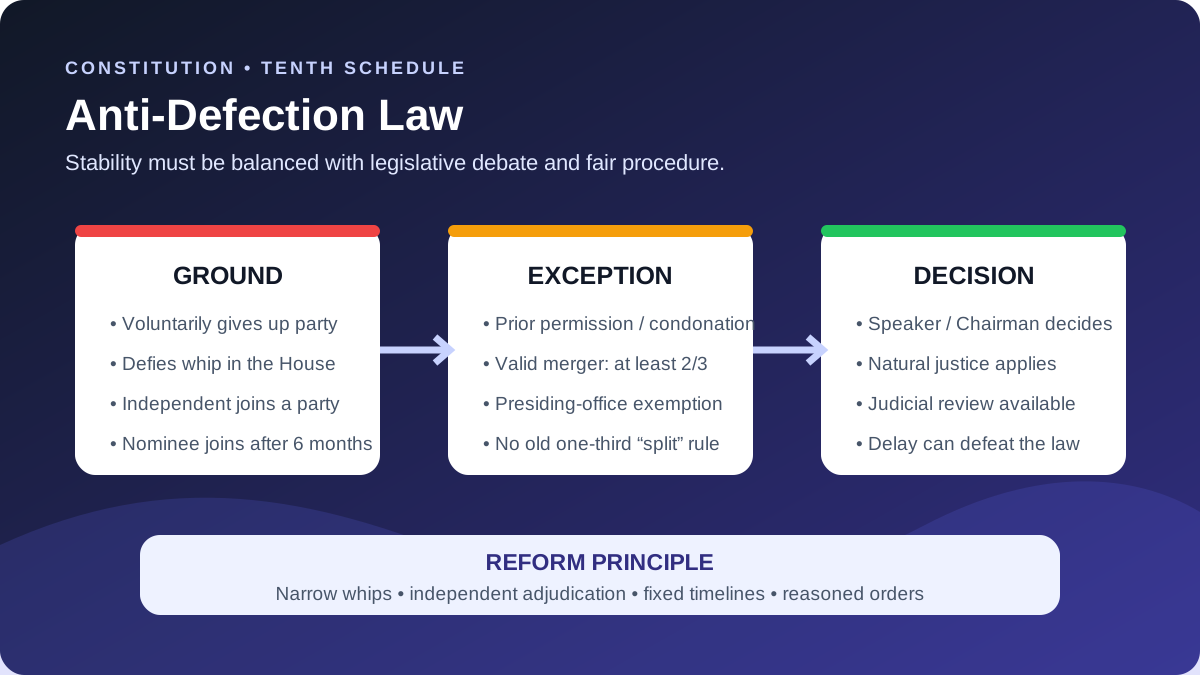
Why was the anti-defection law enacted?
Frequent defections in the 1960s and 1970s destabilised state governments and produced the expression “Aaya Ram, Gaya Ram”. Legislators could change parties in exchange for office or other advantage without seeking a fresh mandate. Parliament responded in 1985 by adding the Tenth Schedule.
The law pursues three legitimate goals:
- government stability by preventing opportunistic loss of a legislative majority;
- electoral accountability because a member was elected on a party symbol and programme; and
- integrity of legislative voting by discouraging inducement-driven switches.
When can a legislator be disqualified?
| Member | Ground under the Tenth Schedule | Important qualification |
|---|---|---|
| Party member | Voluntarily gives up membership of the political party | A formal resignation is not necessary; conduct can show abandonment |
| Party member | Votes or abstains contrary to a party direction in the House | No disqualification if there was prior permission or the party condones the act within 15 days |
| Independent member | Joins a political party after election | The bar protects the independent mandate |
| Nominated member | Joins a party after six months from taking the seat | Joining within the first six months is permitted |
The expression “voluntarily giving up membership” is wider than submitting a resignation letter. In Ravi S. Naik v Union of India (1994), the Supreme Court explained that intention can be inferred from conduct. Publicly supporting a rival formation or acting consistently against one’s party may therefore matter, depending on the facts.
What is the merger exception?
Paragraph 4 protects members where the original political party merges with another party and at least two-thirds of the legislature party agrees to the merger. Members who accept the merger and those who choose to function as a separate group are protected in the circumstances specified by the Schedule.
A common error is to say that one-third of legislators can form a protected split. The 91st Constitutional Amendment Act, 2003 deleted the old split exception. A two-thirds group does not receive a free-standing licence to defect; the constitutional text links the protection to a merger of the original party.
Who decides a defection case?
The Speaker or Chairman of the House decides a Tenth Schedule petition. In Kihoto Hollohan v Zachillhu (1992), the Supreme Court upheld the law but held that the presiding officer’s final decision is open to judicial review for jurisdictional error, constitutional violation, mala fides or breach of natural justice.
This arrangement creates an institutional conflict. The Speaker is expected to act impartially but normally comes from a political party and may have incentives connected with the government’s survival. Courts review the decision; they do not ordinarily replace the Speaker as the first decision-maker.
Can the Speaker delay a decision?
The Tenth Schedule sets no express deadline. In Keisham Meghachandra Singh v Speaker, Manipur (2020), the Supreme Court said disqualification petitions should ordinarily be decided within a reasonable period of three months, absent exceptional circumstances. The Court also asked Parliament to consider an independent tribunal.
Delay is not a technical issue. If a member continues to vote for months while a petition remains undecided, the eventual disqualification may not undo changes in government or legislation. Conversely, a rushed proceeding without documents and a fair opportunity to respond can violate natural justice.
What did the Maharashtra judgment clarify?
In Subhash Desai v Principal Secretary, Governor of Maharashtra (2023), a Constitution Bench examined the interaction between intra-party disputes, whips, the Speaker and a floor test. Among its key points:
- the Speaker must recognise the whip authorised by the political party, not merely a faction of the legislature party;
- a floor test cannot be used simply to resolve an internal party dispute without objective material showing that the government has lost confidence;
- resignation does not erase pending disqualification consequences automatically; and
- the question from Nabam Rebia about whether a Speaker facing a removal notice can decide disqualification petitions was referred to a larger Bench.
Himachal Pradesh 2024: what actually happened?
Six Congress MLAs cross-voted in the February 2024 Rajya Sabha election and later did not comply with a party whip requiring presence and support during the state Budget and Finance Bill proceedings. The Speaker disqualified them on 29 February 2024.
The legal basis was the alleged defiance of the whip inside the Legislative Assembly, not the Rajya Sabha ballot by itself. That distinction matters because the Tenth Schedule concerns voting or abstention “in such House”. The former MLAs challenged the order, the Supreme Court declined interim stay, and they withdrew the case in May 2024 after joining another party and the announcement of by-elections.
Does a whip apply to every political vote?
No. The constitutional ground applies when a member votes or abstains contrary to a direction in the House of which that person is a member. Presidential elections use a secret ballot and party whips do not apply. Rajya Sabha elections are conducted by elected MLAs under election law; cross-voting there is politically significant but is not automatically disqualification under paragraph 2(1)(b) for a vote in the Assembly.
Benefits and democratic costs
| What the law protects | What the law can weaken |
|---|---|
| Stability of a government with an electoral mandate | Independent judgment of legislators |
| Party programme presented to voters | Legislative scrutiny of ordinary bills |
| Protection against inducement-based switching | Dissent within parties |
| Predictability on confidence and money votes | Accountability of party leadership to its members |
The central design error is the use of whips on too many matters. If every bill becomes a loyalty test, debate cannot change the outcome and committees lose influence. Party discipline is necessary to sustain a parliamentary government, but it need not eliminate all legislative choice.
Reforms that can improve the law
- Restrict binding whips: disqualification should attach mainly to confidence motions, no-confidence motions, money bills and votes central to government survival.
- Use an independent adjudicator: the President or Governor acting on the Election Commission’s advice, or a specialised tribunal, would reduce the Speaker’s conflict of interest.
- Set a firm timeline: require a reasoned order within a defined period, with a shorter period when a floor test is imminent.
- Protect natural justice: supply the petition and evidence, allow a meaningful reply and hold a fair hearing.
- Clarify merger law: require proof of an actual organisational merger, not only numerical movement inside the House.
- Regulate internal party democracy: transparent leadership elections and candidate selection can reduce factional conflict.
- Consider a fresh mandate: a legislator who voluntarily changes allegiance could be required to resign and contest again, subject to carefully drafted safeguards.
These reforms complement wider work on electoral integrity. LearnPro’s explainer on de-listing inactive political parties examines another part of party regulation.
UPSC and State PSC relevance
The anti-defection law is a core GS Paper II topic covering Parliament, state legislatures, constitutional bodies and judicial review. In Prelims, remember the four member categories, the 15-day condonation rule, six-month rule for nominees and two-thirds merger threshold. In Mains, balance government stability against deliberative democracy.
Mains practice question: The anti-defection law has limited retail defection but weakened legislative independence without eliminating political instability. Critically examine and suggest reforms.
Conclusion
India needs party discipline, but not at the cost of turning legislatures into extensions of party offices. A narrower whip, an impartial decision-maker, fixed timelines and fair procedure would protect both stability and debate. The law should punish genuine change of allegiance, not ordinary disagreement within a democratic party.
Frequently asked questions
Where is the anti-defection law found?
It is in the Tenth Schedule of the Constitution, inserted by the 52nd Constitutional Amendment Act, 1985.
Who decides whether a member is disqualified?
The Speaker or Chairman of the House decides first, and the final decision is subject to judicial review.
How many members are needed for the merger exception?
At least two-thirds of the members of the legislature party must agree to the qualifying merger conditions under paragraph 4.
Can a party member be disqualified without formally resigning?
Yes. Voluntarily giving up party membership can be inferred from conduct; a formal resignation is not essential.
Does the anti-defection law apply to a Presidential election?
No. The election uses a secret ballot, electors vote according to their choice and a party whip does not apply.
Primary references
- Legislative Department: Constitution of India and Tenth Schedule
- Supreme Court: case record linking Keisham Meghachandra and Subhash Desai
- Law Commission of India: Reports 170 and 255 on electoral reform
- PRS Legislative Research: anti-defection design and reform
- Election Commission: Presidential election and party whips





Sources and further reading
- Legislative Department: Constitution of India and Tenth Schedulelegislative.gov.in
- Supreme Court: case record linking Keisham Meghachandra and Subhash Desaiapi.sci.gov.in
- Law Commission of India: Reports 170 and 255 on electoral reformlawcommissionofindia.nic.in
- PRS Legislative Research: anti-defection design and reformprsindia.org
- Election Commission: Presidential election and party whipseci.gov.in