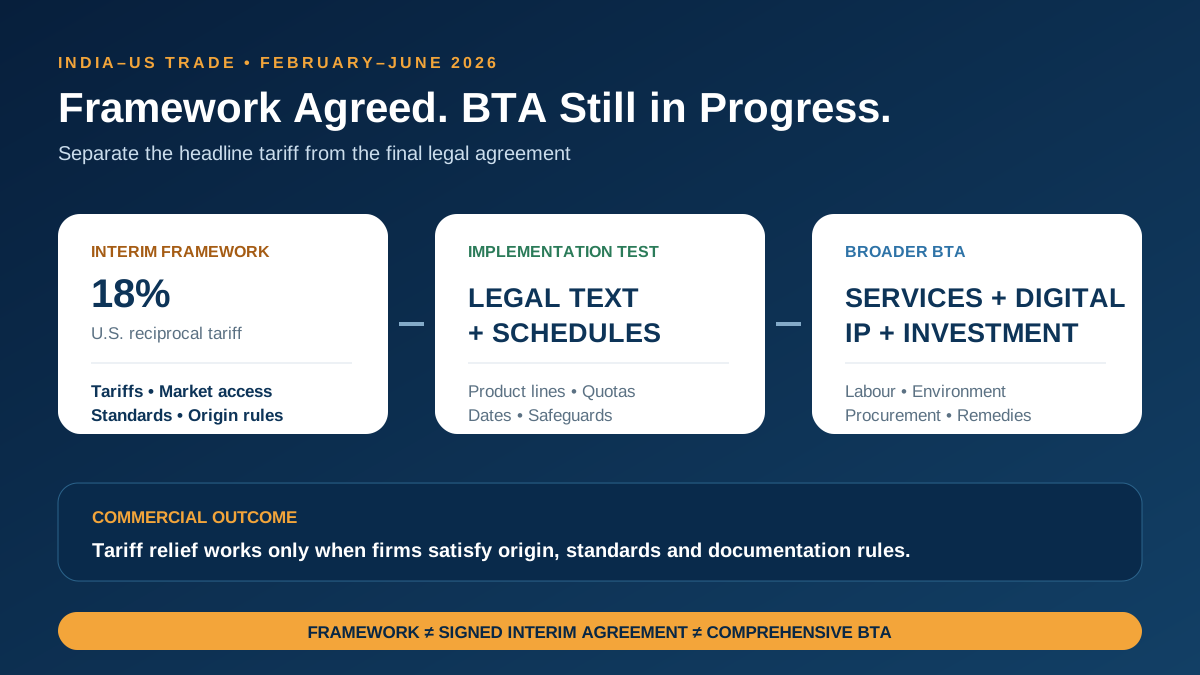
The India–US trade deal 2026 has moved beyond preliminary negotiation but has not yet become a completed, comprehensive free-trade agreement. On 6 February 2026, India and the United States announced a framework for an Interim Agreement on reciprocal trade and reaffirmed negotiations for a broader Bilateral Trade Agreement (BTA).
The framework contains important tariff, market-access, standards, digital-trade and economic-security commitments. Yet the joint statement explicitly said the two sides would work toward finalising the Interim Agreement. High-level talks continued in June 2026. The accurate description is therefore: an agreed framework with identified terms, followed by negotiation and implementation—not a fully concluded BTA.
How did the negotiations develop?
| Date | Development | Meaning |
|---|---|---|
| 13 February 2025 | Leaders launched BTA negotiations under the India–US COMPACT | Political mandate for a multi-sector agreement |
| April 2025 | Terms of Reference were finalised | Defined the negotiating roadmap |
| 6 February 2026 | Joint statement announced a framework for an Interim Agreement | Key tariff and non-tariff terms identified |
| February 2026 | United States announced an 18% reciprocal tariff rate for originating Indian goods and removal of an additional tariff | Immediate commercial significance, subject to applicable legal instruments and product conditions |
| June 2026 | USTR Jamieson Greer visited New Delhi for further talks | Interim Agreement and broader BTA negotiations continued |
What is the present status?
Three documents or stages must not be confused:
- Terms of Reference: a negotiating roadmap, not a trade agreement.
- Framework for an Interim Agreement: a political understanding that lists key intended terms.
- Final Interim Agreement and BTA: negotiated legal texts with schedules, rules, exceptions, entry-into-force provisions and enforcement mechanisms.
As of July 2026, official public material showed that the framework had been announced and talks had continued. The broader BTA was not presented as concluded. A headline that simply says “trade deal finalised” would therefore hide important legal and implementation stages.
Major terms in the interim framework
United States commitments affecting Indian exports
- 18% reciprocal tariff: the United States said it would apply an 18% rate under its reciprocal-tariff executive order to originating Indian goods, including textiles and apparel, leather and footwear, plastics and rubber, organic chemicals, home décor, artisanal products and certain machinery.
- Potential tariff removal: subject to successful conclusion of the Interim Agreement, the reciprocal tariff would be removed on a wide range of identified goods, including generic pharmaceuticals, gems and diamonds, and aircraft parts.
- Aircraft relief: specified tariffs on certain Indian aircraft and aircraft parts were to be removed.
- Automotive parts: India was to receive a preferential tariff-rate quota consistent with U.S. national-security requirements.
- Pharmaceuticals: negotiated treatment for generic pharmaceuticals and ingredients was linked to the result of a U.S. Section 232 investigation.
Indian commitments affecting US exports
- eliminate or reduce tariffs on all U.S. industrial goods covered by the arrangement;
- reduce tariffs on a range of agricultural products such as dried distillers’ grains, red sorghum for animal feed, tree nuts, fruit, soybean oil, wine and spirits;
- address barriers affecting U.S. medical devices;
- remove restrictive import-licensing procedures for identified ICT goods;
- review acceptance of U.S.-developed or international standards and testing requirements in agreed sectors; and
- address long-standing non-tariff barriers affecting U.S. food and agricultural products.
India’s official explanation stated that sensitive sectors such as dairy, meat, poultry and cereals remained protected within the announced package. Final legal schedules remain essential for determining the exact product coverage, tariff phase-outs, quotas and safeguards.
Rules of origin: the hidden core of the deal
A tariff preference applies only to an originating good. Rules of origin determine whether a product has sufficient production or value addition in India or the United States to qualify. They prevent a third country from routing minimally processed goods through one partner merely to obtain a lower tariff.
Strict rules can support domestic manufacturing but also raise documentation costs and disrupt global supply chains. For textiles, electronics, pharmaceuticals, gems and machinery, the following details matter:
- minimum regional-value content;
- change-in-tariff-classification rules;
- product-specific processing requirements;
- treatment of imported inputs;
- cumulation between the partners; and
- verification, certificates and penalties.
A headline tariff rate cannot predict export gains unless firms can satisfy the origin rule.
Tariff-rate quota explained
A tariff-rate quota (TRQ) allows a specified quantity of imports at a lower tariff; imports above the quota face a higher rate. It is different from complete tariff elimination. For Indian automotive parts, commercial value will depend on the quota volume, allocation method, eligible product lines and above-quota tariff.
Trade profile behind the negotiations
USTR data show the scale and imbalance that shape U.S. objectives:
| Indicator | Value | Interpretation |
|---|---|---|
| US–India goods trade, 2025 | $149.4 billion | Large and expanding merchandise relationship |
| US goods exports to India | $45.6 billion | Up 9.8% from 2024 |
| US goods imports from India | $103.8 billion | Up 18.9% from 2024 |
| US goods trade deficit with India | $58.2 billion | A central U.S. negotiating concern |
| Goods and services trade, 2024 | $212.3 billion | Shows importance beyond merchandise |
| Services trade, 2024 | $83.4 billion | Near-balanced, with a small U.S. surplus reported |
A bilateral goods deficit is not automatically proof of unfair trade. It reflects savings, demand, exchange rates, production networks and comparative advantage as well as tariffs. But it strongly influences U.S. trade policy and demands for “reciprocity”.
Why India wants the agreement
- Export competitiveness: lower U.S. tariffs can protect market share in textiles, leather, engineering goods, gems, pharmaceuticals and labour-intensive manufacturing.
- Investment: predictable access may attract firms seeking supply-chain diversification.
- Technology: cooperation on GPUs, data centres, aircraft and advanced manufacturing can deepen industrial capability.
- Strategic alignment: trade supports cooperation in critical technology, defence and resilient supply chains.
- Employment: export-intensive sectors employ large numbers of workers and women.
- Negotiating leverage: a bilateral arrangement may reduce the disadvantage created by U.S. deals with competing exporters.
Why the United States wants the agreement
- greater access to India’s large consumer and industrial market;
- lower Indian tariffs on industrial and agricultural exports;
- acceptance of standards and faster regulatory approvals;
- more predictable digital-trade and investment rules;
- large purchases of energy, aircraft, technology and coking coal; and
- alignment on supply chains, export controls and non-market practices of third countries.
The $500 billion purchase intention
The joint statement says India intends to purchase $500 billion of U.S. energy products, aircraft and parts, precious metals, technology products and coking coal over five years. This should not be read as a guaranteed government purchase contract.
Actual imports will depend on commercial demand, prices, financing, procurement decisions, private buyers, exchange rates and regulation. The number is a political and trade objective; fulfilment must be measured against transaction-level data over time.
Sensitive issues for India
Agriculture and dairy
India’s farm sector supports millions of small producers and is politically sensitive. Market access involving dairy, cereals, oilseeds, meat or genetically modified products touches food security, livelihoods, religious practices, sanitary standards and price stability. Tariff cuts need product-level safeguards, transition periods and domestic competitiveness measures.
Medical devices and pharmaceuticals
The United States seeks fewer price and regulatory barriers for medical devices, while India prioritises affordable health care. Indian generic pharmaceuticals are a major export interest but can be affected by U.S. national-security investigations, intellectual-property demands and regulatory approvals.
Digital trade and data
Negotiations may cover cross-border data flows, source code, digital taxes, localisation, cybersecurity and treatment of digital products. India must balance innovation and services exports with privacy, competition, taxation and regulatory autonomy.
Energy and strategic dependence
More U.S. energy imports can diversify supply, but procurement should remain price-sensitive and consistent with India’s energy-security and climate goals. A trade commitment should not create expensive or inflexible dependence.
Potential winners and adjustment risks
| Sector | Possible gain | Key risk or condition |
|---|---|---|
| Textiles and apparel | Improved U.S. price competitiveness | Rules of origin, cotton/input costs and competition |
| Leather and footwear | Labour-intensive export growth | Standards, scale and supply-chain compliance |
| Generic pharmaceuticals | Potential tariff relief and market expansion | Section 232 outcome and regulatory barriers |
| Gems and diamonds | Possible reciprocal-tariff removal | Traceability, demand and third-country inputs |
| US agriculture | Lower Indian tariffs on selected products | Indian safeguards and sensitive exclusions |
| Indian MSMEs | New orders and integration into supply chains | Certification and origin-documentation costs |
Interim agreement versus a comprehensive BTA
The interim framework targets urgent tariff and market-access issues. The broader BTA negotiations cover additional areas including:
- remaining tariffs and non-tariff barriers;
- customs and trade facilitation;
- technical barriers and good regulatory practices;
- services and investment;
- intellectual property;
- labour and environment;
- government procurement;
- trade remedies; and
- state-owned enterprises and unfair trade practices.
This breadth explains why the BTA cannot be assessed solely by the 18% headline tariff.
How should India negotiate?
- Publish the legal text and schedules: businesses need exact tariff lines, dates, quotas and origin rules.
- Protect vulnerable livelihoods: sensitive farm sectors require exclusions, safeguards or gradual adjustment.
- Secure services gains: India should seek professional mobility, recognition of qualifications and predictable digital access.
- Reduce compliance costs: build testing, traceability and origin-certification support for MSMEs.
- Retain policy space: health, data protection, food security and climate measures need carefully drafted exceptions.
- Use objective review clauses: monitor trade balance, utilisation of preferences, jobs and sectoral injury.
- Avoid purchase-target accounting: judge imports by value, competitiveness and strategic need.
The agreement should also be viewed alongside India’s wider trade strategy. LearnPro’s analysis of the India–EU FTA and Trade and Technology Council shows why market diversification remains essential.
UPSC and State PSC relevance
The India–US trade deal 2026 links GS Paper II international relations with GS Paper III trade, industry and agriculture. For Prelims, know the difference between a framework, interim agreement, BTA, tariff-rate quota and rules of origin. In Mains, assess export opportunities against agriculture, regulatory autonomy, digital trade and implementation risk.
Mains practice: The India–US interim trade framework can strengthen manufacturing and strategic supply chains, but its gains will depend on product schedules, rules of origin and protection of sensitive sectors. Discuss.
Conclusion
The February 2026 framework is a substantial political and commercial breakthrough, not merely an announcement that talks may begin. But it is equally inaccurate to treat it as the completed BTA. India should convert headline tariff relief into usable export access while protecting vulnerable producers and securing gains in services, technology and investment. The final judgment must rest on the legal text and actual utilisation—not promotional claims from either side.
Frequently asked questions
Has the India–US BTA been finalised?
No comprehensive BTA had been publicly concluded as of July 2026. The countries announced a framework for an Interim Agreement in February and continued broader negotiations.
What tariff did the United States announce for Indian goods?
The joint framework states an 18% reciprocal tariff for originating Indian goods covered by the relevant U.S. executive order, with additional product-specific relief subject to stated conditions.
Did India open every agricultural sector?
No. India offered tariff reductions on a range of U.S. products, while its official account said sensitive areas such as dairy, meat, poultry and cereals remained protected.
What are rules of origin?
They determine whether a product has enough production or value addition in a partner country to qualify for preferential tariffs.
Is the $500 billion purchase figure guaranteed?
No. The joint statement describes an Indian intention over five years. Actual purchases depend on demand, prices, procurement and commercial decisions.
Official references
- United States–India Joint Statement, 6 February 2026
- USTR: June 2026 India visit and continuing BTA talks
- Government of India: sectoral implications of the interim framework
- USTR: United States–India trade data