India’s data quality framework is moving from a narrow technology issue to a core question of governance. NITI Aayog’s report India’s Data Imperative: The Pivot Towards Quality argues that India’s digital systems have achieved enormous scale, but the next test is whether every record is accurate, complete, current and usable.
This shift matters because a small error is not merely a bad spreadsheet entry. A wrong bank number can stop a pension, a duplicate beneficiary can divert public money, and inconsistent health records can delay treatment. NITI Aayog therefore treats data quality as a frontline service obligation—not an occasional database clean-up exercise.
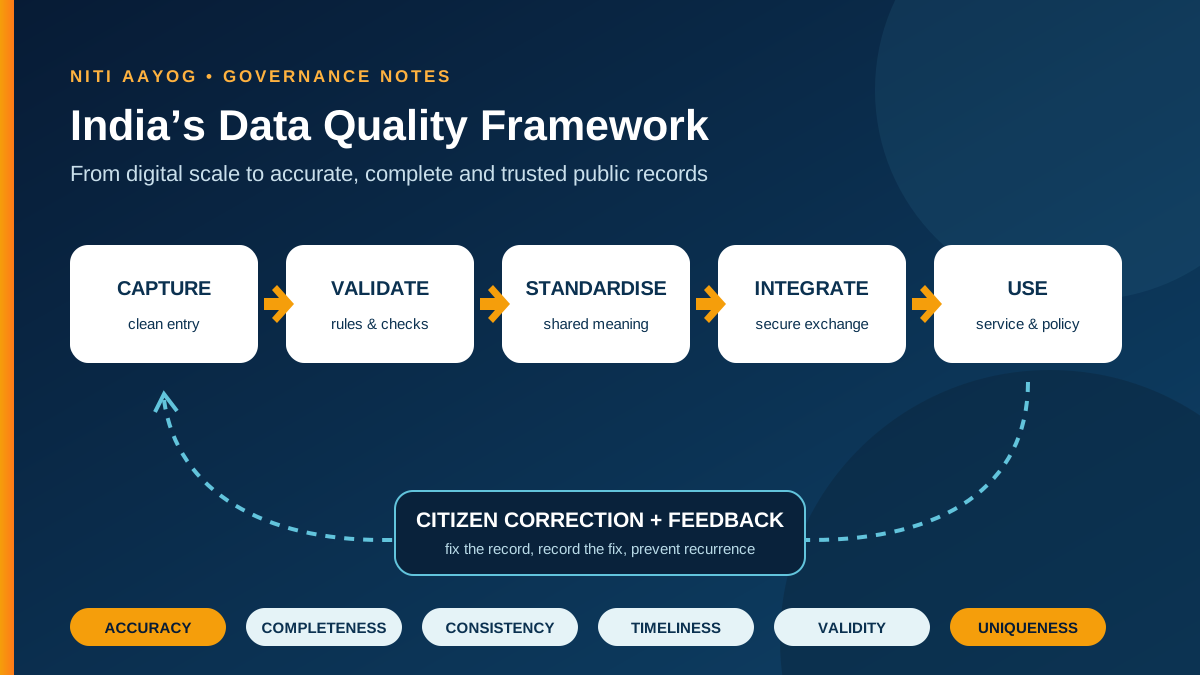
Why is India’s data quality framework in the news?
NITI Aayog released the third issue of its Future Front: Quarterly Frontier Tech Insights series on 24 June 2025. Prepared with knowledge partner Gramener, the report examines data-quality failures across the public-sector data value chain and offers two practical tools:
- a Data Quality Scorecard to measure the current health of a dataset; and
- a Data Quality Maturity Framework to assess whether an institution can maintain quality over time.
The report’s message is simple: India has built digital rails such as identity, payments and public registries; it must now improve the fidelity of the data moving through those rails. This is directly connected to the wider debate on India’s Digital Public Infrastructure strategy.
Why does data quality matter for governance?
Public decisions increasingly depend on databases. Governments use them to identify beneficiaries, plan schools and hospitals, transfer subsidies, issue documents and measure outcomes. If the input is unreliable, even a well-designed programme can produce exclusion, leakage or misleading evidence.
| Data problem | Example | Governance consequence |
|---|---|---|
| Wrong value | An incorrect bank-account or identity field | A legitimate benefit may fail or reach the wrong person |
| Missing field | No contact, location or eligibility detail | The record cannot trigger a service or follow-up |
| Duplicate record | One person or household appears more than once | Counts and expenditure may be inflated |
| Stale record | A death, migration or change in eligibility is not updated | Policy and delivery continue on an outdated assumption |
| Incompatible format | Departments use different codes for the same district | Datasets cannot be joined reliably |
NITI Aayog identifies three broad costs: fiscal leakage, policy blind spots and erosion of public trust. Its report estimates that erroneous or duplicate beneficiary records can drain welfare budgets by 4–7 per cent annually. The exact effect varies by scheme, so the figure should be read as the report’s system-wide estimate rather than a loss rate for every programme.
Six attributes of high-quality data
The framework converts the vague instruction to “improve data” into six attributes that can be measured.
| Attribute | Meaning | Useful test |
|---|---|---|
| Accuracy | The value matches a trusted real-world source | Does the verified account, address or code match? |
| Completeness | Required fields and records are present | What percentage of mandatory fields is blank? |
| Consistency | The same entity has compatible values across systems | Do age, name and district agree across records? |
| Timeliness | The record is updated quickly enough for its intended use | How long is the lag between approval and registry update? |
| Validity | The value follows defined format, range and logic rules | Is the date possible and does the PIN code exist? |
| Uniqueness | One real-world entity is represented once | What share of records are probable duplicates? |
These attributes must be judged against the purpose of a dataset. A yearly update may be timely for one planning exercise but dangerously stale for a real-time payment or emergency-health system.
Data Quality Scorecard: making failure visible
The proposed scorecard assigns each attribute an indicator, target, current result, owner and review cycle. For example, a programme may require at least 98 per cent of beneficiary bank records to pass verification, less than 1 per cent duplication, and registry updates within three days.
A useful scorecard should answer five questions:
- What is being measured? The indicator must be precise and reproducible.
- What is the target? Teams need a threshold, not an abstract aspiration.
- Who owns the correction? Every red indicator needs a named steward.
- When will it be reviewed? Quality decays when monitoring is irregular.
- Can citizens correct an error? Feedback should change the underlying record, not only close a complaint ticket.
The scorecard is not intended to punish field staff. It can reveal whether repeated mistakes come from poor forms, unrealistic targets, weak training, absent reference data or incompatible systems.
Data Quality Maturity Framework
A clean-up drive can temporarily improve a database. The maturity framework asks whether the organisation has made quality routine. NITI Aayog describes a progression from foundational to institutionalised practice across seven dimensions.
- Governance and ownership: named custodians with clear authority and budgets.
- Standards and metadata: shared definitions, formats and maintained data dictionaries.
- Capture and validation: mandatory fields, logic checks, reference checks and duplicate detection.
- Monitoring and reporting: dashboards that track error, missingness and update lag.
- Correction and feedback: traceable workflows, grievance redress and audit trails.
- Interoperability and integration: common identifiers, schemas and controlled APIs.
- Culture and capacity: training and incentives that treat quality as programme performance.
This is a self-assessment tool, not a national ranking. A department can use it to identify its current level and create a funded, time-bound plan for improvement.
NITI Aayog’s three practical pathways
1. Fix it at the source
Prevent errors during entry through format checks, drop-down lists, mandatory fields and validation against trusted reference data. Departments should also deduplicate registries and maintain a basic data dictionary explaining each field, accepted format and update rule.
2. Keep it clean
Use frequent sample-based audits, assign a steward for every high-value dataset and connect citizen grievances to back-end correction. The report suggests that even a monthly review of 5–10 per cent of recent entries can expose recurring problems before they spread.
3. Make it matter
Dashboards should display quality indicators—not only enrolments and outputs. Reviews and incentives should recognise accurate work, while short campaigns can clear old backlogs. The larger aim is to reward both speed and fidelity.
Interoperability: clean data must also work together
Two individually accurate datasets may still fail when they use different definitions, codes or identifiers. Interoperability requires common schemas, reference codes, metadata and secure interfaces. NITI Aayog points to tools such as the India Enterprise Architecture, data-governance standards, DigiLocker and consent-driven data flows as building blocks.
Interoperability does not mean unrestricted data sharing. Access must be lawful, necessary, purpose-bound and controlled. LearnPro’s explainer on the DPDP Act and India’s data-governance framework covers the privacy side of this relationship.
Data quality, privacy and cyber security are different
| Concept | Central question | Why it is not enough alone |
|---|---|---|
| Data quality | Is the record fit for its intended use? | Accurate data can still be collected or used unlawfully |
| Privacy | Is personal data processed lawfully and for a defined purpose? | Lawfully held data can still be inaccurate |
| Cyber security | Is the system protected against unauthorised access, alteration and disruption? | A secure database may preserve the wrong information |
The Digital Personal Data Protection Act, 2023 and the notified DPDP Rules, 2025 create a phased legal framework for digital personal data. Data-quality programmes must operate within that framework. Correction, purpose limitation, security safeguards and grievance systems are therefore complementary parts of trustworthy governance.
Major implementation challenges
- Legacy systems: older databases may lack validation, version control and audit trails.
- Institutional silos: ministries and states may use conflicting formats and identifiers.
- Unclear ownership: errors remain unresolved when nobody has authority over the full lifecycle.
- Bad incentives: targets may reward forms submitted rather than correct records.
- Exclusion risk: automated deduplication or matching can wrongly remove genuine beneficiaries.
- Correction burden: citizens may face long queues to repair an error they did not create.
- AI amplification: models trained on incomplete or biased data can reproduce mistakes at scale.
The last risk also connects this issue to artificial intelligence in Indian governance. Better algorithms cannot compensate for undefined, stale or unrepresentative inputs.
Way forward for a trustworthy public data ecosystem
- Adopt quality-by-design: build validation and correction into the service rather than repairing records later.
- Name accountable stewards: assign ownership at national, state, district and programme levels.
- Publish data dictionaries: define every important field, code, source and update rule.
- Measure all six attributes: coverage alone must not be treated as success.
- Provide human redress: people need accessible, time-bound ways to inspect and correct records.
- Use proportionate safeguards: matching and deduplication should include confidence levels and review before harmful action.
- Build common standards: interoperable schemas should coexist with privacy, consent and access controls.
- Audit outcomes: measure whether improved data actually reduces exclusion, leakage and delay.
UPSC relevance
India’s data quality framework links GS Paper II topics—governance, transparency, welfare delivery and accountability—with GS Paper III topics such as Digital India, artificial intelligence, cyber security and technology infrastructure. It is also useful for essays on state capacity, evidence-based policy and trust in institutions.
Possible Mains question: “India’s digital-governance challenge is shifting from scale to fidelity.” Explain the importance of data quality and suggest safeguards against exclusion, privacy violations and institutional silos.
Conclusion
India’s digital platforms cannot be judged only by the number of users or transactions. The next stage of reform must ask whether records are correct, current, interoperable and open to correction. NITI Aayog’s framework provides a practical starting point: define quality, measure it, assign ownership, prevent errors at source and create feedback loops. Trustworthy data is not the final product of good governance; it is one of its essential inputs.
Frequently asked questions
What is India’s data quality framework?
It is a practical governance approach set out in NITI Aayog’s India’s Data Imperative report. It uses six quality attributes, a scorecard and a maturity framework to help public institutions prevent, measure and correct unreliable data.
What are the six attributes of high-quality data?
They are accuracy, completeness, consistency, timeliness, validity and uniqueness. Each attribute should be measured against the intended use of a dataset.
What is the difference between data quality and data privacy?
Data quality asks whether information is fit for use; privacy asks whether personal data is processed lawfully and for a legitimate purpose. Accurate data can still violate privacy, while lawfully collected data can still be wrong.
What is a Data Quality Scorecard?
It is a tracker that gives each quality attribute an indicator, target, current result, responsible owner and review cycle. It turns a general concern into measurable corrective work.
Why is data quality important for UPSC?
It connects governance, welfare delivery, accountability, Digital India, AI, privacy, cyber security and evidence-based policymaking across GS Papers II and III.
Official references
- NITI Aayog: India’s Data Imperative—The Pivot Towards Quality
- NITI Aayog release on the third Future Front issue
- MeitY: Digital Personal Data Protection Rules, 2025