The Digital Payments Intelligence Platform (DPIP) is being developed as a system-wide fraud-intelligence layer for India’s digital-payment ecosystem. Instead of each bank or payment provider seeing only its own fraud reports, DPIP is designed to let participating financial institutions contribute and use shared intelligence about suspicious accounts, devices and transaction patterns.
The Reserve Bank of India proposed the platform in June 2024 after noting that growing digital-payment fraud required network-level intelligence and real-time data sharing. RBI Innovation Hub (RBIH) now describes DPIP as a centralised intelligence-sharing platform and a national fraud-account repository for digital transactions. It is not a consumer payment app, and it does not replace a bank’s legal duty to protect customers or investigate disputed transactions.
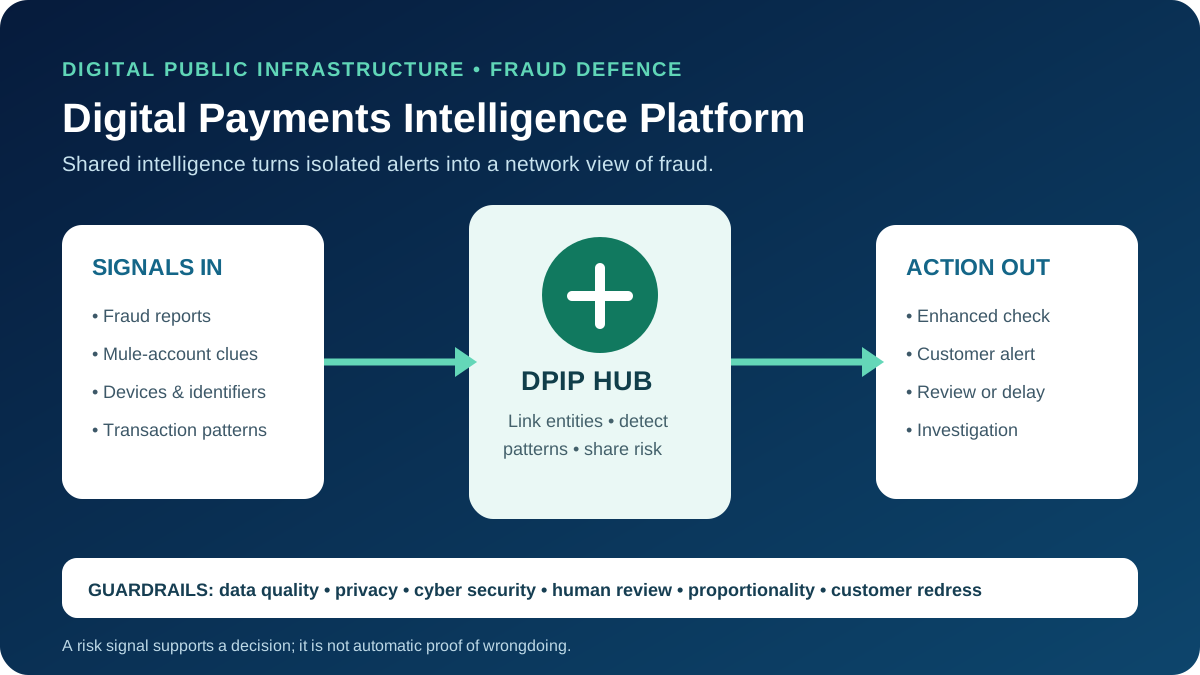
Why is a Digital Payments Intelligence Platform needed?
India’s payment systems process transactions across banks, UPI apps, wallets, card networks and other intermediaries. Fraudsters exploit this interconnected structure. A victim may use Bank A, the first beneficiary account may be in Bank B, and the money may then be split across several mule accounts in other institutions.
When every institution examines only its own data, the full pattern becomes visible too late. Common fraud methods include:
- Social engineering: a scammer persuades a customer to reveal credentials or authorise a payment.
- Mule accounts: bank accounts are rented, purchased or misused to receive and layer stolen money.
- Account takeover: stolen credentials, SIM manipulation or malware gives an attacker control.
- Remote-access scams: victims install screen-sharing or device-control software.
- Impersonation: fraudsters pose as police officers, bank staff, relatives, merchants or government agencies.
- Rapid layering: funds move through many accounts immediately after the first transfer.
Traditional controls remain essential, but a networked fraud requires networked defence. One institution’s confirmed fraud report can become an early warning for others.
How did DPIP evolve?
| Stage | Development | Significance |
|---|---|---|
| June 2024 | RBI proposed a Digital Payments Intelligence Platform for network-level intelligence and real-time data sharing. | Recognised that institution-specific fraud systems were insufficient. |
| Expert review | RBI constituted a committee under former NPCI chief executive A. P. Hota to examine the platform’s design. | Brought payment-system, banking and technology expertise into the architecture. |
| RBIH development | RBI Innovation Hub developed the platform and published project documentation. | Moved DPIP from a policy proposal towards a shared operational infrastructure. |
| Phased use | Participating institutions can contribute fraud intelligence and integrate platform outputs into their own risk controls. | Value increases as data quality, institutional coverage and feedback improve. |
The precise onboarding schedule and production controls should be taken from current RBI/RBIH communications rather than assumed. DPIP’s public project description establishes its architecture and purpose; it does not mean every payment in India is already screened by a single automatic blocking engine.
How can DPIP work?
- Fraud signal: a bank or payment institution identifies a suspicious or confirmed fraudulent account or transaction.
- Standardised report: relevant indicators are sent to the shared platform under defined rules.
- Entity linking: the platform connects common accounts, devices, phone numbers, identifiers or transaction paths.
- Network intelligence: analytics identify patterns that may not be visible within one institution.
- Risk output: participating institutions receive warnings, repository matches or risk information.
- Institutional action: the regulated entity applies proportionate controls—enhanced verification, delay, alert, review, freeze request or investigation—as permitted by law and policy.
- Feedback: confirmed outcomes improve future detection and reduce repeated false alarms.
The platform’s main value is collective memory. If one bank learns that an account is being used to receive scam proceeds, the information should not remain trapped inside that bank while the same account targets customers elsewhere.
DPIP versus existing fraud controls
| Control | Primary role | How DPIP complements it |
|---|---|---|
| Bank transaction monitoring | Detect unusual behaviour within one institution | Adds external network intelligence and cross-institution matches |
| KYC and customer due diligence | Verify identity and assess customer risk | Helps reveal when a verified identity or account is later used as a mule |
| NPCI/payment-network controls | Secure specific payment rails and enforce operating rules | Connects broader fraud intelligence across participating entities |
| Financial Fraud Risk Indicator | Shares telecom-linked fraud risk signals | Can enrich payment-side analysis with other ecosystem indicators |
| MuleHunter.AI | Supports detection of suspected mule bank accounts | Provides a specialised analytical capability within the wider anti-fraud ecosystem |
| 1930 cyber-fraud helpline | Receives citizen reports and supports rapid fund interception | Reported outcomes can help strengthen institutional intelligence |
LearnPro’s explainer on the Financial Fraud Risk Indicator and MuleHunter shows how telecom, banking and artificial-intelligence tools can complement one another.
Why is DPIP a form of digital public infrastructure?
Digital public infrastructure (DPI) consists of shared, interoperable systems that allow many public and private actors to deliver services. DPIP can be understood as a protective layer for India’s payment DPI because it:
- creates a common intelligence utility rather than a separate closed system for each bank;
- uses shared standards and interfaces for participating institutions;
- supports public goals—trust, safety and financial inclusion—across competing providers;
- can improve as more verified signals and outcomes are contributed; and
- separates the common intelligence layer from each institution’s final customer decision.
Calling it DPI does not remove the need for governance. A central repository of sensitive fraud signals can create serious consequences if data are inaccurate, over-retained or misused.
Benefits of the Digital Payments Intelligence Platform
- Earlier detection: repeated beneficiary accounts or devices can be recognised before losses spread.
- Faster response: shared data can reduce time lost in institution-to-institution communication.
- Mule-network discovery: graph analysis can reveal clusters, layering and common controllers.
- Lower duplication: institutions need not independently rediscover every known fraud pattern.
- Adaptive intelligence: confirmed cases can improve rules and models across the network.
- Consumer trust: fewer successful scams can strengthen confidence in digital payments.
- Systemic view: regulators can identify emerging fraud typologies and concentrated vulnerabilities.
Risks and governance safeguards
1. Privacy and purpose limitation
Only data necessary for fraud prevention should be collected. Use must be limited to defined purposes, with access control, encryption, logging, retention limits and deletion rules consistent with applicable banking law and the Digital Personal Data Protection framework.
2. False positives
A risk flag is not proof of guilt. Students, gig workers, small merchants or new-to-bank customers can display unusual patterns without committing fraud. High-impact action should include human review and proportionate verification.
3. Explainability and redress
If a legitimate account is restricted, the customer needs a clear complaint channel, time-bound review and correction of inaccurate data. A secret score without redress can create financial exclusion.
4. Data quality
Incorrect reports can contaminate a shared repository. Institutions need common definitions for suspected, attempted and confirmed fraud, along with confidence levels and outcome feedback.
5. Cybersecurity
A national fraud repository is itself a high-value target. Segmentation, zero-trust access, independent audits, breach response, resilience testing and strict vendor management are essential.
6. Accountability
RBI/RBIH may operate shared infrastructure, but participating regulated entities remain responsible for customer treatment, fraud reporting, legal compliance and reasoned decisions. Algorithmic output cannot erase institutional duty.
What should a customer do after a digital-payment fraud?
- Call 1930 immediately and submit a report on the National Cyber Crime Reporting Portal.
- Notify the bank or payment provider through its official channel and record the complaint number.
- Block compromised access by changing credentials and contacting the telecom provider if the SIM is affected.
- Preserve evidence such as transaction IDs, messages, phone numbers, screenshots and account details.
- Do not send another payment to anyone claiming that a fee is required to recover the first loss.
RBI’s customer-liability rules make prompt reporting important. DPIP is a back-end preventive system; it does not replace the customer’s need to report quickly.
UPSC relevance
The Digital Payments Intelligence Platform connects GS Paper III themes: digital public infrastructure, financial inclusion, cyber security, artificial intelligence, banking regulation and consumer protection. It also raises GS Paper II questions about privacy, due process and institutional accountability.
Possible Mains question: “Network-level intelligence can reduce digital-payment fraud, but centralised risk data can also create privacy and exclusion risks. Evaluate the design principles required for DPIP.”
Conclusion
DPIP responds to a simple weakness in digital finance: fraud travels across institutions faster than isolated warnings. A shared intelligence platform can detect mule networks and repeated signals earlier, but its legitimacy depends on accurate data, proportionate action, privacy safeguards, cyber resilience and accessible redress. The correct objective is not to block more transactions; it is to prevent more fraud while allowing legitimate payments to remain fast and inclusive.
Frequently asked questions
What is the Digital Payments Intelligence Platform?
DPIP is a centralised intelligence-sharing platform developed through RBI Innovation Hub to help participating financial institutions report and use shared digital-payment fraud intelligence.
Is DPIP a payment app for customers?
No. It is back-end infrastructure for fraud intelligence. Customers continue to use their normal bank or payment apps.
Does DPIP automatically prove that an account is fraudulent?
No. A platform signal or risk flag must be assessed under defined rules. Institutions need proportionate action, human review and customer redress to manage false positives.
How is DPIP different from a bank’s fraud system?
A bank’s system mainly sees that bank’s own customers and transactions. DPIP is intended to add shared, cross-institution intelligence and a wider view of fraud networks.
What number should a victim call after cyber financial fraud?
Call the national cyber-fraud helpline 1930 immediately, notify the bank or payment provider and file a report through the National Cyber Crime Reporting Portal.
Official references
- RBI Innovation Hub: Digital Payments Intelligence Platform
- RBIH documentation: DPIP
- RBI: June 2024 developmental and regulatory policy statement