
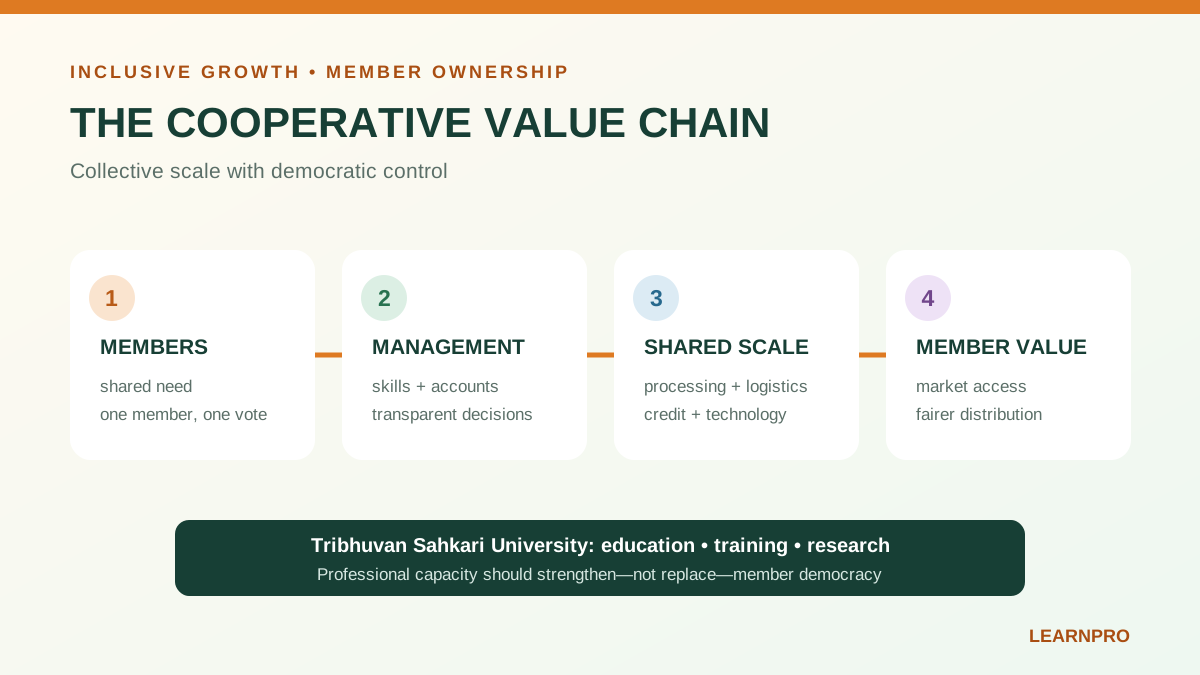
Cooperatives in India allow producers, workers, consumers and users of a service to own an enterprise collectively and govern it democratically. They are especially useful where individuals have little bargaining power but can achieve scale by pooling procurement, processing, credit, marketing or infrastructure.
The establishment of Tribhuvan Sahkari University (TSU) in Anand, Gujarat, brought renewed attention to the need for professional management in the cooperative sector. Parliament enacted the Tribhuvan Sahkari University Act in April 2025 and declared the university an institution of national importance. Its purpose is not merely to award degrees: it is intended to build skills, research and institutional capacity for cooperatives across India.
What is a cooperative?
A cooperative is an autonomous association of persons who voluntarily unite to meet common economic, social or cultural needs through a jointly owned and democratically controlled enterprise. Unlike an investor-owned company, control usually follows the principle of one member, one vote, subject to the applicable law and by-laws.
| Feature | Cooperative model | Investor-owned company |
|---|---|---|
| Primary purpose | Member service and shared benefit | Return on invested capital |
| Control | Democratic member control | Generally linked to shareholding |
| Surplus | Reserves, member benefit or patronage-based distribution | Dividend or retained profit |
| Strength | Aggregates many small participants | Can mobilise concentrated capital quickly |
| Typical risk | Weak participation or political capture | Market concentration or shareholder dominance |
Why are cooperatives called an economic backbone?
Cooperatives connect economic activity with social organisation. They can convert a dispersed group of farmers, artisans, borrowers or consumers into a negotiating unit. Official government communication in 2025 referred to approximately 8.42 lakh cooperative societies in India and a very large membership base.
- Agriculture: dairy, sugar, fertiliser, seed, storage and marketing cooperatives can reduce transaction costs and improve price discovery.
- Credit: cooperative banks and credit societies serve households and small enterprises, including areas where commercial banking may have limited reach.
- Housing: members pool land, finance and maintenance responsibilities.
- Fisheries and forests: collective management can improve access to equipment, processing, transport and markets.
- Women’s economic participation: member-owned institutions can formalise savings, production and market linkages.
- Consumer welfare: consumer cooperatives can aggregate demand and supply essential goods.
Cooperatives are not identical to micro, small and medium enterprises, although they may operate businesses of similar scale. Read LearnPro’s separate guide to cooperatives and MSMEs in India for a direct comparison.
Constitutional and legal framework
The 97th Constitutional Amendment added the words “co-operative societies” to Article 19(1)(c), inserted Article 43B as a Directive Principle and introduced Part IXB. Article 43B asks the State to promote voluntary formation, autonomous functioning, democratic control and professional management of cooperative societies.
In Union of India v. Rajendra N. Shah (2021), the Supreme Court held that the amendment’s application to cooperatives operating only within a state required ratification by at least half the states and was invalid for want of that ratification. The provisions continued to operate for multi-state cooperative societies. This reflects India’s federal structure: state cooperatives generally fall within the states’ legislative field, while Parliament regulates multi-state cooperatives.
Major legal categories include:
- state cooperative societies governed by the relevant state Act;
- multi-state cooperative societies governed by the Multi-State Co-operative Societies Act, 2002;
- cooperative banks subject to cooperative law and applicable banking regulation; and
- sector-specific institutions working under additional regulatory frameworks.
Tribhuvan Sahkari University: legal status and purpose
The Tribhuvan Sahkari University Act, 2025 converted the Institute of Rural Management Anand into a university structure and made it one of the university’s schools. The Act came into force on 5 April 2025. It names the university after Tribhuvandas Kishibhai Patel, a major figure in India’s dairy cooperative movement.
| Element | Provision or significance |
|---|---|
| Status | Institution of national importance |
| Location | Anand, Gujarat |
| Core mandate | Technical and management education, training, research and development for the cooperative sector |
| Network function | Affiliation and recognition of institutions can extend training beyond a single campus |
| Governance bodies | Includes governing, academic, capacity-building, research and assessment institutions under the Act |
| Public accountability | Annual report and accounts; the university and IRMA School are public authorities under the RTI Act |
A cooperative university can address a persistent gap: many societies are created with a sound social objective but lack professionals in accounting, risk management, supply chains, digital systems, law and member communication. Training should therefore reach elected directors, employees and ordinary members, not only full-time students.
Major weaknesses in India’s cooperative sector
1. Dormant membership
Democratic design works only when members receive information, attend meetings and question management. A formal annual general meeting cannot substitute for continuous participation.
2. Political and elite capture
Local power groups may dominate elections, credit decisions or procurement. External control can also reduce autonomy. Clear eligibility rules, secret ballots where required, conflict-of-interest disclosure and independent audits are essential.
3. Weak professional capacity
Some societies lack reliable accounts, market analysis, technology systems and risk controls. Professionalisation must support democracy rather than displace members.
4. Uneven regulation
Cooperatives sit at the intersection of state law, central law, sector regulation and federalism. Overlapping supervision can create gaps or compliance burdens. The remedy is clear institutional responsibility and interoperable records.
5. Capital constraints
Member ownership protects democratic control, but raising long-term capital can be difficult. Solutions must avoid turning external investors into de facto controllers.
How can cooperatives become more competitive?
- Digitise records: maintain accurate member registers, accounts, inventories and voting records with privacy and audit safeguards.
- Professionalise boards: require continuing education in finance, law, markets and risk without weakening elected control.
- Strengthen member voice: provide simple disclosures in local languages and accessible grievance channels.
- Build federations: pool branding, testing, storage, logistics and e-commerce while retaining local ownership.
- Use outcome-based support: link public assistance to active membership, timely audits, inclusion and business performance.
- Protect autonomy: keep legitimate supervision proportionate and prevent arbitrary interference.
- Include ecological safeguards: resource-based cooperatives should respect carrying capacity and community rights. See the linked analysis of Community Forest Resource Rights and Gram Sabha powers.
UPSC and State PSC relevance
Cooperatives in India are relevant to GS Paper II under constitutional bodies, federalism and governance; GS Paper III under agriculture, inclusive growth and rural development; and GS Paper IV under democratic accountability and conflict of interest.
Mains practice question: Professional management and democratic member control must advance together if cooperatives are to support inclusive growth. Discuss with reference to recent institutional reforms.
Conclusion
Cooperatives become an economic backbone when members genuinely own decisions and professional systems convert collective strength into reliable services. Tribhuvan Sahkari University can help close the capacity gap, but education must be paired with transparent elections, audits, member participation and competitive business models.
Frequently asked questions
What is a cooperative society?
It is a member-owned and democratically controlled organisation formed to meet shared economic, social or cultural needs.
What is Tribhuvan Sahkari University?
It is an institution of national importance in Anand created by a 2025 central Act for cooperative education, training, research and capacity building.
What does Article 43B provide?
It directs the State to promote voluntary formation, autonomous functioning, democratic control and professional management of cooperatives.
Who regulates multi-state cooperative societies?
They are governed by central law, principally the Multi-State Co-operative Societies Act, 2002, while state cooperatives are generally governed by state legislation.
Why do cooperatives need professional management?
They need reliable accounting, technology, market, compliance and risk skills to convert member ownership into sustainable economic results.
Primary and authoritative references
- India Code: Tribhuvan Sahkari University Act, 2025
- Ministry of Cooperation, Government of India
- Supreme Court: Union of India v. Rajendra N. Shah, 2021





Sources and further reading
- India Code: Tribhuvan Sahkari University Act, 2025indiacode.nic.in
- Ministry of Cooperation, Government of Indiacooperation.gov.in
- Supreme Court: Union of India v. Rajendra N. Shah, 2021main.sci.gov.in