
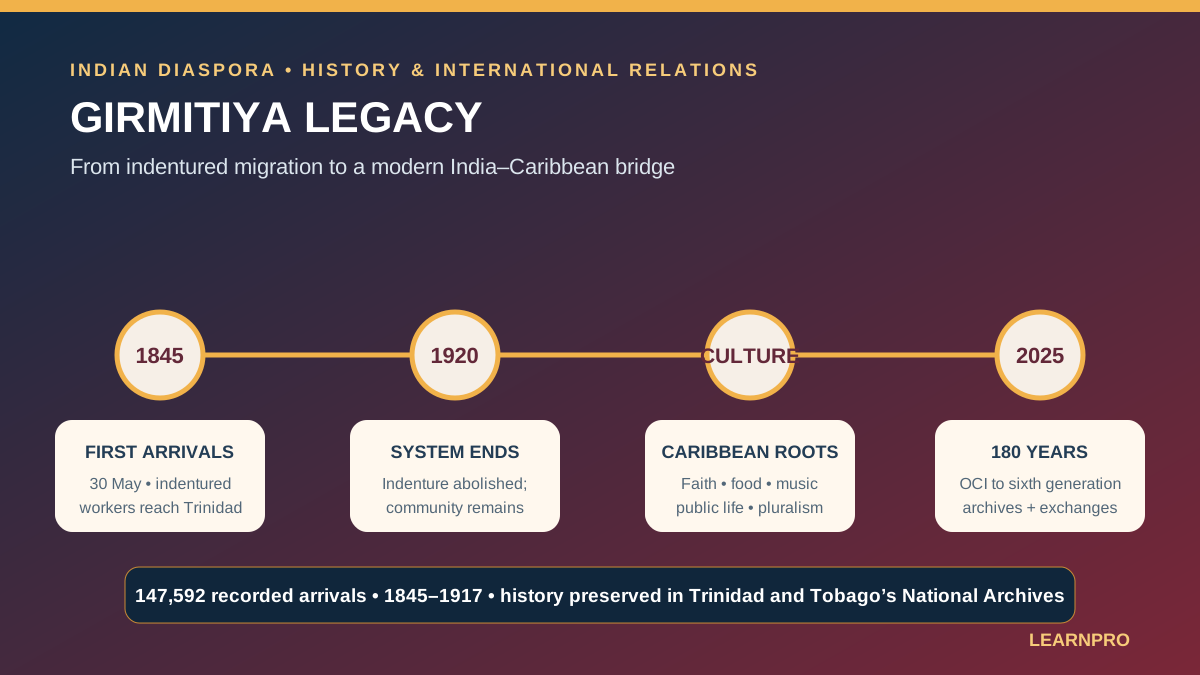
Indian diaspora in Trinidad and Tobago is the result of a long historical journey that began with indentured migration under British colonial rule. On 30 May 1845, the first group of Indian indentured workers reached Trinidad. Their descendants are now an integral part of the country’s politics, economy, literature, religion, food and music.
The subject became especially important in July 2025, when an Indian Prime Minister made the first bilateral visit to Trinidad and Tobago in 26 years. The visit marked 180 years since the first Indian arrivals and linked historical memory with modern diaspora diplomacy.
Key facts at a glance
| Theme | Key point |
|---|---|
| First arrival | 30 May 1845 |
| Indenture period | 1845–1917; the system was abolished in 1920 |
| Recorded arrivals | 147,592 Indian labourers, according to Trinidad and Tobago’s National Archives |
| Main work | Sugar plantations, with records also covering cocoa and coconut estates |
| 2025 milestone | 180th anniversary of the first arrivals |
| Recent policy | India announced OCI eligibility up to the sixth generation of the community |
What was the indenture system?
After the abolition of slavery created a labour shortage in Britain’s Caribbean colonies, colonial authorities recruited workers from India under fixed-term contracts. The word girmitiya came from the Indian pronunciation of “agreement”, the contract under which a worker travelled and laboured overseas.
Indenture was legally different from slavery, but it operated within a deeply unequal colonial system. Workers faced restricted movement, plantation discipline, poor living conditions and weak bargaining power. A normal contract lasted five years, after which a person might re-indenture, return to India or settle in Trinidad.
Trinidad and Tobago’s National Archives records that 147,592 Indian labourers arrived between 1845 and 1917. Most came from northern Indian regions then described as the North-Western Provinces, Oudh, Bihar and Bengal; a smaller number came from the Madras Presidency. The majority eventually made Trinidad their home.
Timeline of the Girmitiya experience
| Year | Development | Significance |
|---|---|---|
| 1845 | First indentured Indians arrived on 30 May | Beginning of a permanent Indo-Trinidadian community |
| 1917 | Recruitment and shipping of indentured labour ended; the last ship arrived | End of organised migration under indenture |
| 1920 | Indenture system was abolished | Formal closure of the colonial labour institution |
| 2025 | 180th anniversary and high-level bilateral visit | Heritage became a platform for modern cooperation |
How the community preserved its identity
Migration did not reproduce Indian society unchanged. Traditions were adapted to a Caribbean environment and mixed with African, European, Chinese and indigenous influences. This created a distinct Indo-Caribbean identity.
- Religion: Hindu and Muslim institutions, temples, mosques, festivals and community organisations became important anchors.
- Language: Bhojpuri and other Indian languages influenced local speech, songs and ritual vocabulary, while English became dominant.
- Festivals: Divali and Hosay became major elements of national culture rather than private community observances alone.
- Music: tassa drumming, chutney and chutney-soca demonstrate cultural fusion.
- Food: roti, doubles and other Indo-Trinidadian foods developed through local ingredients and Caribbean tastes.
- Public life: descendants of indentured migrants have contributed to education, business, administration, arts and national politics.
Why Nelson Island and archival records matter
New arrivals were once processed or quarantined at Nelson Island. The site therefore carries both family memory and the history of colonial labour control. The 2025 India–Trinidad and Tobago joint statement recognised its potential for cultural tourism.
The National Archives holds 17 general registers covering 298 ships. Entries can include a worker’s name, age, sex, father’s name, assigned estate and, in later volumes, caste and village of origin. Digitising these records can help descendants trace families while protecting fragile documents. It also turns diaspora policy from symbolism into verifiable historical research.
What changed during the 2025 visit?
Prime Minister Narendra Modi visited Trinidad and Tobago on 3–4 July 2025. It was the first bilateral visit by an Indian Prime Minister since 1999. The two governments announced or advanced cooperation in culture, education, health, digital public infrastructure, sports and people-to-people links.
Measures directly connected with the diaspora included:
- OCI cards up to the sixth generation of the Indian diaspora in Trinidad and Tobago;
- renewal of the bilateral Programme of Cultural Exchanges for 2025–28;
- digitisation of Indian arrival and other records at the National Archives;
- support for cultural tourism associated with Nelson Island;
- revival of academic chairs in Hindi and Indian Studies at the University of the West Indies;
- Indian yoga trainers and support for including yoga in the national school curriculum;
- training for a group of Trinidad and Tobago pundits in India; and
- sports cooperation, including an offer to train aspiring women cricketers.
OCI card: connection, not dual citizenship
The phrase “Overseas Citizenship of India” can be misleading. An OCI cardholder remains a foreign national; OCI is not Indian citizenship and does not provide an Indian passport. Cardholders receive a lifelong multiple-entry visa and specified economic and educational benefits, but important political restrictions remain.
| OCI generally provides | OCI does not provide |
|---|---|
| Lifelong multiple-entry visa and exemption from registration for extended stay | Voting rights or membership of Parliament or a State legislature |
| Specified parity with NRIs in notified fields | Eligibility for constitutional offices or ordinary public services |
| A durable legal link with India | Right to buy agricultural, plantation or farmhouse property |
Extending eligibility to the sixth generation is therefore best understood as a tool of heritage connection and long-term mobility, not as the creation of dual nationality.
Role of the diaspora in India’s foreign policy
A diaspora can support relations through knowledge, investment, tourism, education and cultural familiarity. But people should not be treated merely as instruments of the ancestral state. Indo-Trinidadians are citizens of Trinidad and Tobago with a Caribbean identity of their own.
Effective diaspora diplomacy should therefore be based on consent and mutual benefit:
- protect memory through archives, museums and research;
- make consular access clear without overstating OCI rights;
- support two-way exchange rather than one-directional cultural projection;
- connect skills and institutions in health, education, sport and digital technology; and
- respect plural identities within Trinidad and Tobago’s multi-ethnic democracy.
For the wider diplomatic context, see LearnPro’s analysis of India–Ghana relations and Global South cooperation and the United Nations at 80.
Challenges that remain
- Incomplete records: names were often misspelled or anglicised, and some registers have gaps.
- Generational distance: ancestral connection becomes harder to document over five or six generations.
- Romanticising indenture: celebrating cultural survival must not erase coercion and exploitation.
- Identity politics: heritage policy should strengthen pluralism, not create ethnic competition.
- Implementation: archival digitisation, academic chairs and exchange programmes require budgets, standards and continuity.
UPSC and State PSC relevance
Indian diaspora in Trinidad and Tobago is relevant to GS Paper I under colonialism and Indian society, and GS Paper II under diaspora policy and international relations. A strong answer should connect indentured labour history with contemporary soft power while clearly distinguishing OCI from citizenship.
Mains practice question: The Girmitiya diaspora is both a record of colonial exploitation and a bridge in India’s contemporary foreign relations. Discuss with reference to Trinidad and Tobago.
Conclusion
The Indo-Trinidadian story is not simply an overseas extension of India. It is a Caribbean history shaped by migration, hardship, adaptation and citizenship. The most credible form of diaspora engagement is one that preserves records, explains legal rights honestly and builds equal partnerships. Memory becomes diplomatic strength only when it is matched by scholarship and mutual respect.
Frequently asked questions
When did Indians first arrive in Trinidad and Tobago?
The first indentured Indian workers arrived in Trinidad on 30 May 1845. The date is commemorated as Indian Arrival Day.
How many indentured Indians came to Trinidad?
Trinidad and Tobago’s National Archives records 147,592 Indian labourers arriving between 1845 and 1917.
What does Girmitiya mean?
Girmitiya refers to an indentured worker recruited under an “agreement”, pronounced as girmit in Indian usage.
Does an OCI card give Indian citizenship?
No. An OCI cardholder is a foreign national. OCI provides specified travel and other benefits but not voting rights, an Indian passport or full citizenship.
What was announced for the diaspora in 2025?
India announced OCI eligibility up to the sixth generation and supported archival digitisation, cultural exchanges, academic links, yoga education and sports cooperation.
Primary references and official records
- National Archives of Trinidad and Tobago: Girmitiya arrivals and records
- National Archives: General Registers of Indian Indentureship, 1845–1917
- India–Trinidad and Tobago joint statement, July 2025
- Prime Minister of India: address to the Indian community
- Government of India: official OCI frequently asked questions
- Ministry of External Affairs: Pravasi Bharatiya Divas




Sources and further reading
- National Archives of Trinidad and Tobago: Girmitiya arrivals and recordsnatt.gov.tt
- National Archives: General Registers of Indian Indentureship, 1845–1917natt.gov.tt
- India–Trinidad and Tobago joint statement, July 2025pmindia.gov.in
- Prime Minister of India: address to the Indian communitypmindia.gov.in
- Government of India: official OCI frequently asked questionsociservices.gov.in