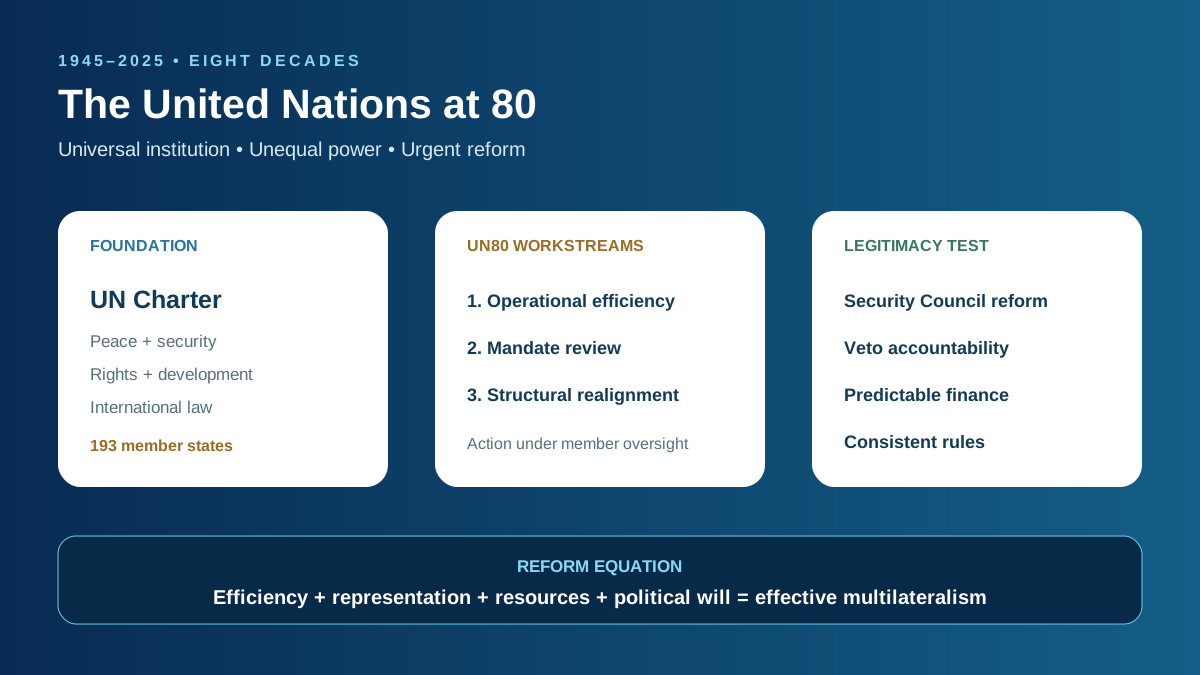
The United Nations at 80 is both an institutional achievement and a warning. The UN Charter was signed on 26 June 1945 and entered into force on 24 October 1945. Eight decades later, the organisation has 193 members, a universal legal Charter and an unmatched network for peace, development, humanitarian action and human rights. Yet its core political machinery still reflects the power distribution of 1945.
The anniversary produced the UN80 Initiative, launched in March 2025 to improve efficiency, review mandates and consider structural realignment. By May 2026, the Secretary-General described reform as entering a decisive phase. Administrative savings are necessary, but the central test remains political: can member states make the UN more representative and effective without weakening its universal character?
How was the United Nations created?
Delegates at the San Francisco Conference unanimously adopted the Charter on 25 June 1945 and representatives of 50 countries signed it the next day. Poland signed later and became one of the 51 original members. India, then under colonial rule but with separate international representation, was an original signatory and founding member.
The Charter came into force only after ratification by China, France, the Soviet Union, the United Kingdom, the United States and a majority of the other signatories. That condition was met on 24 October 1945, now observed as United Nations Day.
Purposes and principles of the Charter
Article 1 identifies four broad purposes:
- maintain international peace and security;
- develop friendly relations among nations based on equal rights and self-determination;
- achieve international cooperation on economic, social, cultural, humanitarian and human-rights problems; and
- serve as a centre for harmonising the actions of nations.
Article 2 includes sovereign equality, good-faith performance of obligations, peaceful settlement of disputes, restraint from the threat or use of force and non-intervention in matters essentially within domestic jurisdiction, subject to the Charter’s enforcement framework.
The six principal organs
| Organ | Core role | Key limitation or feature |
|---|---|---|
| General Assembly | Universal deliberation, budget and standard-setting | Most resolutions are recommendatory |
| Security Council | Primary responsibility for international peace and security | Five permanent members hold veto power |
| ECOSOC | Coordinates economic, social and development work | Large and fragmented UN development system |
| International Court of Justice | Settles interstate disputes and gives advisory opinions | Contentious jurisdiction generally depends on state consent |
| Secretariat | Implements mandates under the Secretary-General | Depends on member-state mandates and finance |
| Trusteeship Council | Supervised trust territories | Suspended regular operations in 1994 after the last trust territory became independent |
What has the UN achieved?
Decolonisation and universal membership
The UN supplied a legal and political forum for self-determination as colonial empires dissolved. Universal membership gives small states a formal voice and a platform that bilateral power politics cannot provide.
International law and common standards
The UN system helped develop treaties and norms covering human rights, refugees, oceans, diplomatic relations, disarmament, climate, trade and international crimes. Compliance is uneven, but shared legal language shapes state behaviour and accountability.
Peacekeeping and mediation
UN peace operations have monitored ceasefires, protected civilians, supported elections and helped states move out of conflict. Peacekeeping is not named explicitly in the Charter; it evolved pragmatically between peaceful settlement under Chapter VI and enforcement under Chapter VII.
Development and humanitarian coordination
The Sustainable Development Goals, humanitarian appeals, refugee protection, food assistance, health coordination and disaster response provide a common framework. UN agencies often remain where bilateral actors cannot operate impartially.
Why is the UN facing a legitimacy crisis?
- Veto paralysis: a permanent member can block Council action even during mass violence or a direct conflict involving itself or an ally.
- Representation deficit: Africa and Latin America have no permanent Council seats; Asia’s representation does not reflect contemporary population and economic weight.
- Selective enforcement: international rules appear weaker when great powers apply them differently across conflicts.
- Mandate overload: member states create new tasks without always retiring obsolete ones or providing adequate resources.
- Fragmentation: overlapping agencies, funding channels and reporting systems raise transaction costs.
- Financial vulnerability: delayed contributions and reliance on earmarked voluntary finance distort priorities.
- New governance gaps: cyber operations, artificial intelligence, autonomous weapons, pandemics and climate-linked insecurity move faster than intergovernmental negotiation.
What is the UN80 Initiative?
The Secretary-General launched UN80 in March 2025 around three workstreams:
- Efficiency and improvement: simplify administration, reduce duplication and redesign common services under existing authority.
- Mandate implementation review: examine how mandates are created, delivered and reviewed. The General Assembly established an open informal working group to consider proposals.
- Structural and programme realignment: consider changes across peace and security, development, humanitarian action and human rights.
The General Assembly welcomed the initiative by consensus in July 2025 while affirming that reform must remain member-state-led, inclusive and transparent. A May 2026 progress report argued that the status quo was untenable and separated proposals ready for decision from those requiring more design.
UN80 should not be confused with Security Council reform. The Secretary-General can reorganise management within delegated authority, but Charter-level changes and shifts in member-state power require intergovernmental agreement.
The deeper reform agenda
Security Council representation
Reform requires agreement on permanent and non-permanent categories, regional representation, veto arrangements, size and working methods. Article 108 makes Charter amendment difficult: it requires a two-thirds General Assembly vote and ratification by two-thirds of members, including all five permanent Council members.
Veto restraint and accountability
Even without abolishing the veto, states can support voluntary restraint in mass-atrocity situations, fuller explanations of vetoes and stronger General Assembly debate after a veto.
Mandate discipline
Every mandate should have a clear objective, lead entity, budget, review date and result indicator. Sunset or renewal clauses can prevent programmes from continuing only because closure is politically difficult.
Predictable finance
Members must pay assessed contributions on time. Flexible pooled funding can reduce donor-driven fragmentation, while transparent evaluation should protect frontline outcomes rather than administrative structures.
Networked multilateralism
The UN should work with regional organisations, development banks, scientific bodies, cities, civil society and responsible business. Cooperation must expand expertise without allowing unelected actors to replace member-state accountability.
India and UN reform
India’s case rests on its population, economy, democratic system, contribution to peacekeeping, development partnerships and role in the Global South. India works with Brazil, Germany and Japan in the G4 for Security Council reform and supports greater African representation.
India’s priorities should include:
- expansion in both permanent and elected Council membership;
- stronger voice for Africa and developing countries;
- counter-terrorism cooperation, including progress on a comprehensive convention;
- protection and resourcing of peacekeepers;
- digital public infrastructure and technology capacity for developing states;
- climate finance and reform of multilateral development institutions; and
- a rules-based system applied consistently to all powers.
India should combine its demand for status with proposals for institutional responsibility. Reform credibility depends on supporting international law, peaceful settlement, adequate UN financing and transparent multilateral decisions.
UPSC and State PSC relevance
The United Nations at 80 is relevant to GS Paper II international institutions, India’s foreign policy and global governance. For Prelims, remember the Charter dates, original membership and six principal organs. For Mains, distinguish administrative UN80 reform from Charter-based Security Council reform.
Mains practice question: The UN’s crisis at eighty is not a failure of multilateralism but a failure to adapt its authority, representation and resources to contemporary realities. Discuss.
Conclusion
The UN has not eliminated war, but no other body combines universal membership, legal authority, humanitarian reach and convening power. Its survival alone is not a sufficient measure of success. The next decade must produce more representative political authority, disciplined mandates, predictable finance and measurable delivery. A reformed UN remains preferable to a fragmented world governed only by rival power blocs.
Frequently asked questions
When was the UN Charter signed?
It was signed in San Francisco on 26 June 1945 and entered into force on 24 October 1945.
How many original UN members were there?
There were 51 original members: 50 states signed at San Francisco and Poland signed later.
What are the three UN80 workstreams?
Operational efficiency, review of mandate implementation, and structural or programme realignment across the UN system.
Can the Secretary-General reform the Security Council?
No. The Secretary-General can propose changes, but Council composition and Charter amendments require decisions and ratification by member states under the Charter.
Why does India seek a permanent Security Council seat?
India cites its population, economic and political weight, peacekeeping contribution, development role and the need for stronger Global South representation.
Primary references
- United Nations Charter
- United Nations at 80 official portal
- UN80 Initiative: official FAQ and workstreams
- UN80 progress report, May 2026