
Development finance reform became a central global issue at the Fourth International Conference on Financing for Development (FFD4), held in Sevilla, Spain, from 30 June to 3 July 2025. Governments adopted the Compromiso de Sevilla, or Sevilla Commitment, as the first intergovernmentally agreed financing-for-development framework since the 2015 Addis Ababa Action Agenda.
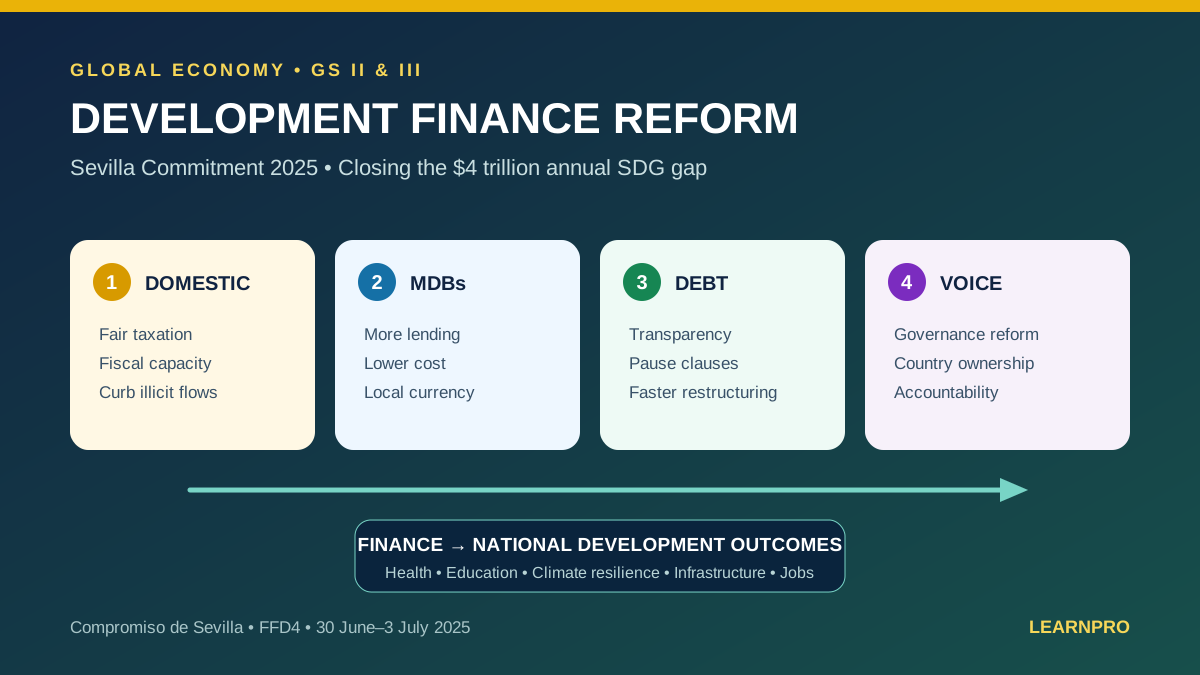
The problem is not simply a shortage of money. Developing countries face high borrowing costs, rising debt service, weak tax capacity, volatile private flows, climate shocks and limited influence in global financial institutions. The United Nations estimates an annual $4 trillion financing gap for the Sustainable Development Goals in developing countries. Reform must therefore change both the volume and the terms of finance.
What is financing for development?
Financing for development is broader than foreign aid. It includes domestic taxation, public budgets, private investment, international trade, official development assistance, multilateral development banks, sovereign borrowing, debt restructuring, remittances and climate finance. The objective is to mobilise resources while keeping development plans nationally owned and debt sustainable.
The UN process has developed through four main milestones:
| Conference | Year | Main contribution |
|---|---|---|
| Monterrey, Mexico | 2002 | Established a broad global compact on domestic resources, trade, aid, debt and systemic reform |
| Doha, Qatar | 2008 | Reviewed Monterrey amid the global financial crisis |
| Addis Ababa, Ethiopia | 2015 | Linked financing with the 2030 Agenda and the SDGs |
| Sevilla, Spain | 2025 | Focused on the investment gap, debt crisis and reform of global financial architecture |
Why was a new framework necessary?
- SDG gap: developing countries need trillions of dollars in additional annual investment.
- Debt pressure: many governments spend more on interest than on essential health or education.
- Cost of capital: poorer countries often borrow at much higher rates despite needing long-term infrastructure.
- Climate vulnerability: disasters destroy assets, reduce revenue and force emergency borrowing.
- Weak tax systems: informality, illicit flows and international profit shifting narrow the domestic resource base.
- Unequal voice: governance shares in international financial institutions do not adequately reflect the economic weight and needs of developing countries.
The challenge is closely related to the developing countries debt crisis. Debt can finance growth, but high interest costs and repeated refinancing can turn it into a barrier to development.
Three pillars of the Sevilla Commitment
The United Nations summarises the agreement around three connected tasks:
- catalyse investment at scale for sustainable development;
- address the debt and development crisis; and
- reform the international financial architecture.
These pillars recognise a sequencing problem. Private capital cannot replace public institutions in countries where projects are not prepared, currency risk is high and public services have little commercial return. Public finance, concessional lending and capacity building must create the conditions for productive investment.
Domestic public resources and tax cooperation
Domestic revenue is the most reliable long-term source of development finance because it strengthens accountability between citizens and the State. The Sevilla framework supports better tax administration, progressive systems, digital capacity and action against illicit financial flows. It includes a commitment by donors to double support for stronger fiscal systems by 2030 for countries seeking to raise tax-to-GDP ratios, especially toward at least 15%.
But more revenue must not mean regressive taxation of poor households. Reforms should widen direct-tax bases, improve property and environmental taxation, simplify compliance, strengthen customs and reduce exemptions that lack a clear public purpose. International tax cooperation is necessary because profit shifting cannot be solved by one country acting alone.
Multilateral development banks: more and better lending
Multilateral development banks (MDBs) can borrow cheaply, lend for long periods and support projects that private investors consider too risky. The Sevilla agenda calls for a potential tripling of annual MDB lending capacity while preserving financial sustainability. Methods include capital optimisation, additional shareholder support, rechannelled Special Drawing Rights and stronger risk-sharing.
Volume alone is not enough. Better MDB finance should provide:
- longer maturities and grace periods;
- lower fees and reduced borrowing costs;
- more local-currency finance to limit exchange-rate risk;
- climate-resilient debt clauses that pause payments after major shocks;
- simpler project preparation and procurement support; and
- greater developing-country voice in governance and project design.
A full-cycle approach to sovereign debt
Debt reform must operate before, during and after a crisis.
| Stage | Priority action |
|---|---|
| Before distress | Transparent borrowing, debt registries, prudent maturity and currency structure, and stronger public investment management |
| During shocks | Liquidity support, debt-pause clauses and rapid access to emergency finance |
| During restructuring | Timely, predictable and comparable treatment of official and private creditors |
| After restructuring | Growth-restoring investment rather than prolonged austerity that recreates distress |
The Sevilla Platform for Action translates parts of this agenda into voluntary initiatives. These include a Debt Swaps for Development Hub, a Debt Pause Clause Alliance and the Sevilla Forum on Debt, launched in October 2025 with support from UNCTAD and UN DESA. Such initiatives are useful only if they complement—not delay—actual restructuring when debt is unsustainable.
Private finance: useful but not free money
Private capital can finance renewable energy, transport, digital networks and productive enterprises. Blended finance may use limited public resources to reduce risks. However, public guarantees create contingent liabilities, and poorly designed public-private partnerships can hide future costs.
Every blended-finance project should disclose the subsidy, risk allocation, expected development impact and fiscal exposure. Social sectors such as primary health and basic education should not be judged only by commercial returns. The guiding question is additionality: did public support generate a development outcome that would otherwise not occur?
Climate finance and development finance cannot be separated
Climate shocks weaken budgets and increase debt, while clean infrastructure requires large initial investment. Development finance should therefore integrate resilience, adaptation and loss-and-damage needs. Grants are appropriate where projects create global public benefits or where vulnerable countries cannot carry more debt.
Read LearnPro’s linked guide to climate finance sources and instruments.
What does the Sevilla Platform for Action add?
The Sevilla Commitment is a negotiated political framework; the Platform for Action is a set of implementation initiatives. More than 130 initiatives were announced around investment, debt, domestic resources and institutional reform. This distinction matters because a platform initiative is voluntary and may involve only participating governments or institutions; it is not automatically a binding commitment for every UN member.
India’s interests and possible role
- MDB reform: India promoted the G20 roadmap for bigger, better and more effective MDBs during its 2023 presidency.
- Global South voice: India can connect FFD follow-up with the G20, BRICS and its development partnerships.
- Digital public infrastructure: low-cost public platforms can improve tax administration, payments and delivery when adapted with safeguards.
- Local-currency finance: deeper bond markets and risk-sharing can reduce dependence on foreign-currency borrowing.
- Development partnership: lines of credit and capacity building should publish project, debt and outcome information.
- Tax cooperation: India has an interest in fair rules for the digital economy and limiting base erosion.
India must also apply the same principles domestically: transparent public debt, credible state finances, effective project selection and protection of social spending.
Limitations of the Sevilla outcome
- the commitment is politically important but largely non-binding;
- voluntary initiatives vary in finance, membership and accountability;
- old ODA promises remain incompletely fulfilled;
- debt restructuring still depends on fragmented creditor groups;
- private-finance mobilisation estimates can overstate real additional capital; and
- governance reform in the IMF and World Bank remains dependent on shareholder agreement.
How should implementation be measured?
Success should be tracked through net resource transfers, borrowing costs, MDB disbursements, debt-restructuring time, domestic revenue composition, climate-finance additionality and changes in health, education and infrastructure outcomes. Counting announcements or gross finance alone can conceal repayments, profit outflows and guarantees.
UPSC and State PSC relevance
Development finance reform is relevant to GS Paper II under international institutions and Global South cooperation and to GS Paper III under inclusive growth, external debt, infrastructure and climate finance. Use the $4 trillion gap, the three Sevilla pillars, MDB reform and the debt-cycle framework as answer anchors.
Mains practice question: The crisis of development finance is as much about the price and governance of capital as its quantity. Discuss in light of the Sevilla Commitment.
Conclusion
The Sevilla Commitment correctly treats taxation, investment, debt and financial governance as one system. Its credibility will depend on whether political promises reduce real borrowing costs, accelerate debt resolution and protect development spending. Finance is useful only when it expands national policy space and improves people’s lives.
Frequently asked questions
What is the Sevilla Commitment?
It is the outcome framework adopted at the Fourth International Conference on Financing for Development in Sevilla in 2025.
How large is the SDG financing gap?
The United Nations identifies an annual gap of about $4 trillion in developing countries.
What are the three main pillars?
They are investment at scale, action on the debt and development crisis, and reform of the international financial architecture.
Is the Sevilla Commitment legally binding?
No. It is an intergovernmentally agreed political framework whose results depend on implementation by governments and financial institutions.
What is the Sevilla Platform for Action?
It is a collection of more than 130 voluntary initiatives intended to convert parts of the Sevilla agenda into practical action.
Primary references and official updates
- UN DESA: Fourth International Conference on Financing for Development
- UN DESA: Compromiso de Sevilla and official documents
- United Nations: FFD4 closing outcomes
- United Nations: Sevilla Platform for Action
- United Nations: launch of the Sevilla Forum on Debt





Sources and further reading
- UN DESA: Fourth International Conference on Financing for Developmentfinancing.desa.un.org
- UN DESA: Compromiso de Sevilla and official documentsfinancing.desa.un.org
- United Nations: FFD4 closing outcomesun.org
- United Nations: Sevilla Platform for Actionun.org
- United Nations: launch of the Sevilla Forum on Debtun.org