
Tags: GS Paper 3 – Security; Science and Technology: Indigenisation of Technology
For Prelims: Pralay, quasi-ballistic missile, DRDO, Dr APJ Abdul Kalam Island, Integrated Test Range Chandipur, Prithvi, Agni, BrahMos, Integrated Rocket Force
For Mains: Conventional missile capabilities and deterrence, self-reliance in defence (Atmanirbhar Bharat)
Why in News?
On 5 November 2026, the Defence Research and Development Organisation (DRDO) successfully flight-tested the indigenous Pralay quasi-ballistic missile from Dr. APJ Abdul Kalam Island off the Odisha coast. The test was part of user evaluation trials, and all mission objectives were met. The success clears the way for its induction into the armed forces.
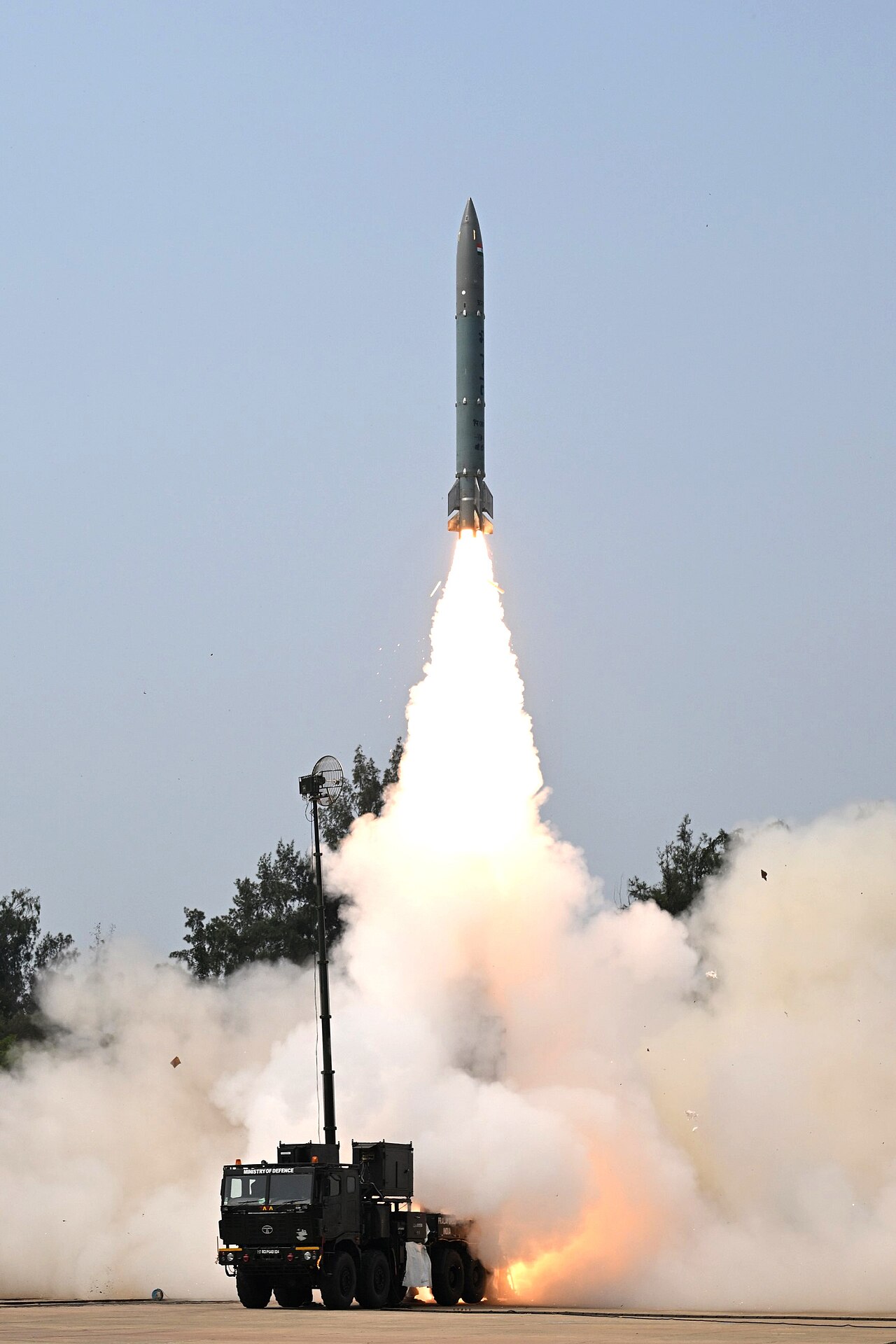
About the Pralay Missile
- Type: A canister-based, surface-to-surface, quasi-ballistic tactical missile carrying a conventional warhead.
- Range: About 150–500 km, with a payload of about 500–1,000 kg.
- Propulsion: A solid-propellant rocket motor. It is derived from the Prithvi Defence Vehicle (PDV) technology of the ballistic missile defence programme.
- Quasi-ballistic flight: It follows a flatter trajectory and can manoeuvre in mid-air, which makes it harder for interceptor missiles to track.
- Launch platform: A road-mobile launcher, which allows quick deployment and better survivability.
- The first test was in December 2021. Two consecutive tests in July 2025 validated its maximum and minimum ranges.
Strategic Significance
- Conventional deterrence: Can strike high-value targets such as radars, command centres, airfields and logistics hubs without crossing the nuclear threshold.
- Theatre requirement: Suited to the northern and western borders. It is expected to be central to a proposed Integrated Rocket Force.
- Compares with: China’s Dongfeng-12 and Russia’s Iskander in its class.
- Self-reliance: Developed by DRDO laboratories with Indian industry partners.
Testing Infrastructure
- Dr. APJ Abdul Kalam Island (formerly Wheeler Island) in the Bay of Bengal off Odisha is India’s main missile test site.
- The Integrated Test Range (ITR), Chandipur tracks test flights using radars, electro-optical systems and telemetry.
Related Indian Missiles (Prelims Snapshot)
| Missile | Type | Approx. range |
|---|---|---|
| Prithvi-II | Surface-to-surface ballistic | 350 km |
| Pralay | Quasi-ballistic, conventional | 150–500 km |
| BrahMos | Supersonic cruise (with Russia) | 290–450+ km |
| Agni-V | Intercontinental-range ballistic | 5,000+ km |
| Nirbhay | Subsonic cruise | 1,000 km |
Frequently Asked Questions (FAQs)
1. What kind of warhead does Pralay carry?
A conventional warhead.
2. Where was the test carried out?
From Dr. APJ Abdul Kalam Island, off the Odisha coast.
3. What makes a quasi-ballistic missile harder to intercept?
Its lower trajectory and ability to manoeuvre in flight.
Practice Question
Prelims: Consider the following about Pralay: (1) It is a surface-to-surface quasi-ballistic missile. (2) It carries only nuclear warheads. (3) It is launched from a mobile launcher. Which of the statements given above are correct? Answer: 1 and 3 only.
Sources and further reading
- Ministry of Defencecommons.wikimedia.org