
Tags: GS Paper 1 – Population and Associated Issues; GS Paper 2 – Government Policies, e-Governance
For Prelims: Census Act 1948, Registrar General and Census Commissioner of India, Census Management and Monitoring System (CMMS), Houselisting Operations, Population Enumeration, caste enumeration, delimitation
For Mains: Significance of timely Census data for policy, digital Census and data quality, link between Census and delimitation and women’s reservation
Why in News?
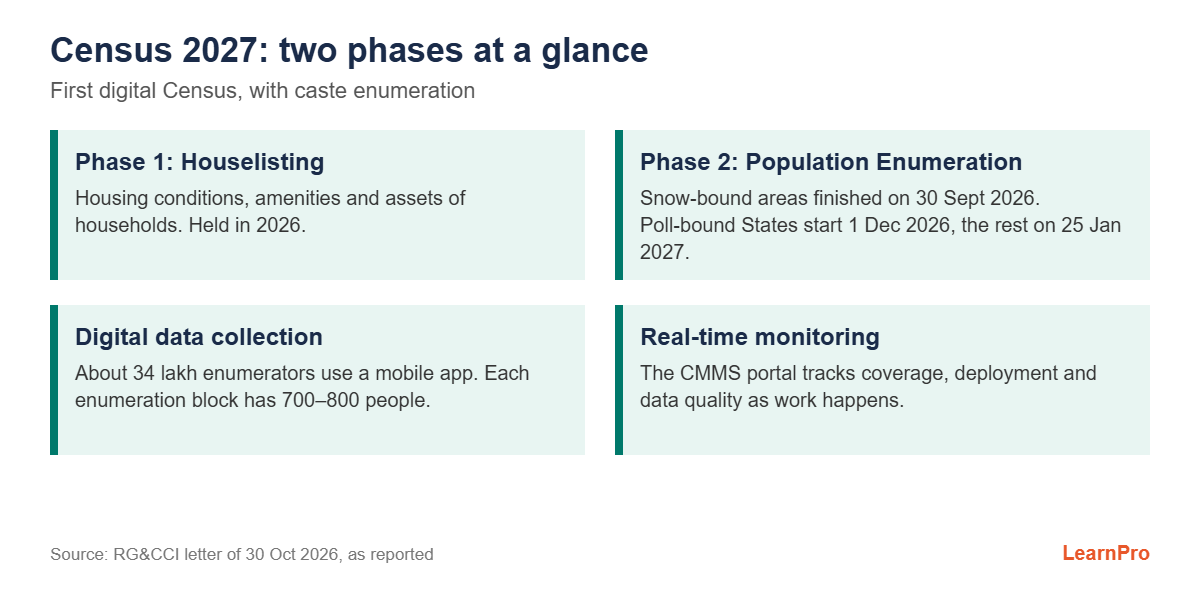
The Registrar General and Census Commissioner of India (RG&CCI) has asked all States to track the Population Enumeration (PE) phase of Census 2027 in real time through the Census Management and Monitoring System (CMMS). The aim is to identify lagging areas and data quality problems and fix them quickly. Census 2027 is India’s first digital Census.
Summary
- CMMS will be the main platform for planning, training, deploying field staff, supervising them and resolving issues.
- Door-to-door enumeration will begin on 1 December 2026 in the poll-bound States of Uttar Pradesh, Uttarakhand, Punjab and Goa, and on 25 January 2027 in the rest of India. It ended on 30 September 2026 in snow-bound areas.
- About 34 lakh enumerators, mostly government school teachers, will collect data through a mobile app.
- Enumerators will ask about 40 questions, including new ones. Respondents may give identifiers such as mobile, Aadhaar and voter ID numbers if they have them.
Census in India: Key Facts
- Legal basis: The Census Act, 1948 and the Census Rules, 1990. The Census is a Union subject (Entry 69, Union List).
- Authority: The Office of the RG&CCI under the Ministry of Home Affairs.
- History: The first non-synchronous Census was held in 1872 and the first synchronous one in 1881. The 2011 Census was the 15th overall and the 7th after Independence.
- Confidentiality: Under Section 15 of the Census Act, individual data is confidential and cannot be used as evidence in court.
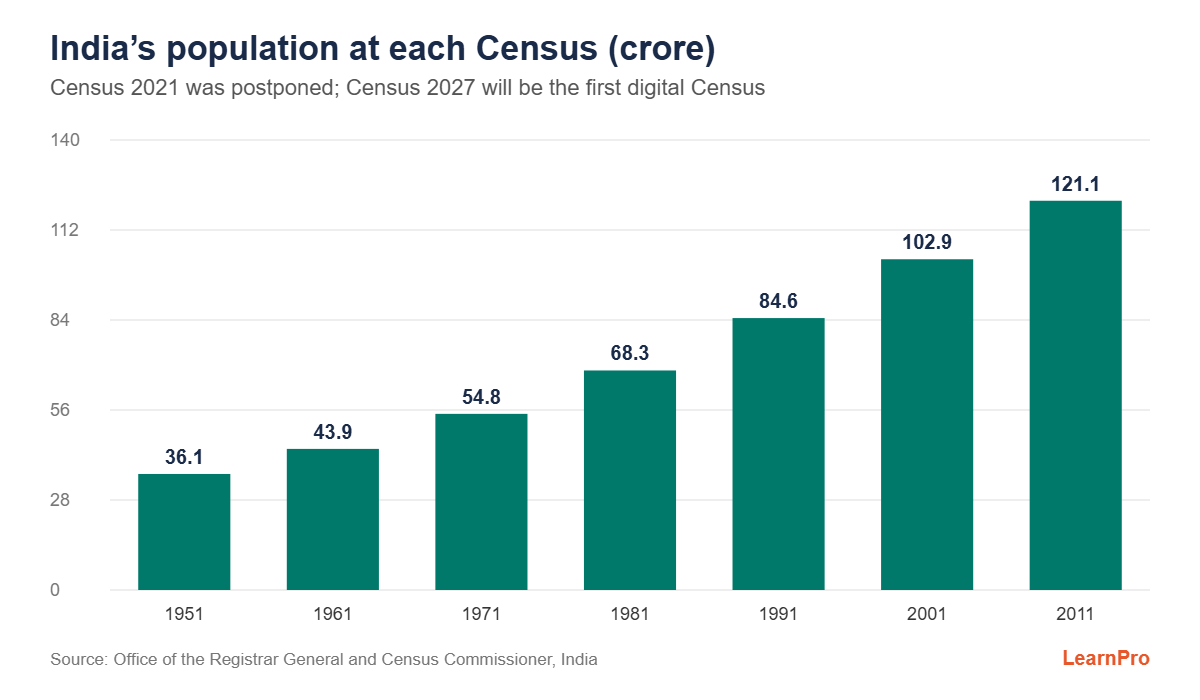
- Delay: Census 2021 was postponed because of COVID-19. The reference date for Census 2027 is 1 March 2027, and 1 October 2026 for snow-bound areas.
- Caste: Census 2027 will include caste enumeration, the first since 1931 apart from SC and ST counts.
Why does Real-Time Monitoring Matter?
- Problems fixed during fieldwork: With paper schedules, errors were found only months later. Digital dashboards make it possible to correct them while enumeration is still going on.
- Coverage: Missed households, migrant settlements and remote areas can be spotted quickly.
- Accountability: Shows how well enumerators are deployed, trained and supervised.
- Faster results: Data can be processed and published sooner.
Concerns
- Data integrity: During houselisting, there were reports of enumerators being asked to revisit households and “correct” answers on sensitive indicators such as open defecation and LPG access. This raises fears of administrative pressure to show better numbers.
- Privacy: Collecting Aadhaar, mobile and passport details must follow the Digital Personal Data Protection Act, 2023.
- Digital divide: Enumerators use their own phones and face connectivity problems in remote areas.
- Workload: Teachers taken away for the Census leaves gaps in schools.
Significance of Census 2027
- It is the basis for delimitation of constituencies, since the freeze under Article 82 ends after the first Census taken after 2026.
- It enables women’s reservation under the 106th Amendment (2023), which applies after delimitation based on that Census.
- It updates the base for welfare schemes such as NFSA coverage, Finance Commission devolution, and planning for urbanisation and migration.
Conclusion
Real-time monitoring can make Census 2027 faster and more accurate. Its credibility, however, depends on accurate data rather than ‘corrected’ data, and on strong privacy safeguards for the personal details being collected.
Frequently Asked Questions (FAQs)
1. Under which law is the Census conducted?
The Census Act, 1948.
2. What is the reference date for Census 2027?
1 March 2027, and 1 October 2026 for snow-bound areas.
3. Which ministry is the Census Commissioner’s office under?
The Ministry of Home Affairs.
Practice Question
Mains: Discuss the opportunities and risks of India’s first digital Census. How does Census 2027 affect delimitation and women’s reservation? (250 words)