
The Bihar SIR 2025 was a Special Intensive Revision of all Assembly-constituency electoral rolls in Bihar before the November 2025 election. It became a major constitutional case because the Election Commission of India (ECI) required a fresh enumeration process, used the 2003 intensive-revision roll as a reference and examined eligibility documents for many electors.
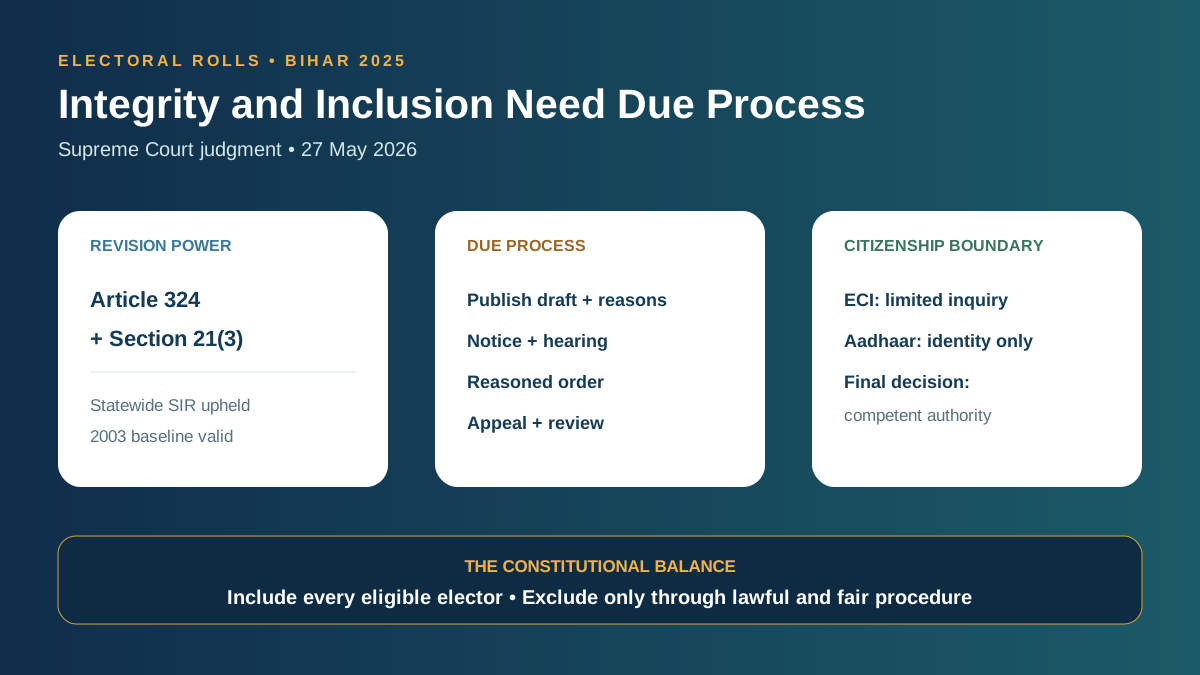
On 27 May 2026, the Supreme Court upheld the exercise in Association for Democratic Reforms v Election Commission of India. The judgment recognised broad ECI power to revise rolls, but also drew an essential boundary: the Commission may conduct a limited inquiry into citizenship for electoral eligibility; a final citizenship adjudication belongs to the competent authority under the Citizenship Act.
What did the ECI order?
On 24 June 2025, the ECI directed a Special Intensive Revision in every Bihar Assembly constituency. It cited the long interval since the 2003 intensive revision, migration, urbanisation, unreported deaths and duplicate or otherwise ineligible entries.
Booth Level Officers conducted house-to-house visits and distributed enumeration forms. Electors linked to the 2003 roll received a presumption of eligibility for the documentation stage. Persons not traced to that roll had to submit the form with documents under the specified regime.
| Stage | What happened | Legal significance |
|---|---|---|
| 24 June 2025 | ECI ordered statewide SIR | Article 324 read with Section 21(3), RP Act 1950 |
| 1 August 2025 | Draft roll published | Non-inclusion remained provisional; claims and objections followed |
| 30 September 2025 | SIR completed; final roll published | Final roll contained about 7.42 crore electors |
| November 2025 | Bihar Assembly election held | Polls used the revised roll |
| 27 May 2026 | Supreme Court judgment | SIR upheld with citizenship and remedy clarifications |
How many electors were affected?
According to the Supreme Court’s official summary, Bihar had about 7.89 crore electors before the exercise. Nearly 65 lakh names were absent from the draft roll published on 1 August 2025. The final roll contained about 7.42 crore electors.
These figures should not be described as a single mass finding of “non-citizens”. Draft exclusions included reported deaths, permanent shifting, duplicate enrolment, untraceable electors and non-submission, alongside disputed eligibility cases. A draft roll is also not the end of the claims, objections, hearing and appeal process.
SIR versus summary revision
| Feature | Summary revision | Intensive/Special Intensive Revision |
|---|---|---|
| Starting point | Existing roll is updated | More extensive field verification or fresh enumeration |
| Typical focus | Additions, deletions and corrections since last roll | Systemic verification where ECI records special reasons |
| Field work | Targeted claims and BLO verification | Broader house-to-house or document-linked exercise |
| Legal source | RP Act and Registration of Electors Rules | Section 21(3) plus Article 324, subject to statutory safeguards |
Constitutional and statutory framework
- Article 324: vests superintendence, direction and control of elections in the ECI.
- Article 325: requires one general electoral roll and prohibits exclusion only on religion, race, caste or sex.
- Article 326: provides adult suffrage, subject to citizenship, age and lawful disqualifications.
- Section 16, RP Act 1950: disqualifies a person from registration if not an Indian citizen, among other grounds.
- Section 21: governs preparation and revision of electoral rolls; subsection (3) enables special revision for recorded reasons.
- Sections 22 and 23: address correction/deletion and inclusion of names.
- Section 24: provides appeals against specified Electoral Registration Officer decisions.
- Rule 21A, Registration of Electors Rules 1960: requires safeguards for deletion, including notice and opportunity in applicable cases.
What did the Supreme Court decide?
1. ECI had power to order the SIR
The Court held that Section 21(3) is an autonomous statutory source for a special revision and works with Article 324. ECI’s constitutional power continues alongside parliamentary law, but cannot override an express statutory prohibition.
2. The purpose was legitimate and proportionate
Inclusion of eligible electors and exclusion of ineligible entries are both part of electoral integrity. The Court accepted migration, deaths, duplication and the time elapsed since 2003 as rational reasons for a comprehensive exercise. It found the procedure proportionate when read with notice, hearing, claims, objections and appeals, including safeguards strengthened during litigation.
3. The 2003 roll was a permissible reference point
Entry on an existing roll creates a rebuttable presumption of validity, not a permanent immunity from verification. The Court considered the 2003 baseline rational because it followed an earlier intensive exercise rather than only routine summary updates.
4. Aadhaar proves identity, not citizenship
During the proceedings, the Court required Aadhaar to be accepted as a twelfth identity document under Section 23(4). It reiterated that Aadhaar establishes identity for this purpose but is not proof of citizenship. EPIC was not treated as conclusive because it flows from entry in the roll being verified.
5. ECI’s citizenship inquiry is limited
Citizenship is a condition for enrolment, so ECI may examine whether that condition appears satisfied. But it cannot finally determine citizenship under the Citizenship Act. When ECI is not satisfied, it must refer the matter to the competent Central Government authority. A deletion on that ground remains subject to that adjudication.
Procedural safeguards for electors
- Reasons must be recorded: revision and individual decisions cannot be unexplained administrative acts.
- Draft exclusion is provisional: electors must have a meaningful claims-and-objections opportunity.
- Notice and hearing matter: doubtful entries require fair procedure and a reasoned order.
- Excluded-name lists must be accessible: the Court directed publication with reasons so people could seek correction.
- Statutory appeal remains available: Section 24 provides a two-tier appellate route in the applicable framework.
- Judicial review survives: wrongful deletion for absence, death, shifting or duplication can still be challenged.
Democratic concerns and lessons
Roll purity and universal inclusion are complementary goals. Duplicate and deceased entries weaken accuracy, but wrongful deletion prevents an eligible citizen from exercising a constitutional right. The burden of a mass exercise falls hardest on migrants, women without consistent documents, poor households, elderly persons, persons with disabilities and residents affected by floods or displacement.
Future revisions should provide:
- adequate time that does not collide with floods, migration cycles or an imminent election;
- plain-language and multilingual instructions;
- offline assistance rather than digital-only access;
- searchable exclusion lists with privacy safeguards;
- daily public statistics on forms, notices, decisions and appeals;
- independent audit of duplicate detection and matching errors; and
- special support through BLOs, parties and civil-society organisations.
What should a voter do?
A voter should verify their name through the official ECI Voters’ Service Portal, the Voter Helpline App or helpline 1950. If a name is missing or details are wrong, use the prescribed registration, correction, claim or appeal route. Possession of an EPIC card alone does not permit voting if the name is absent from the current electoral roll.
UPSC and State PSC relevance
The Bihar SIR 2025 connects GS Paper II topics on the Constitution, ECI, Representation of the People Act, citizenship and democratic participation. In an answer, balance roll integrity with non-arbitrary exclusion and explain the Court’s distinction between electoral inquiry and final citizenship adjudication.
Mains practice question: The integrity of an electoral roll depends equally on removing ineligible entries and protecting eligible citizens from wrongful exclusion. Discuss in light of the Supreme Court’s Bihar SIR judgment.
Conclusion
The Supreme Court validated the legal power and overall design of Bihar’s 2025 SIR. It did not convert administrative convenience into unlimited authority. The durable principle is that verification must operate through transparency, notice, hearing, reasoned decisions, appeal and a clear boundary between electoral administration and citizenship adjudication.
Frequently asked questions
What was the Bihar SIR 2025?
It was a statewide Special Intensive Revision of electoral rolls ordered by ECI on 24 June 2025 before the Bihar Assembly election.
Did the Supreme Court uphold the exercise?
Yes. On 27 May 2026, the Court upheld ECI’s power, the legitimate purpose and the proportionality of the procedure, read with its safeguards.
Is Aadhaar proof of Indian citizenship?
No. The Court required Aadhaar to be accepted as an identity document for the SIR but clarified that it is not proof of citizenship.
Can ECI decide citizenship finally?
No. It may conduct a limited eligibility inquiry for the roll. A final citizenship determination belongs to the competent authority under citizenship law.
Can a person vote only with a voter ID card?
No. The person’s name must appear on the current electoral roll. EPIC is an identity document, not a substitute for enrolment.
Primary references
- Supreme Court: ADR v ECI, Bihar SIR judgment summary (2026 INSC 564)
- Election Commission of India: Bihar SIR roll portal
- Election Commission of India: elector services
- India Code: Representation of the People Act, 1950





Sources and further reading
- ECI Voters’ Service Portalvoters.eci.gov.in
- Supreme Court: ADR v ECI, Bihar SIR judgment summary (2026 INSC 564)sci.gov.in
- Election Commission of India: Bihar SIR roll portaleci.gov.in
- Election Commission of India: elector serviceseci.gov.in
- India Code: Representation of the People Act, 1950indiacode.nic.in