Updates
GS Paper IIIEconomy

‘Invisible Hand’ in India’s Foreign Trade

LearnPro Editorial
7 Jul 2025
Updated 3 Mar 2026
6 min read
Share

‘Invisible Hand’ in India’s Foreign Trade: The Rise of Intangibles

The dynamics of India’s foreign trade have undergone a transformative shift, with the focus expanding from tangible goods like merchandise to "invisibles" — primarily services exports and remittance inflows. This shift embodies the tension between "traditional trade in goods" versus "knowledge-driven intangible trade". As India positions itself as the "office of the world," services exports such as IT and professional services, alongside diaspora remittances, have increasingly kept India's current account balanced. However, challenges in infrastructure, skills, and access to global markets remain critical for sustaining this transition.

UPSC Relevance Snapshot

  • GS-II: Impact of Indian diaspora, international institutions, trade alliances.
  • GS-III: Indian economy, trade policy, service sector growth.
  • Essay Paper: "India as a global hub for services exports".

Conceptual Clarity: Tangibles vs Invisibles in Trade

The term "invisible hand" in India's foreign trade refers to the growing dominance of services (intangibles) over goods (tangibles). Unlike merchandise trade, services exports involve low trade costs, rely on skilled human capital, and are less subject to trade wars or tariffs. This distinction is crucial for India's strategy in global trade.

  • Tangibles: Physical goods like textiles, chemicals, and engineering products, relying heavily on manufacturing and global supply chains.
  • Invisibles: Export of IT, business, and financial services, as well as remittances — contributing a substantial share of forex inflows.
  • Resilience of Invisibles: Services exports maintain growth even during global trade slowdowns (e.g., COVID-19 recovery). Data shows services exports grew by 12.8% in FY25 (April-November).

Economic Significance of Services in India

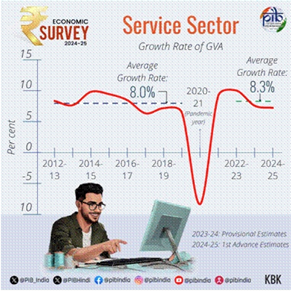
The services sector underpins India's economy, from growth and employment to external trade. It now constitutes around 55% of India’s Gross Value Added (GVA) and employs nearly 30% of the workforce, according to the Economic Survey 2024-25.

  • India ranks 7th globally with a 4.3% share in world services exports (WTO data).
  • Key contributions include IT exports (accounting for 40-50% of total services exports) and remittances from a 32-million-strong diaspora, estimated at $107 billion in 2022 (World Bank).
  • The concept of 'servicification' — blending services with industrial processes — has also driven manufacturing competitiveness.

Evidence and Data: Comparing India's Performance

India’s focus on invisibles has placed it ahead of several emerging markets but far behind developed nations with established knowledge economies.

Country Share in Global Services Exports (2023) Remittances as % of GDP Services Sector Contribution to GDP
India 4.3% 3.1% 55%
China 4.2% 0.5% 53.3%
USA 11.4% 0.2% 77%
Philippines 1.5% 9.6% 58.4%

Limitations and Open Questions

Despite its growing reliance on invisibles, India's foreign trade faces persistent challenges linked to structure and capacity. These challenges bring into question the sustainability of the growth model.

  • Infrastructure Gaps: Lack of adequate digital connectivity and high-quality urban infrastructure affects service delivery from Tier-2/3 cities.
  • Skilled Workforce Shortages: A mismatch in supply-demand for high-value skills limits services export expansion.
  • Regulatory Barriers: Stringent visa regimes or data localization norms by other countries impede global access markets.
  • Global Economic Sensitivity: Business services and IT segments remain exposed to slowing demand from major economies, such as the USA and EU.

Structured Assessment: Dimensions of India's Invisible Trade

  • Policy Design: Does India's focus on services trade align with global digitalization and knowledge-intensive value chains? Initiatives such as UPI exports and e-governance portals complement IT services export potential.
  • Governance Capacity: Bureaucratic hurdles in enabling smooth cross-border transaction ecosystems (e.g., ease of opening Indian subsidiaries abroad) persist.
  • Structural and Behavioral Factors: State-level disparities in service-led employment opportunities highlight regional imbalances, undermining equitable benefits.

Exam Integration

📝 Prelims Practice
  1. Which of the following correctly distinguishes between visible and invisible exports?
    • A. Visible exports refer to high-tech goods, and invisible exports refer to traditional services.
    • B. Visible exports are tangible physical goods, while invisible exports are services such as tourism, IT, and remittances.
    • C. Invisible exports are measured separately and do not contribute to GDP.
    • D. Visible trade includes manufacturing services, while invisible trade excludes software exports.
    Answer: B
  2. The phrase "servicification" is best associated with:
    • A. The digital transformation of educational services.
    • B. The integration of service elements in manufacturing processes.
    • C. The rise of intangible goods replacing physical goods in trade.
    • D. The shift in workforce composition towards the tertiary sector.
    Answer: B
✍ Mains Practice Question
Q: “India’s foreign trade is gradually moving from the export of goods to knowledge-driven intangibles.” Discuss the factors driving this shift, its economic implications, and the challenges in sustaining it. (250 words)
250 Words15 Marks

Practice Questions for UPSC

Prelims Practice Questions

📝 Prelims Practice
Which of the following correctly distinguishes between visible and invisible exports?

Which of the following statements is correct?

  • aVisible exports refer to high-tech goods, and invisible exports refer to traditional services.
  • bVisible exports are tangible physical goods, while invisible exports are services such as tourism, IT, and remittances.
  • cInvisible exports are measured separately and do not contribute to GDP.
  • dVisible trade includes manufacturing services, while invisible trade excludes software exports.
Answer: (b)
📝 Prelims Practice
The phrase 'servicification' is best associated with:

Which of the following statements is correct?

  • aThe digital transformation of educational services.
  • bThe integration of service elements in manufacturing processes.
  • cThe rise of intangible goods replacing physical goods in trade.
  • dThe classification of all services under intangible assets.
Answer: (b)
✍ Mains Practice Question
Critically examine the role of intangible exports in transforming India’s economic landscape, highlighting both opportunities and challenges (250 words).
250 Words15 Marks

Frequently Asked Questions

What are the key reasons for the rise of intangibles in India's foreign trade?

The rise of intangibles in India's foreign trade is primarily attributed to the increasing export of services, particularly in IT and professional domains, and significant remittances from the Indian diaspora. Additionally, the lower trade costs associated with services and their resilience during global economic slowdowns contribute to their growing importance compared to traditional tangible goods.

How does the concept of 'servicification' impact India's manufacturing sector?

'Servicification' refers to the integration of service elements within manufacturing processes, enhancing the competitiveness of the manufacturing sector. This approach allows manufacturers to leverage technological advancements and skilled services, thereby increasing efficiency and value addition in the production process.

What challenges does India face in sustaining its intangible trade growth?

India faces several challenges in sustaining the growth of its intangible trade, including infrastructure gaps, a shortage of skilled workforce, and regulatory barriers that limit access to global markets. Furthermore, the country’s reliance on the global economic environment introduces vulnerabilities, particularly in sectors like IT, which are sensitive to demand fluctuations in developed economies.

Why is understanding the distinction between tangible and intangible trade crucial for India's trade strategy?

Understanding the distinction between tangible and intangible trade is crucial for India's trade strategy as it highlights the shift in global trade dynamics towards knowledge-driven services. This comprehension enables policymakers to focus on enhancing capabilities in the services sector while addressing the structural issues that hinder effective participation in the global market.

How does India's performance in global services exports compare with that of other nations?

India ranks seventh in global services exports, with a 4.3% share, showcasing its competitive position in the international market. However, it still lags behind developed countries like the USA, which leads with an 11.4% share, indicating room for improvement in service sector productivity and competitiveness.

Source: LearnPro Editorial | Economy | Published: 7 July 2025 | Last updated: 3 March 2026

Share
About LearnPro Editorial Standards

LearnPro editorial content is researched and reviewed by subject matter experts with backgrounds in civil services preparation. Our articles draw from official government sources, NCERT textbooks, standard reference materials, and reputed publications including The Hindu, Indian Express, and PIB.

Content is regularly updated to reflect the latest syllabus changes, exam patterns, and current developments. For corrections or feedback, contact us at admin@learnpro.in.

This Topic Is Part Of

Related Posts

Science and Technology

Missile Defence Systems

Context The renewed hostilities between the United States-led coalition (including Israel and United Arab Emirates) and Iran have tested a newly integrated regional air and missile defence network in West Asia. What is a missile defence system? Missile defence refers to an integrated military system designed to detect, track, intercept, and destroy incoming missiles before they reach their intended targets, thereby protecting civilian populations, military installations, and critical infrastruct

2 Mar 2026Read More
International Relations

US-Israel-Iran War

Syllabus: GS2/International Relations Context More About the News Background of the Current Escalation Global Implications Impact on India Way Forward for India About West Asia & Its Significance To Global Politics Source: IE

2 Mar 2026Read More
Polity

Securities and Exchange Board of India (SEBI) on Market Manipulators

Context The Securities and Exchange Board of India (SEBI) will enhance surveillance and enforcement on market manipulators and cyber fraudsters through technology and use Artificial Intelligence (AI). Securities and Exchange Board of India (SEBI) It is the regulatory authority for the securities and capital markets in India. It was established in 1988 and given statutory powers through the SEBI Act of 1992.

2 Mar 2026Read More
Polity

18 February 2026 as a Current Affairs Prompt: How to Convert a Date into UPSC Prelims-Grade Facts (Acts, Rules, Notifications, Institutions)

A bare date like “18-February-2026” is not a defensible current-affairs topic unless it is anchored to a primary instrument such as a Gazette notification, regulator circular, court judgment, or a Bill/Act. The exam-relevant task is to convert the date into verifiable identifiers—issuing authority, legal basis (Act/Rules/Sections), instrument number, effective date, and thresholds—because UPSC frames MCQs around precisely these hard edges. The central thesis: the difference between narrative awareness and Prelims accuracy is source hierarchy discipline.

2 Mar 2026Read More

Enhance Your UPSC Preparation

Study tools, daily current affairs analysis, and personalized study plans for Civil Services aspirants.

Try LearnPro AI Free

Our Courses

72+ Batches

Our Courses
Contact Us