
India trade strategy is moving from defensive tariff policy toward a network of selective, high-value agreements. The old debate—whether India should simply join every large trade bloc—misses the real issue. India needs agreements that improve export access and supply-chain participation while domestic reforms raise the ability of firms and workers to use those preferences.
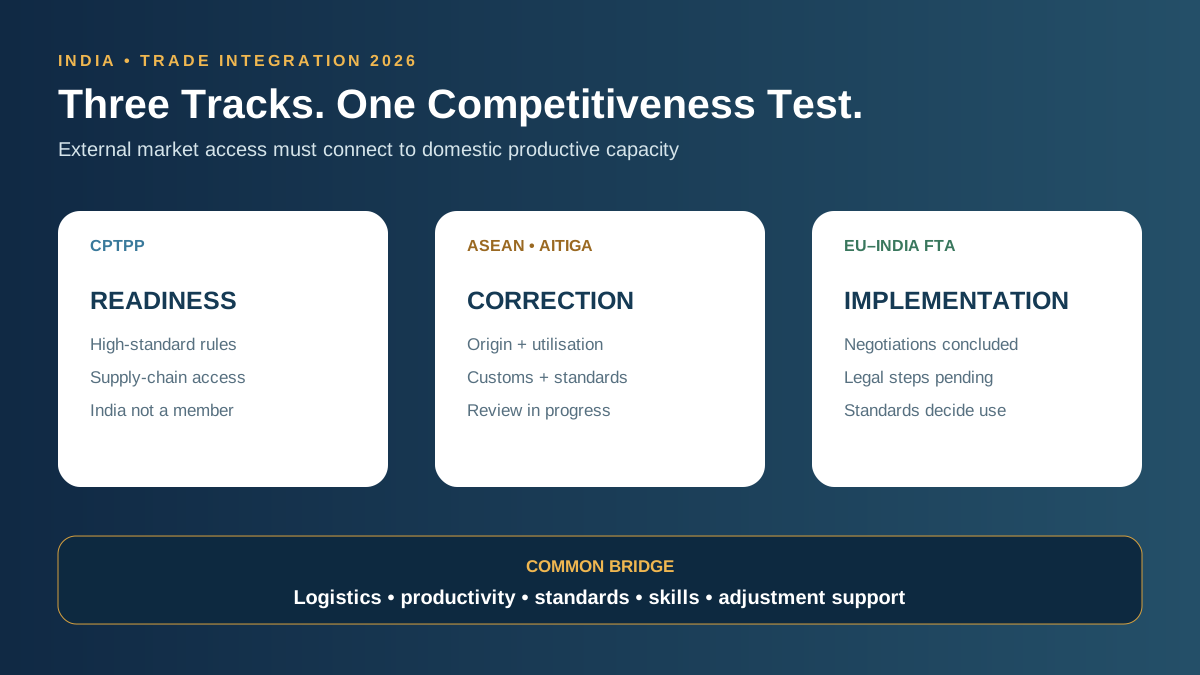
By July 2026, three tracks were at different stages: India remained outside the CPTPP; the ASEAN–India Trade in Goods Agreement (AITIGA) review continued; and India and the European Union had concluded FTA negotiations on 27 January 2026, although legal revision, signature and internal procedures were still required before the agreement became binding.
Why does India need a new trade strategy?
Global trade is becoming more regional, strategic and rules-intensive. Tariffs still matter, but firms now choose locations based on trusted supply chains, digital rules, carbon standards, subsidies, export controls, logistics and access to several markets through one production base.
India’s total goods and services exports were estimated by the Commerce Ministry at a record $860.09 billion in FY 2025–26. The next step is not export growth alone, but a larger share of value-added manufacturing and tradable services.
Three trade tracks, three different statuses
| Track | Status by July 2026 | Strategic question |
|---|---|---|
| CPTPP | India is not a member or announced accession candidate | Can India meet high-standard rules and gain sufficient market access? |
| ASEAN / AITIGA | Existing goods agreement under review | Can utilisation, origin rules and the goods imbalance improve? |
| EU–India FTA | Negotiations concluded; legal and ratification steps remained | Can firms comply with standards and convert preferences into exports? |
What is the CPTPP?
The Comprehensive and Progressive Agreement for Trans-Pacific Partnership is a high-standard trade agreement among 12 parties: Australia, Brunei, Canada, Chile, Japan, Malaysia, Mexico, New Zealand, Peru, Singapore, the United Kingdom and Viet Nam. The original agreement entered into force in 2018; the UK became the first accession economy.
CPTPP goes beyond tariff cuts. It contains rules on services, investment, government procurement, state-owned enterprises, intellectual property, labour, environment, digital trade, customs and regulatory transparency. Its value lies in common rules across multiple markets, allowing firms to build regional supply chains.
Why might India consider CPTPP accession?
- Supply-chain access: common origin rules can make India more attractive for production linked to Japan, Southeast Asia, Canada, Mexico and the UK.
- Export diversification: greater access reduces dependence on a few large markets.
- Services and digital trade: predictable rules can help IT, professional and digitally delivered services.
- Investment signalling: high-standard commitments may reduce regulatory uncertainty.
- Rule-making voice: membership would let India influence the evolution of Indo-Pacific trade rules from inside.
Why is accession difficult?
- Agriculture and dairy: rapid tariff opening could expose small producers to highly competitive imports.
- Rules of origin: India must prevent simple trans-shipment while ensuring exporters can document regional value.
- Government procurement and SOEs: disciplines may constrain policy tools used for development and public objectives.
- Digital rules: cross-border data provisions must be reconciled with privacy, security, taxation and regulatory autonomy.
- Intellectual property: India must protect affordable medicines and the flexibilities available under international law.
- Adjustment costs: workers and smaller firms need time, credit, technology and social protection when import competition rises.
The correct approach is a chapter-by-chapter cost–benefit assessment, not accession as symbolism. India can also pursue regulatory alignment and sectoral agreements without immediately joining the full treaty.
ASEAN: improve the agreement India already has
AITIGA entered into force in 2010. India later chose not to join RCEP, partly because of concerns over goods deficits, origin enforcement and import competition. ASEAN nevertheless remains central to India’s Act East policy and regional supply chains.
The AITIGA review should prioritise:
- Simpler, product-specific origin rules with effective verification against third-country circumvention;
- faster customs and paperless trade through interoperable documents and risk management;
- correction of inverted duties that make imported finished goods cheaper than inputs;
- better preference utilisation by MSMEs through clear certificates and exporter support;
- standards cooperation for food, pharmaceuticals, electronics and engineering goods; and
- services, investment and mobility so the relationship is not judged only by the merchandise deficit.
A trade deficit is not automatically harmful if imports are productive inputs and financed sustainably. The right diagnostic is product-level: Is the deficit driven by essential intermediates, weak competitiveness, unfair practices or circumvention?
EU–India FTA: negotiation concluded, implementation not automatic
India and the EU concluded FTA negotiations on 27 January 2026. The published text remained subject to legal revision and would become binding only after signature and completion of internal procedures. Separate negotiations on investment protection and geographical indications continued.
According to the European Commission’s chapter summary, the EU would eliminate tariffs on more than 90% of tariff lines and India on 86%, with partial liberalisation taking overall coverage higher. Indian opportunities include textiles, footwear, fisheries, chemicals and pharmaceuticals, while services commitments cover professional mobility and regulatory predictability.
Market access will still depend on:
- rules-of-origin documentation;
- sanitary, technical and product standards;
- the EU Carbon Border Adjustment Mechanism and wider sustainability rules;
- data and digital compliance;
- quality certification and traceability; and
- timely domestic adjustment for exposed sectors.
A coherent strategy rather than disconnected FTAs
- Set sector-level objectives: identify products and services where India can gain market share, not only tariff lines to exchange.
- Fix logistics and ports: an FTA cannot compensate for unreliable freight, customs delay or high power cost.
- Build standards infrastructure: laboratories, accreditation, traceability and mutual recognition turn paper access into shipments.
- Use trade-adjustment support: retraining, technology credit and temporary safeguards should help viable firms adapt.
- Protect strategic policy space precisely: narrow, transparent exceptions are better than broad unpredictability.
- Coordinate industrial and trade policy: incentives should create competitive capacity, not permanent protection.
- Publish utilisation data: evaluate agreements through preference use, export diversification, investment and domestic value addition.
This approach complements the India–US interim trade framework and BTA negotiations. Multiple agreements can diversify risk, but conflicting origin rules and standards can also raise compliance costs.
UPSC and State PSC relevance
India trade strategy connects GS Paper II regional groupings and bilateral relations with GS Paper III liberalisation, manufacturing, services and inclusive growth. For Prelims, distinguish CPTPP membership from accession interest and FTA conclusion from entry into force. For Mains, link external agreements with domestic competitiveness and adjustment.
Mains practice question: India’s trade strategy should be judged not by the number of agreements signed but by its capacity to convert market access into domestic value addition and productive employment. Discuss.
Conclusion
India should not choose between global integration and domestic development. Well-designed trade agreements can support development when firms can meet standards, workers can adjust and strategic exceptions are clear. The EU agreement is the immediate implementation test; AITIGA is the correction test; CPTPP is the long-term readiness test. Domestic competitiveness is the bridge connecting all three.
Frequently asked questions
Is India a member of CPTPP?
No. India was not a CPTPP member or formally announced accession candidate as of July 2026.
How many CPTPP parties are there?
There are 12 parties, including the United Kingdom as the first accession economy.
Has the EU–India FTA entered into force?
No. Negotiations concluded in January 2026, but the text required legal revision, signature and completion of internal procedures before becoming binding.
What is AITIGA?
It is the ASEAN–India Trade in Goods Agreement, in force since 2010 and under review to improve its operation and balance.
Why are rules of origin important?
They determine whether a product contains enough qualifying production to receive an FTA tariff and help prevent simple trans-shipment from non-members.
Primary references
- European Commission: EU–India agreements and status
- European Commission: published FTA text and legal disclaimer
- CPTPP ministerial statement, June 2026
- Government of India TradeStat database





Sources and further reading
- European Commission: EU–India agreements and statuspolicy.trade.ec.europa.eu
- European Commission: published FTA text and legal disclaimerpolicy.trade.ec.europa.eu
- CPTPP ministerial statement, June 2026international.gc.ca
- Government of India TradeStat databasetradestat.commerce.gov.in