
 Forest Services
Introduction to Jharkhand Economy
The Jharkhand economy has witnessed gradual progress, with significant contributions from mineral resources, industries, agriculture, and emerging services sectors. While the industrial and mining sectors have driven economic growth, the agriculture and tourism sectors remain underutilized, reflecting challenges and opportunities for sustainable development.

Gross State Domestic Product (GSDP) of Jharkhand
The Gross State Domestic Product (GSDP) of Jharkhand has shown significant recovery post-pandemic. Despite economic challenges, the Jharkhand economy is projected to continue growing at a steady pace.
Gross State Domestic Product (GSDP) is the total value of all goods and services produced within a state's borders over a specific period of time. It's a key indicator of a state's economic growth and is the counterpart to the national gross domestic product (GDP).
GSDP Growth Trends:
- Post-COVID Recovery:
- The GSDP contracted during 2020-21 due to the nationwide lockdown and pandemic-induced slowdown. It stood at ₹2,19,483 crore at constant prices and ₹2,96,664 crore at current prices during this year.
- Since 2021-22, Jharkhand’s economy has exhibited consistent recovery.
- Recent Growth Performance:
- Between 2020-21 and 2022-23, the GSDP grew at an average annual rate of 8.8% at constant prices.
- The growth rate of the nominal GSDP (current prices) averaged 15.2% during the same period, showcasing strong resilience.
- GSDP Projections:
- For the financial year 2023-24, the GSDP is estimated to grow by 7.1% at constant prices and 8.7% at current prices.
- Projected GSDP:
- Constant Prices: ₹2,78,316 crore.
- Current Prices: ₹4,28,155 crore.
- Projected GSDP:
- For 2024-25, the state’s GSDP is forecasted to increase by 7.7% at constant prices and 9.8% at current prices.
- Projected GSDP:
- Constant Prices: ₹2,99,843 crore.
- Current Prices: ₹4,70,104 crore.
- Projected GSDP:
- For the financial year 2023-24, the GSDP is estimated to grow by 7.1% at constant prices and 8.7% at current prices.

GSDP at Constant Prices (Rs. Crores) and the Growth Rate (in percentage)
GSDP Contribution to India’s Economy:
- Jharkhand’s GSDP accounts for approximately 1.62% of India’s overall GDP.
- Although the state contributes disproportionately less compared to its share of the national population (2.7%) and geographical area (2.4%), its economic share has gradually improved post-2019.
Per Capita Income Trends:
- 2020-21:
- At constant prices: ₹51,464.
- At current prices: ₹69,963.
- 2022-23:
- At constant prices: ₹60,033.
- At current prices: ₹91,874.
- 2023-24 Estimates:
- At constant prices: ₹63,443.
- At current prices: ₹98,649.
- 2024-25 Forecast:
- At constant prices: ₹67,347.
- At current prices: ₹1,07,027.

Per Capita Income Trends: (Jharkhand Economy)
Comparison with National Growth:
- Between 2020-21 and 2022-23, Jharkhand’s GSDP grew at a faster pace (8.8%) than the national GDP (8.1%).
- This trend underscores the resilience of Jharkhand Economy in the face of economic disruptions and its ability to outpace national growth rates.
Key Takeaways:
- The steady increase in GSDP, coupled with strong recovery trends, indicates positive economic momentum in Jharkhand Economy.
- Focus on infrastructure development, industrial growth, and economic diversification will be crucial for sustaining this growth trajectory of Jharkhand Economy.
- Improvements in per capita income demonstrate better income distribution, though gaps remain in underperforming sectors like agriculture of Jharkhand Economy.
Sector-Wise Analysis of Jharkhand Economy
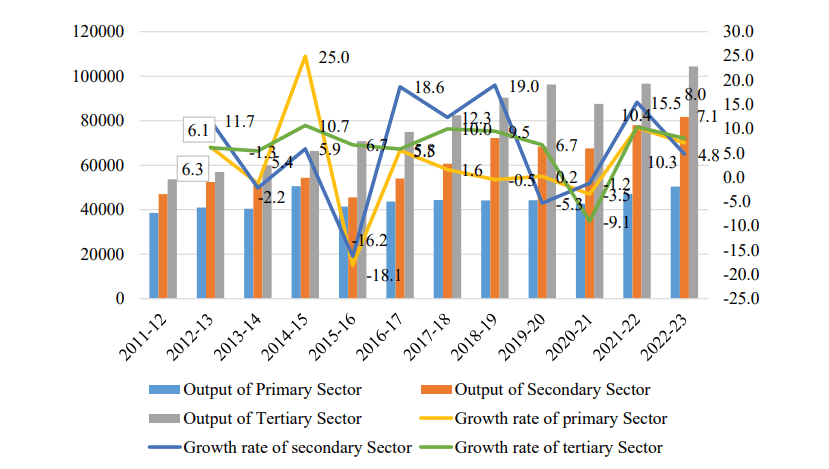
The GSVA of the Primary, Secondary and Tertiary Sectors (in Rs. crores) and their
Growth-Rate (in %) in Jharkhand Economy
A. Primary Sector (Agriculture, Forestry, Animal Husbandry, and Fishing):
The primary sector remains critical for Jharkhand economy, though its share in the Gross Value Added (GVA) has shown modest growth. Agriculture, forestry, and fishing play a central role in rural livelihoods.
Gross value added (GVA) is the measure of the total value of goods and services produced in an economy( area, region or country). The amount of value-added to a product is taken into account
- Contribution to GVA:
- In 2022-23, the primary sector contributed 21.3% to Jharkhand’s GVA, showing a consistent decline compared to past decades.
- The sector’s CAGR (Compound Annual Growth Rate) between 2011-12 and 2022-23 remained low at 3.1%, reflecting stagnant productivity and variability.
- Agricultural Production Trends:
- Key Crops: Paddy remains the primary crop in Jharkhand Economy, followed by maize, pulses, and oilseeds.
- Paddy:
- Production peaked at 5.36 million tonnes in 2021-22 but fell to 1.82 million tonnes in 2022-23 due to erratic rainfall.
- For 2023-24, paddy production is expected to recover to 2.57 million tonnes.
- Maize: Production declined from 623.4 thousand tonnes in 2021-22 to 402.1 thousand tonnes in 2022-23, with a projected recovery to 504.5 thousand tonnes in 2023-24.
- Paddy:
- Key Crops: Paddy remains the primary crop in Jharkhand Economy, followed by maize, pulses, and oilseeds.
- Horticulture and Allied Sectors:
- Vegetables: Output grew marginally from 293.88 thousand tonnes (2018-19) to 305.28 thousand tonnes (2022-23).
- Fruits: Area under fruit cultivation expanded to 111.36 thousand hectares, though production slightly declined to 1.26 million tonnes.
- Animal Husbandry and Fisheries:
- Milk Production: Increased significantly from 1.89 million tonnes in 2017-18 to 2.57 million tonnes in 2021-22.
- Meat Production: Grew from 0.55 lakh tonnes to 0.79 lakh tonnes over the same period.
- Fish Production: Reached 2.57 lakh tonnes in 2021-22, highlighting steady growth in the fisheries sector.
- Irrigation Coverage:
- The gross irrigated area increased to 2.91 lakh hectares in 2021-22 but remains inadequate, covering only a fraction of Jharkhand's total cultivable land.
- Key Sources: Wells dominate irrigation, followed by tanks, canals, and sustainable practices like sprinkler and drip irrigation.
- Challenges in Agriculture in Jharkhand Economy:
- Irrigation Deficit: Limited coverage remains a significant barrier.
- Fragmented Land Holdings: Over 70% of agricultural holdings are marginal, averaging less than 1 hectare.
- Climate Variability: Fluctuating monsoons and climate change adversely impact crop yields.

Share of the Sub sectors of Primary Sector in the GVA
Government Schemes for Agriculture and Allied Activities in Jharkhand Economy
The Government of Jharkhand has implemented several targeted schemes to address challenges in agriculture, irrigation, allied sectors, and farmers' welfare. These schemes aim to improve productivity, promote modern practices, and enhance income levels for small and marginal farmers and boost Jharkhand Economy .

1. Jharkhand Kisan Fasal Rahat Yojana
- Objective: Provides a security cover for farmers against crop damage caused by natural calamities.
- Key Features:
- Applicable for small and marginal farmers of Jharkhand.
- Ensures timely financial support to help farmers recover from losses.
2. Mukhyamantri Krishi Ashirwad Yojana (MKAY)
- Objective: Financial assistance for small and marginal farmers.
- Details:
- Farmers receive ₹5,000 per acre per year (up to a maximum of 5 acres).
- Benefits are directly transferred to farmers’ bank accounts via DBT (Direct Benefit Transfer).
3. Samekit Birsa Gram Vikas Yojana cum Krishak Pathshala
- Objective: Promotes the adoption of modern agricultural technologies and capacity building.
- Features:
- Each district selects a model farm equipped with advanced tools and technologies for horticulture, livestock rearing, and pisciculture.
- Provides practical training to farmers to enhance productivity and income.
4. Birsa Kisan Yojana (BKY)
- Objective: Ensures streamlined access to government schemes for farmers.
- Details:
- Farmers receive a unique ID card with a barcode, eliminating middlemen.
- Enables quick identification and access to benefits under various agricultural schemes.
5. Jharkhand e-Uparjan Portal
- Objective: Digitizes the agricultural procurement process to ensure transparency and efficiency.
- Key Features:
- Farmers can register and list crops online for sale to government agencies.
- Ensures Minimum Support Price (MSP) payments directly into farmers’ bank accounts.
- Reduces middlemen interference and promotes timely payments.
6. Soil and Water Conservation Scheme
- Objective: Reduces soil erosion and promotes sustainable water conservation.
- Budget and Targets for FY 2023-24:
- ₹16,500 lakh allocated.
- Targets include construction of 3,310 percolation tanks and 1,170 deep borings.
7. Jalnidhi Yojana
- Objective: Ensures
- Focuses on constructing small-scale irrigation structures like check dams, farm ponds, and borewells.
- Aims to increase groundwater recharge and provide reliable water sources for agriculture.
- Promotes community participation in water resource management and sustainable water use.
8. Jharkhand Industrial and Investment Promotion Policy (JIIPP) 2021
- Objective: To attract investment, promote industrial growth, and create employment opportunities.
- Key Features:
- Offers various incentives such as capital subsidies, interest subsidies, stamp duty exemption, and electricity duty exemption.
- Focuses on key sectors like manufacturing, food processing, textiles, automobiles, and IT/ITeS.
- Aims to improve the ease of doing business and develop industrial infrastructure across the state.
- Emphasizes skill development and local employment generation.
9. Jharkhand Startup Policy 2016 (Revised 2023)
- Objective: To foster an innovation-driven ecosystem and support emerging startups in the state.
- Key Features:
- Provides financial assistance, incubation support, and mentorship to eligible startups.
- Focuses on creating a conducive environment for innovation, technology adoption, and entrepreneurship.
- Aims to diversify the state's economy beyond traditional sectors and create high-skilled jobs.
Frequently Asked Questions (FAQs)
- What is the GSDP of Jharkhand and its growth rate?
Jharkhand's Gross State Domestic Product (GSDP) for FY 2022-23 (advance estimates) was approximately ₹3.76 lakh crore, with a growth rate of around 7.8% at constant prices. - What are the primary sectors contributing to Jharkhand's economy?
The primary sectors contributing to Jharkhand's economy are mining (coal, iron ore, bauxite, etc.), agriculture, manufacturing, and services. Mining and allied industries have historically been dominant. - What are some key government initiatives for agricultural development in Jharkhand?
Key initiatives include the Mukhyamantri Krishi Ashirwad Yojana, Jharkhand Rajya Fasal Rahat Yojana, Jharkhand e-Uparjan Portal, Soil and Water Conservation Scheme, and Jalnidhi Yojana, all aimed at farmer welfare, irrigation, and sustainable agriculture. - What is the role of mining in Jharkhand's economy?
Mining plays a crucial role, contributing significantly to the state's revenue and employment. Jharkhand is the leading producer of coal, iron ore, and other minerals in India. However, the state is also focusing on diversifying its economy to reduce over-reliance on mining. - How is Jharkhand promoting industrial development?
Jharkhand is promoting industrial development through policies like the Jharkhand Industrial and Investment Promotion Policy (JIIPP) 2021, which offers incentives to investors, focuses on key sectors, and aims to improve the ease of doing business. The Jharkhand Startup Policy also encourages entrepreneurship and innovation.
Practice Questions for JPSC Exam
- Which of the following schemes in Jharkhand aims to provide a unique ID card with a barcode to farmers, eliminating middlemen?
a) Jharkhand e-Uparjan Portal
b) Kisan Credit Card (KCC)
c) Jharkhand Rajya Fasal Rahat Yojana
d) Mukhyamanrti Krishi Ashirwad Yojana
Correct Answer: d) Mukhyamanrti Krishi Ashirwad Yojana - The "Jalnidhi Yojana" in Jharkhand primarily focuses on:
a) Providing free electricity to farmers.
b) Ensuring water security and irrigation facilities.
c) Promoting organic farming.
d) Distributing high-quality seeds.
Correct Answer: b) Ensuring water security and irrigation facilities.
लर्नप्रो संपादकीय मानकों के बारे में
लर्नप्रो की संपादकीय सामग्री सिविल सेवा तैयारी में अनुभवी विषय विशेषज्ञों द्वारा शोधित और समीक्षित है। हमारे लेख सरकारी स्रोतों, NCERT पाठ्यपुस्तकों, मानक संदर्भ सामग्री और प्रतिष्ठित प्रकाशनों जैसे द हिंदू, इंडियन एक्सप्रेस और PIB से लिए गए हैं।
सामग्री को नवीनतम पाठ्यक्रम परिवर्तनों, परीक्षा पैटर्न और वर्तमान घटनाक्रमों के अनुसार नियमित रूप से अपडेट किया जाता है। सुधार या प्रतिक्रिया के लिए admin@learnpro.in पर संपर्क करें।