Updates
GS Paper IIPolity

From Women’s Development to Women-led Development

LearnPro Editorial
9 Mar 2026
6 min read
Share

From Women’s Development to Women-led Development

The evolution from women’s development to women-led development marks a conceptual shift from addressing women's needs to empowering them as drivers of change. This transition fits within the framework of "passive entitlement vs active agency," highlighting the role of women as influential agents of economic, social, and political transformation. It aligns with Agenda 2030 for Sustainable Development, specifically SDG 5 (Gender Equality) and SDG 8 (Decent Work & Economic Growth). India's policies now emphasize leadership, capacity-building, and systemic inclusion rather than corrective mechanisms alone. This shift is evident in various sectors, including the workforce, where initiatives like Women in Indian Armed Forces have paved the way for greater inclusion.

UPSC Relevance Snapshot

  • GS-I: Women Empowerment, Role of Women in Society
  • GS-II: Governance (Schemes for Vulnerable Sections, Gender Equality, Panchayati Raj)
  • Essay: Themes on Gender Equality, Social Justice

Framework Distinctions: Women’s Development vs Women-led Development

Conceptual Differences

Women's development focuses on state-led support to address systemic barriers like illiteracy or unemployment. In contrast, women-led development shifts agency to women themselves, positioning them as leaders in governance, entrepreneurship, and community welfare. This distinction reframes them from beneficiaries of welfare to architects of solutions. For instance, addressing systemic issues like India’s ‘leaky pipeline’ Problem in education and employment is critical to empowering women as leaders.

  • Women's Development: Relies on top-down programmatic implementation (e.g., Beti Bachao Beti Padhao).
  • Women-led Development: Promotes bottom-up leadership and active decision-making (e.g., SHG-led economic initiatives).
  • Result-Oriented Approach: Women-led development often achieves higher policy resonance due to decentralized governance and local-level implementation.

Status of Women in India: Data and Metrics

India exhibits significant progress across educational, employment, and demographic indicators. However, gender disparities persist, requiring a deeper alignment between governance structures and socio-cultural realities. For example, the Regulations to implement new rural job Act highlight the need for gender-sensitive policies in rural employment schemes.

  • Education:
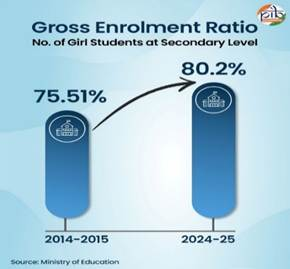
    • Gender Parity Index: 1.0 at foundational to middle levels; 1.1 for secondary education (Source: NFHS-5)
    • Higher Education: Female GER improved from 22.9 to 30.2, with STEM enrolment at 43% — one of the highest globally.
  • Workforce Presence: Women in Agniveer recruitment (armed forces) and permanent commissions across 12 armed units mark key milestones.
  • Demographic Milestone: India's sex ratio touched 1020 (NFHS-5), reflecting growing gender equity.

Comparative Analysis: India vs Global Progress

India's progress in women-led development can be compared globally. For instance, while India has made strides in STEM education, its workforce participation still lags behind global leaders like Sweden. Additionally, addressing challenges like the Cooling effect on the wane in gender-focused policies is essential for sustained progress.

Indicator India Global Leader (Example)
Percentage of Women in STEM Fields 43% 44% (USA, World Bank Data)
Female Workforce Participation Rate 25.1% 57% (Sweden, WDI)
Global Gender Gap Index (2023) Rank 127 Rank 1 (Iceland, WEF GGGR)

Barriers to Women-led Development

Structural Challenges

Despite progress, structural and systemic challenges hinder the realization of gender-equitable economic and social development. These barriers can be categorized as cultural, economic, political, and systemic. For example, the lack of women's reservation in legislative bodies, as discussed in The journey to Viksit Bharat, remains a critical gap in political representation.

  • Cultural Barriers:
    • Gender stereotypes limit women’s representation in leadership positions.
    • Prevalence of child marriage (23.3%, NFHS-5) impacts education and autonomy.
  • Economic Inequality:
    • Gender pay gap remains persistent at 19% (Monster.com report, 2023).
    • Access to financial credit is limited for women entrepreneurs.
  • Political Representation:
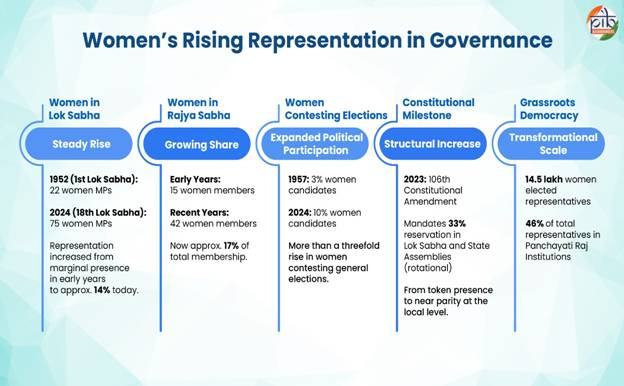
    • Women occupy only 14% of parliamentary seats.
    • Lack of women's reservation in Lok Sabha remains a legislative gap.
  • Safety Issues:
    • High rates of gender-based violence (NCRB, 2023: over 4 lakh cases of crimes against women).
    • Workplace harassment and the absence of grievance redressal mechanisms.

Critical Limitations and Unresolved Debates

The institutional push for women-led development faces inherent challenges at the policy formulation, societal, and operational levels. Major limitations and ongoing debates include:

  • Policy Gaps: Limited scope of reservation policies for women beyond local governance.
  • Funding Challenges: Inadequate financing for women-specific welfare programs, as highlighted by the CAG (2023).
  • Cultural Resistance: Deeply entrenched patriarchal attitudes are slow to change, limiting programmatic success.
  • Measurement Issues: Lack of gender-specific data in critical areas like unpaid domestic work.

Structured Assessment

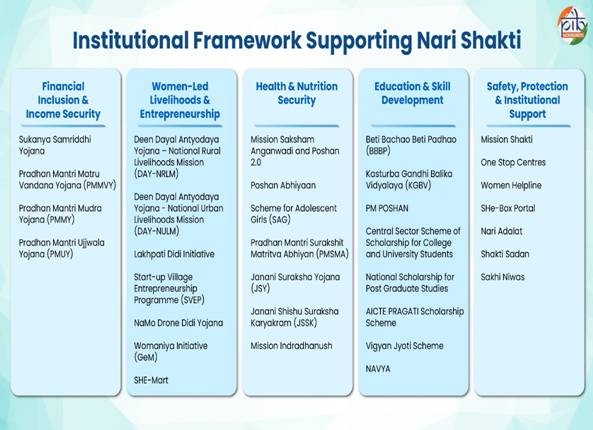
  • Policy Design: Strong policies like PMMVY and Ujjwala Yojana showcase intent, but require better implementation and monitoring.
  • Governance Capacity: Limited convergence between departments (Women and Child Development & Health) affects effectiveness.
  • Behavioural and Structural Factors: Patriarchal mindsets and rigid gender roles hinder adoption of progressive gender norms.

Way Forward

To achieve the vision of women-led development, India must adopt a multi-pronged approach:

  • Policy Strengthening: Implement mandatory reservation for women in legislative bodies and ensure gender-sensitive budgeting across all sectors.
  • Education and Skill Development: Expand access to STEM education and vocational training for women, especially in rural areas. This aligns with global trends, as highlighted in AI & Future of Work.
  • Economic Empowerment: Provide targeted financial incentives and credit facilities for women entrepreneurs to bridge the gender gap in economic participation.
  • Safety and Security: Strengthen legal frameworks to address gender-based violence and workplace harassment, ensuring robust grievance redressal mechanisms.
  • Community Engagement: Promote awareness campaigns to challenge patriarchal norms and foster gender-equitable attitudes at the grassroots level.

Frequently Asked Questions

What is the difference between women’s development and women-led development?

Women’s development focuses on state-led initiatives addressing systemic barriers, while women-led development empowers women as leaders and decision-makers in governance, entrepreneurship, and community welfare.

How does women-led development align with SDGs?

Women-led development aligns with SDG 5 (Gender Equality) and SDG 8 (Decent Work & Economic Growth) by emphasizing leadership, capacity-building, and systemic inclusion.

What are the major barriers to women-led development in India?

Key barriers include cultural stereotypes, economic inequality, limited political representation, and safety issues such as gender-based violence and workplace harassment.

How can India improve women’s workforce participation?

India can improve workforce participation by providing skill development programs, financial incentives for women entrepreneurs, and addressing the gender pay gap through policy interventions.

What role does education play in women-led development?

Education is crucial for empowering women, enhancing their leadership capabilities, and enabling them to participate actively in economic and social decision-making processes.

✍ Mains Practice Question
Prelims Questions: Consider the following statements about women’s education in India: The Gross Enrolment Ratio (GER) for secondary education among females is lower than for foundational levels. India has one of the highest proportions of women STEM graduates globally. Which of the above statements is/are correct? Codes: A. 1 only B. 2 only C. Both 1 and 2 D. Neither 1 nor 2 Answer: B Which of the following is NOT a Constitutional provision supporting women's empowerment in India? A. Article 39 – Equal livelihood opportunities B. Article 51(a)(e) – Renouncing practices derogatory to dignity C. Article 324 – Powers of the Election Commission D. Article 42 – Maternity relief and humane conditions Answer: C
250 Words15 Marks
✍ Mains Practice Question
Mains Question: Critically analyze the transition from women’s development to women-led development in India, highlighting the role of cultural, political, and systemic factors. (250 words)
250 Words15 Marks

Source: LearnPro Editorial | Polity | Published: 9 March 2026

Share
About LearnPro Editorial Standards

LearnPro editorial content is researched and reviewed by subject matter experts with backgrounds in civil services preparation. Our articles draw from official government sources, NCERT textbooks, standard reference materials, and reputed publications including The Hindu, Indian Express, and PIB.

Content is regularly updated to reflect the latest syllabus changes, exam patterns, and current developments. For corrections or feedback, contact us at admin@learnpro.in.

This Topic Is Part Of

Related Posts

Economy

AI & Future of Work: Anthropic’s Labour Market Study

Context A recent labour market study by Anthropic highlights the growing gap between the theoretical capabilities of AI and its actual workplace usage, and reveals early signals of structural shifts in employment. Key Highlights of Anthropic’s Labour Market Study Introduction of a New Metric: A new measure called ‘Observed Exposure’ to assess the impact of AI on jobs. It combines task-level occupational data, academic estimates of AI capability, and real-world usage data from the Claude AI syste

9 Mar 2026Read More
Internal Security

Women in Indian Armed Forces

Context On International Women’s Day (8 March), the expanding leadership and operational roles of women in the Indian Armed Forces highlight their growing contribution to national defence and gender equality. Historical Trajectory of Women in Indias Defence Services The role of women in India’s defence services has evolved steadily from limited support functions to increasingly diverse operational and leadership positions.

9 Mar 2026Read More
Daily Current Affairs

India’s ‘leaky pipeline’ Problem

In News Recently, it has been observed that Globally, women are underrepresented in STEM, a problem often called the “leaky pipeline.” About Women remain significantly underrepresented in STEM globally and in India, despite progress in education access. Women constitute only 35% of STEM graduates across the world and earn only 40% of STEM PhDs. Further, based on data from 146 nations, women scientists comprise only 30% of the STEM workforce, which includes academic jobs and faculty positions.

9 Mar 2026Read More
Polity

Regulations to implement new rural job Act yet to be finalised

Source: The Hindu(Page1) | Syllabus: GS2(Governance)

9 Mar 2026Read More

Enhance Your UPSC Preparation

Study tools, daily current affairs analysis, and personalized study plans for Civil Services aspirants.

Try LearnPro AI Free

Our Courses

72+ Batches

Our Courses
Contact Us