
Brief Context
Published on: 9th December, 2025 According to a recent United Nations report, the Countries across the Asia-Pacific region face unequal starting points, highlighting deep divides in digital and economic readiness.
Source Content
Syllabus: GS3/Economy, Employment, GS4/Impact of AI on Society
Context
- According to a recent United Nations report, the Countries across the Asia-Pacific region face unequal starting points, highlighting deep divides in digital and economic readiness.
Artificial Intelligence (AI) Adoption
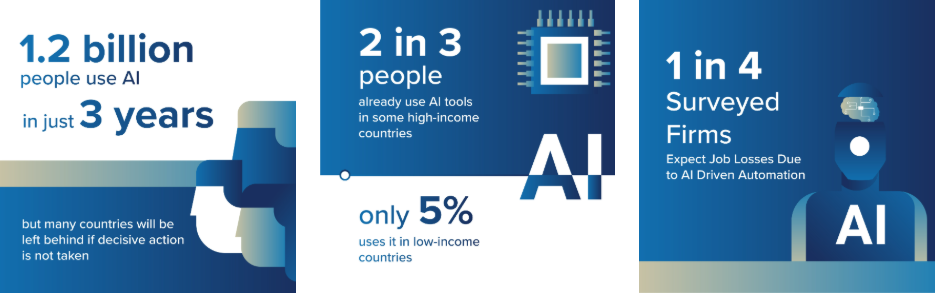
- According to a new UNDP flagship report, it has seen one of the fastest technological adoptions in history, reaching 1.2 billion users in just three years.
- Nearly 70% of these users are in developing countries, but the global distribution remains highly uneven.
- Two-thirds of people in high-income nations already use AI tools, but usage in many low-income economies remains close to 5%.
Understanding the Divergence in AI Adoption
- AI can boost economic growth, enhance public services, expand opportunities, and strengthen resilience.
- But, without inclusive adoption, it may also deepen divides, amplify exclusion, and weaken governance.
- Countries that possess the right mix of connectivity, digital skills, computing capacity, and regulation will capture most of the AI dividend.
- Meanwhile, others risk facing job disruption, data exclusion, misinformation, and even resource strain due to the rising energy and water demands of AI systems falling behind.
AI Adoption Across Asia-Pacific: Promise and Peril
- AI and People:
- Bhutan is piloting AI tutors to personalize school learning.
- Mongolia’s AI-driven credit scoring has provided $70 million in micro-loans to nearly 4,000 small businesses.
- Viet Nam’s digital farming tools reach 39 million farmers with real-time agricultural data.
- Northeast India’s AI flood-forecasting systems have doubled prediction accuracy, saving lives and property.
- However, above advances coexist with persistent inequalities, like:
- 1.6 billion people in the region cannot afford a healthy diet.
- 27 million youths remain illiterate.
- Women in South Asia are 40% less likely than men to own a smartphone.
- Rural and minority groups remain largely invisible in the datasets that train AI models.
- AI and the Economy:
- AI could lift global GDP growth by around 2 percentage points annually and increase productivity by up to 5%, if scaled effectively, in key sectors such as finance and healthcare.
- For example, ASEAN economies could gain nearly $1 trillion in additional GDP over the next decade.
- These gains come with significant labor market disruptions, like:
- 75% of firms expect job losses even as new AI-related roles emerge.
- Female workers are twice as exposed to automation risks compared to male counterparts.
- Informality remains high, with 88% of jobs in India and 60% in Indonesia lacking formal protections, heightening vulnerability to displacement.
- AI could lift global GDP growth by around 2 percentage points annually and increase productivity by up to 5%, if scaled effectively, in key sectors such as finance and healthcare.
- AI and Governance:
- Bangkok’s Traffy Fondue platform has processed 600,000 citizen reports efficiently.
- Singapore’s Moments of Life app reduced new-parent paperwork from 120 minutes to just 15 minutes.
- Beijing’s digital twin systems simulate urban growth and flood risks in real time.
- However, regulatory frameworks lag behind technological advances. Only a handful of countries have comprehensive AI laws, and many systems remain opaque ‘black boxes’.
- By 2027, an estimated 40% of global AI-related data breaches could stem from the misuse of generative AI, underscoring urgent governance challenges.
- Gaps in AI Preparedness: The AI Preparedness Index, developed by the International Monetary Fund (IMF), reveals disparities in readiness across the Asia-Pacific.
- Advanced economies like Singapore, South Korea, and China score above 70%, reflecting robust digital infrastructure, strong innovation ecosystems, and proactive regulation.
- Fragile and low-income states, by contrast, score below 20%, lacking reliable electricity, data systems, and connectivity needed to fully participate in the AI revolution.
- These regional divides are compounded by inequalities within countries, where income and wealth remain concentrated among the top 10%, leaving large segments of the population excluded from technological progress.
Way Forward: Building Inclusive AI Futures
- Building the Foundations for Inclusive AI: The UN report emphasizes that inclusive AI adoption depends on strengthening both hard and soft foundations.
- Hard foundations include affordable and reliable internet access, clean and stable electricity, and cooling and computing resources.
- Soft foundations include human capital development through education and upskilling; effective public institutions to guide digital transformation; and robust legal and ethical frameworks to ensure fairness, privacy, and trust.
- UNDP’s Call to Action: The UNDP urges immediate global and national action to bridge the AI divide:
- Invest in digital infrastructure and connectivity;
- Strengthen AI-related education and skills;
- Develop ethical and safety regulations;
- Promote sustainable and energy-efficient compute;
- Foster regional and global cooperation on standards and open-source AI models;
| Daily Mains Practice Question [Q] To what extent does unequal AI adoption risk reinforcing existing socio-economic disparities in the Asia Pacific region, and what policy interventions could ensure more equitable outcomes? |