
Brief Context
Indias social security framework has long been criticized for its fragmented approach, particularly in addressing the needs of informal workers, and highlighting the need for a comprehensive and universal social protection system.
Source Content
Syllabus: GS2/Governance; Social Issues
Context
- India’s social security framework has long been criticized for its fragmented approach, particularly in addressing the needs of informal workers, and highlighting the need for a comprehensive and universal social protection system.
About the Social Security
- It is a crucial aspect of economic and social policy aimed at providing financial and social protection to the country’s diverse population.
- It is primarily delivered through government initiatives, employer-based benefits, and social insurance programs.
- Social protection is a recognized human right, essential for achieving the Sustainable Development Goals (SDGs).
- Goal 1 of the SDGs aims to end poverty by 2030 through national social protection systems, ensuring the coverage of vulnerable groups.
Global Perspective and Sustainable Development
- India’s Universal Social Security aspiration resonates with ILO’s Social Protection Floors Recommendation, which calls for:
- Basic income security;
- Access to essential health care;
- Extension to informal economy;
- Article 22 of the Universal Declaration of Human Rights: It emphasizes social security as a fundamental right.
- India’s efforts are significant, though still evolving compared to models in countries like Brazil (Bolsa Familia) or South Africa (social pensions).
Current Challenges in Social Security
- Fragmented Framework: Social security in India is often tied to formal employment, leaving informal workers excluded or disadvantaged.
- Welfare boards, which are central to the distribution of benefits, have faced significant inefficiencies and underutilization of funds.
- Gig Workers and Emerging Categories: The rise of gig workers has prompted new schemes, such as health coverage under Ayushman Bharat and transaction-based pension policies.
- However, these measures remain reactive, addressing challenges only when new worker categories emerge.
- Implementation Gaps: Reports reveal delays in remittance payments and underutilization of welfare funds, such as the ₹70,744.16 crore collected for construction workers.
- Even states with strong welfare records, like Kerala, have struggled with the effective functioning of welfare boards.
- Underestimation of Coverage: The ILO report does not account for in-kind benefits like food security and housing or state-administered schemes.
- The actual coverage is expected to be higher once these factors are included.
- Low Coverage in the Unorganized Sector: Over 90% of India’s workforce is in the unorganized sector, yet only a small fraction benefits from social security schemes.
- Challenges in Implementation:
- Fragmentation: Multiple welfare schemes, managed by different departments.
- Identification: Lack of a single unified worker registry (eShram helps but incomplete).
- Funding Gaps: Limited fiscal allocation for full-scale universal coverage.
- Portability: Migrant workers lack portability across states.
- Awareness: Many workers are unaware of entitlements.
India’s Universal Social Security Vision
- It emphasizes inclusion of Unorganized sector workers (~90% of workforce); Migrant workers; Gig and platform economy workers (e.g., Swiggy, Uber); Women workers; and Senior citizens without pensions.
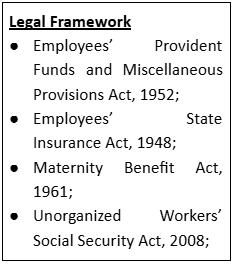
Social Security Code, 2020
- It consolidates nine central labor laws into one unified legislation, as an umbrella scheme.
- It mandates the creation of a National Social Security Board to recommend suitable schemes for different classes of workers, including gig workers and the self-employed.
- It covers a broad spectrum: Provident Fund; Employee State Insurance; Gratuity; Maternity Benefit; Social security for gig and platform workers; and Welfare for unorganized workers.
| Schemes Under the Umbrella | ||
| Scheme | Target Group | Benefit |
| PM-SYM (Pradhan Mantri Shram Yogi Maan-dhan) | Unorganized workers | Pension of ₹3,000/month after age 60 |
| e-Shram Portal | All informal workers | UAN-linked central database for welfare access |
| Atal Pension Yojana | All citizens (mainly unorganized) | Defined pension scheme |
| ESIC (Employees’ State Insurance) | Formal Workers; Now extended to gig workers | Health, maternity, disablement benefits |
Need for a Universal Social Protection System
- Proactive Approach: India must reimagine its social security framework to address the precarious nature of informal work comprehensively.
- A universal system would ensure protection for all workers, regardless of their employment type or sector.
- Integration of Targeted Relief: Combining universal social protection with targeted support for specific worker categories can address unique challenges while ensuring inclusivity.
- Alignment with Global Standards: As a founding member of the ILO, India should ratify the Social Security (Minimum Standards) Convention, 1952, to establish basic social security principles.
Recent Expansions in Social Security
- Extending Benefits to Gig and Platform Workers: Under the social security umbrella through platforms like e-Shram and the Social Security Code 2020.
- Digital and Financial Inclusion: The Jan Dhan-Aadhaar-Mobile (JAM) Trinity has strengthened the delivery of welfare benefits, ensuring direct benefit transfers (DBT) to beneficiaries, reducing leakages, and improving transparency.
- Ration Card Portability under ‘One Nation, One Ration Card’ (ONORC): It enables migrant workers to access subsidized food grains anywhere in India.
- Strengthening Healthcare and Insurance for Informal Workers: The government has been pushing for the inclusion of informal workers in health schemes, ensuring access to PM-JAY and ESIC facilities.
Conclusion
- Relying on piecemeal approaches to social security risks leaving vulnerable workers behind and creating inequities between different categories of informal work.
- By adopting a universal and inclusive social protection system, India can ensure the dignity and well-being of its workforce while fostering sustainable economic growth.
| Daily Mains Practice Question [Q] How can India move beyond fragmented social security measures to establish a universal and inclusive protection system for all workers, ensuring financial stability and dignity? |