
Brief Context
Published on: 24th December, 2025 The agriculture sector in India holds untapped potential to drive green energy revolution with over half of India’s population dependent on farming and rural livelihoods.</p
Source Content
Syllabus: GS3/Agriculture; Renewable Energy
Context
- The agriculture sector in India holds untapped potential to drive green energy revolution with over half of India’s population dependent on farming and rural livelihoods.
About India’s Agriculture & Energy Transition
- The agriculture sector in India contributes nearly 18% to India’s GDP and employs over 42% of the workforce.
- According to India’s Energy Statistics India (2025), agriculture accounts for approximately 17% share of electricity use, particularly for irrigation.
- In several states, it constitutes over 20% of total electricity consumption.
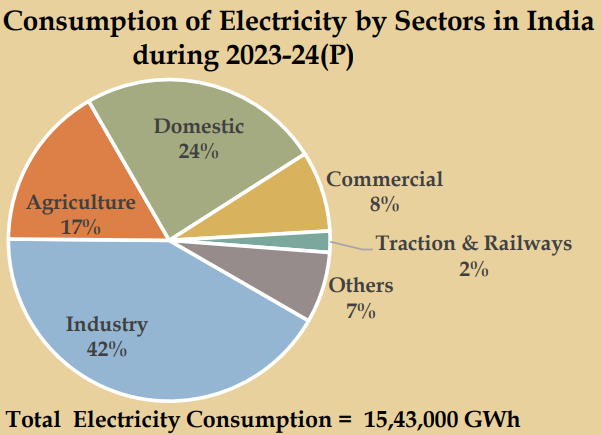
- The agriculture sector in India is both energy-intensive and energy-deficient, heavily on diesel-powered irrigation pumps, and post-harvest losses due to inadequate cold storage and high processing infrastructure.
- Many states provide free or heavily subsidized electricity to farmers, which has led to overuse and inefficiencies, including groundwater depletion.
- According to the International Labour Organization (ILO), India’s renewable energy transition could create 3.7 million green jobs, many connected to agricultural systems.
- Each solar-powered cold storage unit represents a local enterprise requiring technicians, operators, logistics personnel, and community managers.
Issues With Agriculture Sector in India
- Hidden Cost of Food Loss: India loses 30–40% of its fruits and vegetables after harvest, happen during transport, storage, and processing which depend on reliable power.
- A cold storage unit without power is useless; so are processing centers and preservation systems dependent on erratic electricity or costly diesel generators.
- Policy Fragmentation: Energy and agriculture policies are often siloed, limiting cross-sectoral innovation.
- Schemes like PM-KUSUM, the National Solar Mission, and the PM Surya Ghar Muft Bijli Yojana have expanded solar access in rural India, but their full potential remains untapped due to fragmented policy design.
- Awareness & Training: Many farmers remain unaware of DRE solutions or lack the skills to operate and maintain them.
- Financing Gaps: Smallholder farmers often lack access to affordable credit for renewable energy technologies.
- Other challenges include high upfront costs for solar pumps despite subsidies; maintenance challenges in remote rural areas; and water overuse risk with solar irrigation.
Utilising Clean Energy in Agriculture
- Decentralised Renewable Energy (DRE) Solutions: These systems such as solar mini-grids, rooftop panels, and hybrid units reduce dependence on unreliable grids and diesel, cut operating costs, and enable community ownership of energy assets.
- DRE can make rural food systems both resilient and sustainable by localizing power.
- DRE solutions generate employment along the food chain, enhancing both livelihoods and food security.
- Transitions in Energy and Digital Innovation: India’s rural transformation is being shaped by digital platforms like ITC MAARS, offering AI-driven crop advice and market intelligence.
- But, digital tools alone cannot preserve crops or stabilize prices, as they need energy infrastructure to act on information.
- When renewable energy powers cold storages, dryers, and processing units, farmers can convert digital insights into tangible outcomes.
- Together, smart energy and smart advisory systems create a powerful engine for rural resilience.
- Local Innovation and Solutions: Across India, farmers are developing low-cost, context-specific energy innovations. These include:
- Solar dryers made from local materials;
- Converted refrigerated trucks used as mobile cold storages;
- Community-run solar processing units;
- Bridging Policy Silos: Agriculture and energy are managed by separate ministries and financing channels, resulting in missed opportunities.
- Linking renewable energy initiatives with agricultural value chains could help bridge rural infrastructure gaps and cut post-harvest losses.
- Effective coordination between these sectors is key to achieving climate-smart agriculture.
| Case Study of Odisha
– The Markoma Women Farmer Producer Company (FPO) established a 5-metric-tonne Ecozen solar-powered cold storage unit to serve local vegetable growers with support from the Harsha Trust. |
Government Policy & Framework
- PM-KUSUM Scheme (MNRE): It aims to reduce farmers’ dependence on diesel and grid electricity, lower emissions, and provide additional income through surplus energy sales.
- Component A: Installation of 10,000 MW of decentralized ground-mounted grid-connected renewable power plants on barren/fallow land.
- Component B: Installation of 2 million standalone solar agriculture pumps.
- Component C: Solarization of 1.5 million existing grid-connected agriculture pumps.
- Voluntary Carbon Market Framework (Ministry of Agriculture): It encourages climate-smart agriculture while creating new income streams.
- Register GHG mitigation projects (eg, renewable energy use, sustainable practices).
- Earn carbon credit certificates under the Carbon Credit Trading Scheme.
- Monetize eco-friendly practices, especially beneficial for small and marginal farmers.
- Energy Data Management in Agriculture (NITI Aayog): It highlights the need for accurate energy consumption data to design effective clean energy interventions.
- It recommends inter-ministerial coordination and data-driven policy planning, and emphasis on monitoring DRE deployment in rural areas.
- Other Policy Initiatives:
- Clean Plant Programme (CPP): Promotes climate-resilient horticulture through disease-free planting material.
- Support for climate-smart agriculture under various centrally sponsored schemes.
- Incentives for renewable energy adoption in rural infrastructure and agri-processing.
Way Forward: Towards a Resilient, Net-Zero Future
- The NITI Aayog ‘Energy and Agriculture Nexus Report 2025’ outlines potential synergies:
- Bioenergy from crop residues could generate 20 GW of power, helping reduce stubble burning.
- Agro-voltaics (farming under solar panels) can enhance land productivity by 60%, as piloted in Rajasthan and Tamil Nadu.
- Green hydrogen from biomass and waste-to-energy plants are emerging as next frontiers for agri-linked clean energy.
- As India advances toward its 2070 net-zero goal, linking renewable energy with food systems needs to become a national priority. Key actions include:
- Expanding solar integration beyond irrigation to post-harvest systems;
- Offering targeted credit for farmer collectives;
- Encouraging public-private partnerships;
- Investing in green skills training;
| Daily Mains Practice Question [Q] Examine the role of agriculture in India’s clean energy transition. Do you agree that agriculture holds the greatest potential for clean energy transition? |