
Brief Context
Universal healthcare — the ideal system where every citizen, regardless of income, receives quality medical care — needs to begin by making diagnostics accessible, affordable, and ubiquitous.
Source Content
Syllabus: GS2/Issues Related To Health
Context
- Universal healthcare — the ideal system where every citizen, regardless of income, receives quality medical care — needs to begin by making diagnostics accessible, affordable, and ubiquitous.
About Universal Health
- It means that all people have access to the full range of quality health services without financial hardship.
- Key components of UHC include:
- Access to Care: Everyone should be able to obtain necessary health services when they need them.
- Quality Services: The care provided should be effective, safe, and of good quality.
- Financial Protection: Individuals should not face financial difficulties due to medical expenses.
- India is committed to Universal Health Coverage (UHC), as outlined in the National Health Policy 2017 and the UN’s SDGs.
Role of Diagnostics in Effective Healthcare
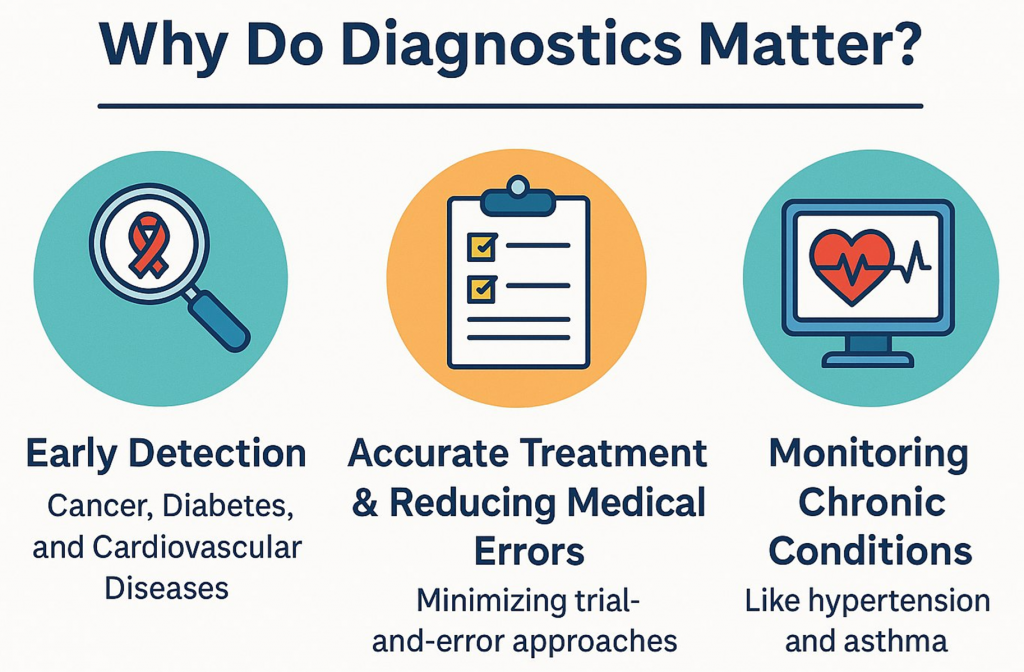
- Accurate diagnosis is the foundation of effective medical treatment. It relies on patient history, clinical examination, and laboratory tests to confirm or adjust the initial assessment, often predicting disease progression.
- Diagnostics guide over 60% of clinical decisions globally, from identifying diseases early to tailoring treatments and monitoring progress.
- In India, diagnostics receive less than 5% of total health spending.
- Without timely and reliable diagnostic services, patients risk delayed or incorrect treatment, leading to worse outcomes and higher costs.
Current Gaps in Diagnosis & Need for Localised Services
- Limited Access and Affordability: Diagnostics account for 10 – 15% of out-of-pocket health expenditure, especially in outpatient care.
- Most public health facilities lack basic diagnostic infrastructure — only 12% of PHCs have labs that meet minimum standards.
- Private labs dominate the market but are often unaffordable for rural and low-income populations.
- Poor Quality and Regulation: India has over 100,000 labs, but fewer than 2% are accredited by NABL.
- Many labs operate without standardized protocols, proficiency testing, or external audits.
- Faulty diagnostics lead to misdiagnosis, delayed treatment, and irrational drug use, fueling antimicrobial resistance.
- Evolving Health Needs and Priority Areas: Shifting demographics and lifestyles have brought non-communicable diseases (NCDs) like diabetes and heart disease to the forefront, alongside persistent infectious diseases such as tuberculosis and malaria.
- Fragmented Data and Digital Disconnect: Lack of integration between public and private diagnostic data systems undermines continuity of care.
- The Ayushman Bharat Digital Mission aims to bridge this gap, but implementation is uneven.
- Neglect of Preventive Diagnostics: Insurance schemes like PM-JAY focus on inpatient care, excluding preventive diagnostics.
- Non-communicable diseases (NCDs) like diabetes and cardiovascular conditions require early detection, which is often missed due to lack of routine screening.
- Workforce and Training Deficit: Many technicians lack proper training in test administration, quality control, and ethical practices.
- Rural areas suffer from acute shortages of skilled diagnostic personnel.
Government and Policy Responses
- National List of Essential Diagnostics (NLED): The ICMR’s updated NLED reflects India’s health and technology transitions. Key inclusions:
- PHC-level HbA1C testing for diabetes monitoring;
- Rapid tests for sickle cell anaemia, thalassaemia, hepatitis B, syphilis, and dengue at sub-centres;
- Molecular TB testing starting from sub-centres, with in-house testing at higher facilities;
- Expanded blood chemistry tests at PHCs;
- Dental X-rays at Community Health Centres (CHCs)
- Ayushman Bharat Health and Wellness Centres: These centers are being equipped to offer frontline diagnostic services, including HbA1c tests for diabetes and rapid tests for infectious diseases.
- The Ayushman Bharat Digital Mission (ABDM) integrates diagnostics with electronic health records, enabling better data sharing and predictive care.
- Vision 2035 by NITI Aayog: Emphasizes lab networks and surveillance systems as critical components of public health infrastructure.
- G20 Health Working Group: Advocates decentralized manufacturing and regional diagnostic strategies to improve access and affordability.
Innovations and Solutions
- Tele-diagnostics: Services like tele-radiology and tele-pathology bridge expertise gaps between rural clinics and urban hospitals.
- Point-of-Care Devices: Portable diagnostic tools are expanding reach in underserved areas.
- AI and Genomics: Advanced technologies are improving diagnostic accuracy and enabling personalized medicine.
- Technological Advances in Diagnostics: District hospitals now offer enhanced imaging, while PHCs are equipped with semi-auto analysers. Modern healthcare benefits from:
- Molecular diagnostics for higher precision;
- Tele-diagnostics (tele-radiology, tele-pathology, tele-dermatology) to bridge expertise gaps;
- Point-of-care devices for frontline use.
- Cost-Effectiveness and Evidence-Based Practice: Choosing the right tests involves balancing accuracy and cost. ICMR plays a key role in developing diagnostic algorithms to guide healthcare providers on:
- Sequential vs. simultaneous testing;
- Cost–benefit trade-offs;
- Maximum value per diagnostic step;
Lessons for India
- Countries like Rwanda and Thailand have shown that investing in diagnostics pays off.
- Rwanda’s community health worker model includes basic diagnostic tools, leading to early detection of diseases like malaria and pneumonia.
- Thailand’s universal coverage scheme includes free diagnostics, which has drastically reduced out-of-pocket expenses.
- Lessons from TB and COVID-19: The COVID-19 pandemic accelerated the spread of RT-PCR and molecular diagnostics across India.
- These technologies are now critical for faster TB detection and drug-resistance monitoring, replacing older, less sensitive techniques.
Roadmap: Democratizing Diagnostics
- Public-Private Partnerships: Encourage collaborations between government and private labs to set up low-cost diagnostic centers in underserved areas.
- Mobile Labs and Telemedicine: Deploy mobile diagnostic vans and integrate remote consultations to reach remote populations.
- Subsidies and Insurance Coverage: Include diagnostics in government health schemes like Ayushman Bharat, ensuring tests are covered and not just treatments.
- Local Manufacturing: Invest in domestic production of diagnostic equipment and reagents to reduce dependency on imports and lower costs.
- Training and Workforce Development: Scale up training for lab technicians and radiologists, especially in Tier 2 and Tier 3 cities.
- Building Technical Capacity: Beyond equipment supply, healthcare delivery needs:
- More trained laboratory technicians;
- Skilled frontline workers for point-of-care testing
- Clinical training in interpreting diagnostic probabilities
- AI could support providers in interpreting results and reducing errors.
Conclusion
- Achieving UHC in India requires diagnostics that are affordable, available close to home, and supported by trained personnel.
- By strengthening the diagnostic backbone—through policy, technology, and training—India can ensure early detection, reduce treatment delays, and improve health outcomes for all.
| Daily Mains Practice Question [Q] Discuss why making diagnostics accessible and affordable should be considered the foundational step toward achieving universal healthcare in India. Support your answer with examples and policy implications. |