
 Forest Services
Disaster Management Cycle: Master Mains 2025
The Disaster Management Cycle includes a comprehensive set of activities, programs, and measures designed to address the phases of a disaster. It consists of actions that are taken before, during, and after a disaster to reduce risks, minimize damage, and aid recovery. The cycle can be divided into two primary phases:
- Pre-Disaster Risk Management Phase:
- Focuses on prevention, mitigation, and preparedness to reduce the likelihood and impact of a disaster.
- Post-Disaster Crisis Management Phase:
- Involves relief, response, rehabilitation, reconstruction, and recovery to help affected communities rebuild and return to normalcy.
Key Stages in the Disaster Management Cycle
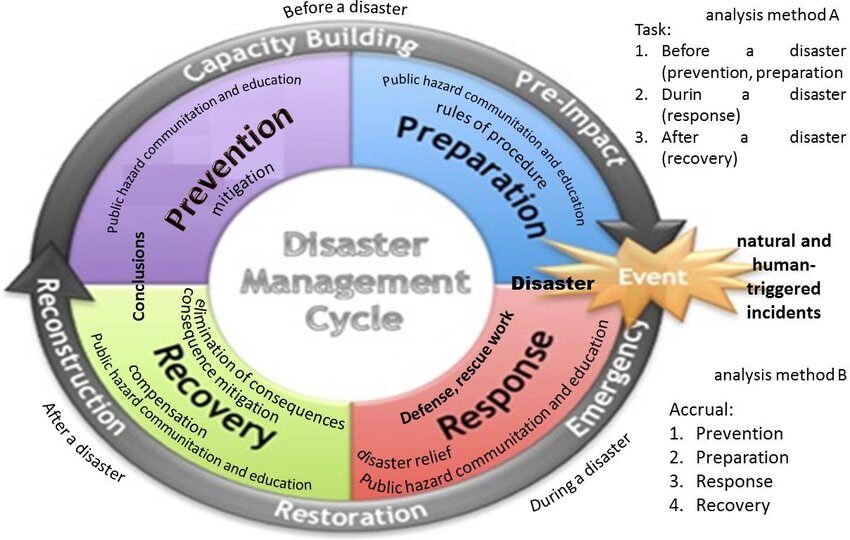
Disaster Management Cycle
1. Before a Disaster (Pre-Disaster Phase)
This phase focuses on reducing risks and vulnerabilities through proactive planning and preparedness measures. Activities include:
- Prevention:
Steps to avoid or reduce the occurrence of disasters.
Examples:- Building earthquake-resistant structures.
- Constructing flood embankments to protect vulnerable areas.
- Implementing afforestation and watershed management to stabilize ecosystems.
- Mitigation:
Actions aimed at reducing the impact of potential disasters.
Examples:- Enforcing building codes to ensure safety standards.
- Developing early warning systems for cyclones, floods, and other hazards.
- Conducting awareness campaigns to educate communities about risks and safety measures.
- Preparedness:
Ensuring that communities, governments, and organizations are ready to respond effectively.
Examples:- Establishing evacuation plans and conducting mock drills.
- Stockpiling emergency supplies, such as food, water, and medical kits.
- Training first responders and community volunteers.
2. During a Disaster (Disaster Occurrence Phase)
This phase involves rapid response to address the immediate needs of those affected by the disaster. The goal is to alleviate suffering, minimize losses, and provide critical support.
- Primary Activities:
These are essential during the crisis and include:- Evacuation: Moving people from danger zones to safe areas.
- Search and Rescue: Locating and rescuing those trapped or injured.
- Provision of Basic Needs:
- Food, clothing, and shelter.
- Medical aid to treat injuries and prevent disease outbreaks.
- Distribution of relief materials, such as blankets and clean water.
- Coordination:
Ensuring seamless collaboration between government agencies, non-profits, and international organizations for efficient disaster response.
3. After a Disaster (Post-Disaster Phase)
The post-disaster phase focuses on recovery, rehabilitation, and reconstruction to restore communities to normalcy and enhance resilience against future disasters.
- Recovery:
Policies and procedures are implemented to restore critical systems and infrastructure. Examples:- Rebuilding communication networks and transportation systems.
- Restoring power grids and water supply.
- Rehabilitation:
This involves restoring essential services and supporting individuals and communities in rebuilding their lives. Examples:- Assisting victims in repairing homes and community facilities.
- Supporting local businesses to restart economic activities.
- Providing psychosocial support to address trauma.
- Reconstruction:
Focused on rebuilding damaged infrastructure and creating sustainable livelihoods.
Examples:- Constructing disaster-resilient buildings and infrastructure.
- Incorporating disaster risk reduction into long-term development plans.
- Implementing strategies to reduce future vulnerabilities, such as zoning laws to avoid high-risk areas.
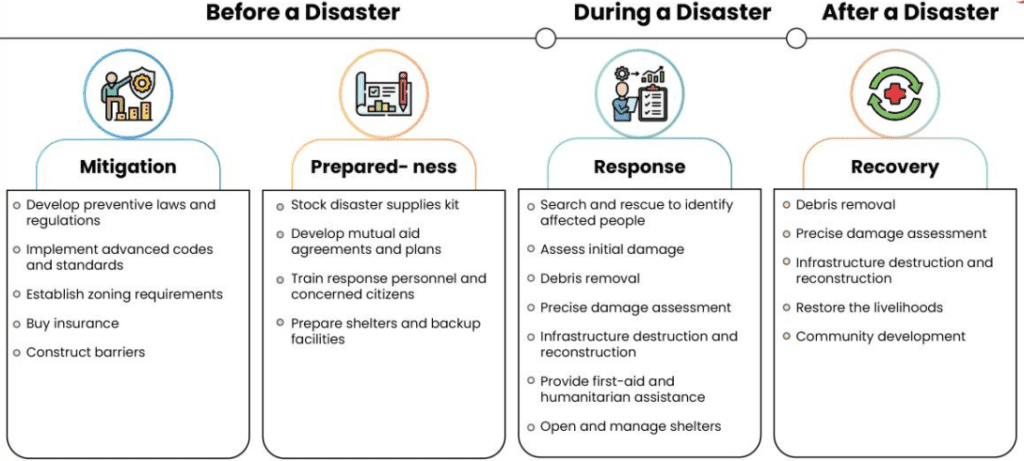
Integration of the Disaster Management Cycle
The disaster management cycle must be an ongoing process, with each phase feeding into the next to ensure continuous improvement. For example:
- Prevention and mitigation in the pre-disaster phase reduce the need for extensive relief efforts during and after a disaster.
- Recovery and reconstruction after a disaster offer opportunities to integrate better planning and risk reduction measures into future development.
By following this cycle, communities can not only rebuild after disasters but also become more resilient to future risks.
Disaster Preparedness in Disaster Management Cycle
What is Disaster Preparedness?
In Disaster Management Cycle Disaster preparedness refers to the actions, strategies, and measures taken to anticipate, prepare for, and reduce the potential impacts of disasters. It aims to minimize loss of life, property, and livelihoods by ensuring that individuals, households, communities, and governments are ready to respond effectively and recover quickly from disaster events.
Disaster preparedness involves a proactive approach, focusing on:
- Predicting and preventing disasters wherever possible.
- Mitigating the impacts of disasters on vulnerable populations.
- Developing effective response mechanisms to cope with the consequences of disasters.
Levels of Disaster Preparedness
Preparedness activities can be implemented at various levels, each playing a critical role in ensuring community resilience.
- Individual-Level Preparedness:
- Equipping individuals with the knowledge and skills to protect themselves during disasters.
- Examples:
- Learning first aid and basic life-saving techniques.
- Understanding evacuation routes and safety protocols.
- Household-Level Preparedness:
- Ensuring that families have the tools and resources needed to cope with emergencies.
- Examples:
- Stockpiling emergency supplies like non-perishable food, water, flashlights, and first aid kits.
- Creating a family evacuation plan and designating meeting points.
- Community-Level Preparedness:
- Engaging communities in collaborative efforts to prepare for disasters.
- Examples:
- Organizing training sessions and mock disaster drills.
- Establishing emergency shelters and ensuring community-wide access to safety equipment.
- Governmental-Level Preparedness:
- Developing comprehensive disaster management policies and systems at regional and national levels.
- Examples:
- Implementing early warning systems to predict and communicate impending disasters.
- Creating contingency plans and mapping evacuation routes.
- Disseminating public awareness campaigns to educate citizens on disaster readiness.
Transition from Traditional to Modern Approaches in Disaster Management Cycle
Historically, disaster management was centered around the 3 Rs:
- Rescue: Saving lives during and immediately after disasters.
- Relief: Providing essential aid to affected populations.
- Restoration: Rebuilding infrastructure and livelihoods post-disaster.
However, modern Disaster Management Cycle emphasizes proactive planning and resilience building, shifting to the 3 Ps:
- Prevention: Taking steps to eliminate or reduce disaster risks (e.g., constructing flood barriers, enforcing building codes).
- Preparedness: Equipping communities to face disasters (e.g., training programs, stockpiling resources).
- Proofing: Building long-term resilience against future disasters (e.g., creating disaster-proof infrastructure).
Importance of Disaster Preparedness in Disaster Management Cycle
- Saves Lives and Reduces Injuries:
- Advanced warning and preparation ensure people can evacuate safely and avoid harm.
- Minimizes Economic Losses:
- Preparedness reduces the cost of response and recovery by mitigating damage to property and infrastructure.
- Empowers Communities:
- Training and awareness programs help communities take charge of their own safety.
- Builds Resilience:
- Preparedness creates systems and infrastructure that are better equipped to handle future disasters, reducing long-term vulnerabilities.
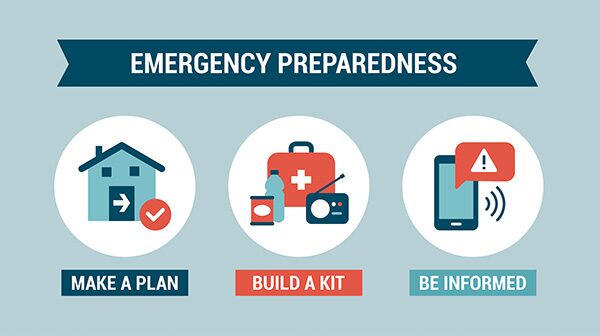
Preparedness is defined by the United
Nations International Strategy for
Disaster Reduction (UNISDR) as
knowledge, capabilities, and actions of
governments, organizations, community
groups, and individuals “to effectively
anticipate, respond to, and recover from,
the impacts of likely, imminent or
current hazard events or conditions.”
Disaster Risk Reduction and Planning in Disaster Management Cycle
What is Disaster Risk Reduction?
Disaster Risk Reduction (DRR) in Disaster Management Cycle refers to the strategies and practices aimed at minimizing the risks associated with disasters. It focuses on reducing exposure to hazards, decreasing vulnerabilities, and enhancing preparedness to prevent or mitigate the adverse impacts of disasters. Effective DRR combines risk management, environmental planning, and community resilience-building at local, national, and international levels.
DRR encompasses a range of activities, including prevention, preparedness, and mitigation, to create safer, more resilient societies.
Key Components of Disaster Risk Reduction Framework
The DRR framework is built on a series of actions designed to identify, manage, and reduce disaster risks effectively. These include:
- Policy Framework Supported by Legal and Institutional Mechanisms:
- A comprehensive policy framework for disas
Planning in Disaster Management Cycle
What is Planning in Disaster Management?
Planning in Disaster Management refers to the systematic process of developing strategies, policies, and procedures to prepare for, respond to, and recover from disasters. It involves anticipating potential hazards, assessing risks, allocating resources, and defining roles and responsibilities for various stakeholders. Effective planning is a continuous and dynamic process that adapts to changing circumstances and lessons learned from past events.
Importance of Planning in Disaster Management
Planning is the cornerstone of effective disaster management for several reasons:
- Reduces Impact: Well-developed plans can significantly reduce the loss of life, injuries, and economic damage by enabling timely and coordinated actions.
- Optimizes Resource Allocation: Planning helps in identifying necessary resources (human, financial, material) and ensuring their efficient deployment before, during, and after a disaster.
- Enhances Coordination: It establishes clear lines of communication and command, fostering better coordination among government agencies, NGOs, communities, and international bodies.
- Builds Resilience: Proactive planning, especially in the DRR phase, helps communities and infrastructure become more resilient to future shocks.
- Facilitates Swift Recovery: Pre-disaster recovery plans can accelerate the rehabilitation and reconstruction process, ensuring that communities "build back better."
- Legal and Ethical Obligation: Governments and authorities have a legal and ethical responsibility to protect their citizens, which necessitates robust disaster planning.
Key Aspects of Disaster Planning
Disaster planning encompasses several critical aspects:
- Hazard Identification and Risk Assessment: The foundational step involves identifying potential hazards (e.g., floods, earthquakes, pandemics) and assessing the likelihood and potential impact of these hazards on vulnerable populations and infrastructure.
- Vulnerability Analysis: Understanding the weaknesses and susceptibilities of communities, systems, and infrastructure to specific hazards.
- Resource Mapping and Mobilization: Identifying available resources (e.g., emergency services, medical supplies, shelters, volunteers) and developing strategies for their rapid mobilization.
- Emergency Response Plans: Detailed plans outlining procedures for evacuation, search and rescue, medical aid, communication, and immediate relief operations during a disaster.
- Continuity Plans: Ensuring that essential government functions and critical services (e.g., power, water, communication) can continue or be rapidly restored after a disaster.
- Recovery and Reconstruction Plans: Strategies for long-term recovery, including housing, economic revitalization, psychological support, and infrastructure rebuilding, often with a focus on DRR principles.
- Training and Drills: Regular training for emergency personnel and conducting mock drills to test the effectiveness of plans and improve response capabilities.
- Public Awareness and Education: Informing the public about potential risks, emergency procedures, and how to prepare themselves and their families.
- Legal and Policy Framework: Establishing the necessary legal backing and policy guidelines to support and enforce disaster management plans.
Frequently Asked Questions (FAQs)
Q1: What is the primary difference between Disaster Management and Disaster Risk Reduction (DRR)?
A1: Disaster Management is a broader term encompassing all phases of a disaster cycle (mitigation, preparedness, response, recovery). DRR is a specific component within disaster management, focusing primarily on proactive measures to prevent new disaster risks, reduce existing risks, and manage residual risks, thereby minimizing the adverse impacts of hazards.
Q2: What is the Sendai Framework for Disaster Risk Reduction?
A2: The Sendai Framework for Disaster Risk Reduction (2015-2030) is an international agreement adopted by UN member states. It outlines a global blueprint for reducing disaster risk and losses. Its primary goal is to prevent new and reduce existing disaster risks, emphasizing the need for a multi-sectoral and inclusive approach to build resilience.
Q3: Why is community participation crucial in Disaster Risk Reduction?
A3: Community participation is vital because local communities are often the first responders and have intimate knowledge of local hazards, vulnerabilities, and resources. Engaging them in DRR planning and implementation ensures that strategies are context-specific, sustainable, and effective, leading to greater ownership and resilience.
Q4: How does climate change impact Disaster Risk Reduction efforts?
A4: Climate change exacerbates existing disaster risks and creates new ones by increasing the frequency and intensity of extreme weather events (e.g., floods, droughts, heatwaves, cyclones). This necessitates integrating climate change adaptation into DRR strategies, focusing on building climate-resilient infrastructure, early warning systems, and sustainable resource management.
1. Which of the following is NOT considered a key component of Disaster Risk Reduction (DRR)?
- Risk Assessment and Early Warning Systems
- Knowledge Management and Education
- Post-disaster tourism promotion
- Structural and Non-Structural Measures
Correct Answer: c) Post-disaster tourism promotion
2. The primary objective of the Sendai Framework for Disaster Risk Reduction (2015-2030) is to:
- Provide immediate humanitarian aid after disasters.
- Focus solely on technological solutions for disaster prediction.
- Prevent new and reduce existing disaster risks.
- Establish a global fund for post-disaster reconstruction.
Correct Answer: c) Prevent new and reduce existing disaster risks.
Source: LearnPro Editorial | Disaster Management | Published: 23 December 2024 | Last updated: 12 March 2026
About LearnPro Editorial Standards
LearnPro editorial content is researched and reviewed by subject matter experts with backgrounds in civil services preparation. Our articles draw from official government sources, NCERT textbooks, standard reference materials, and reputed publications including The Hindu, Indian Express, and PIB.
Content is regularly updated to reflect the latest syllabus changes, exam patterns, and current developments. For corrections or feedback, contact us at admin@learnpro.in.