
Brief Context
X Corp, formerly known as Twitter Inc., is challenging the Indian governments approach to content blocking on its platform, particularly in relation to the Sahyog portal.
Source Content
Syllabus: GS2/Polity and Governance
Context
- X Corp, formerly known as Twitter Inc., is challenging the Indian government’s approach to content blocking on its platform, particularly in relation to the Sahyog portal.
About
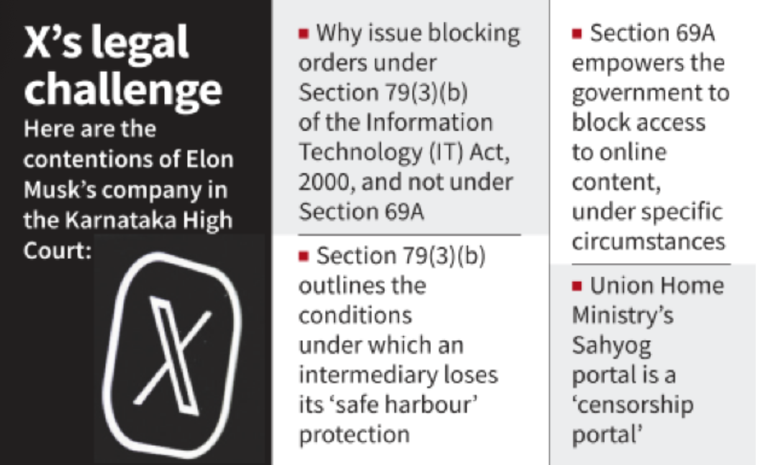
- At the heart of the issue is the invocation of Section 79(3)(b) of the Information Technology Act, 2000, which X Corp believes is being used inappropriately to issue content-blocking orders.
- The Sahyog Portal: It was launched by the Ministry of Home Affairs in 2024.
- The portal acts as a centralized system for government agencies at various levels—ranging from ministries to local police stations—to issue blocking orders more efficiently.
- X Corp has asked the Karnataka High Court to intervene and ensure that content blocking can only occur under Section 69A.
- This legal battle is part of a broader tension between social media platforms and governments worldwide over the regulation of online content and the balance between freedom of expression and national security concerns.
Legal Framework: Section 69A vs. Section 79(3)(b)
- Section 69A of the IT Act, 2000: This section empowers the government to block public access to content on the internet in certain circumstances, such as concerns over national security, sovereignty, public order, or to prevent incitement.
- It includes safeguards as laid out by the Supreme Court in the Shreya Singhal case (2015).
- A reasoned order explaining the necessity of blocking content.
- The person or entity affected should have a chance to contest the order.
- Section 79(3)(b) of the IT Act: This section deals with the liability of intermediaries (such as platforms like X Corp) for third-party content.
- It exempts platforms from liability for illegal content unless they fail to act swiftly to remove or disable access to that content when notified by the government.
- X Corp argues that this provision should not be used to directly block content, as it is not intended for that purpose.
Implications & Way Forward
- Rising State Regulation: The case underscores the growing trend of government intervention and regulation over online content in India.
- Digital Rights at Risk: Lack of transparency in content moderation and takedown processes can undermine users’ fundamental digital rights and freedoms.
- Freedom vs. Security Dilemma: Striking a balance between safeguarding national security and ensuring freedom of expression remains a persistent governance challenge.
Source: TH