
Brief Context
Context Union Budget 2026–27 proposed the Biopharma SHAKTI with an outlay of Rs. 10,000 crores over five years, aimed at strengthening India’s ecosystem for production of biologics and biosimilars. Biopharma Biopharma, or biopharmaceuticals, refers to the part of the pharmaceutical industry that focuses on developing and manufacturing medicines using living biological systems, rather than relying solely on chemical synthesis.
Source Content
Syllabus: GS3/Economy
Context
- Union Budget 2026–27 proposed the Biopharma SHAKTI with an outlay of Rs. 10,000 crores over five years, aimed at strengthening India’s ecosystem for production of biologics and biosimilars.
Biopharma
- Biopharma, or biopharmaceuticals, refers to the part of the pharmaceutical industry that focuses on developing and manufacturing medicines using living biological systems, rather than relying solely on chemical synthesis.
- Biopharma medicines are produced through biological organisms, such as human cells, fungi, or microbes.
- Some examples of biopharmaceuticals include vaccines, antibody treatments, gene therapies, cell implants, modern insulin, and recombinant protein drugs.
- Government’s Aim: Transforming India into a leading global biopharma industry and capturing 5% of the global biopharmaceutical market share.
Key Budget Announcements for Biopharma
- Biopharma SHAKTI: The initiative is designed to support domestic development and manufacturing of high-value biopharmaceutical products and enhance India’s competitiveness in global biologics supply chains.
- Establishment of National Institutes: Establishment of three new National Institutes of Pharmaceutical Education and Research (NIPERs) and the upgradation of seven existing NIPERs.
- This measure seeks to address the growing requirement for highly specialised human resources in biopharma research, development, manufacturing and regulation.
- Strengthening of Research Ecosystem: Creation of a large-scale clinical research ecosystem, with a proposal to develop over 1,000 accredited clinical trial sites across the country.
- This is expected to significantly improve India’s capacity to conduct advanced clinical trials for biologics and biosimilars.
- Regulatory Framework: Enhancing the capacity of the Central Drugs Standard Control Organisation (CDSCO) through the induction of specialised scientific and technical personnel.
- The focus is on improving regulatory efficiency, aligning approval timeframes with global standards.
India’s Pharmaceutical Sector
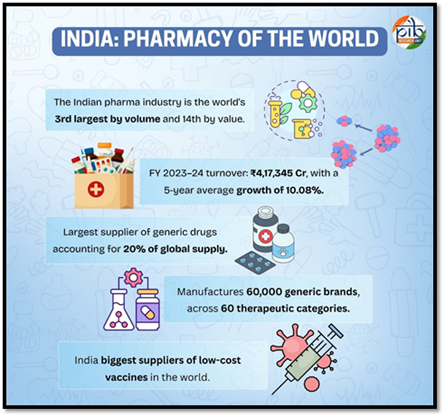
Government Initiatives to Strengthen India’s Biopharma Sector
- National Biopharma Mission (NBM): The NBM – Innovate in India (i3) was launched in 2017 with an aim of transforming India into a $100 billion leading global biotech industry by 2025.
- It is co-funded by the World Bank and implemented by the Biotechnology Industry Research Assistance Council (BIRAC).
- The mission focuses on the development of new vaccines, bio-therapeutics, diagnostics and medical devices.
- The mission also aims to make drugs more affordable and accessible.
- BIRAC-led Biotech Innovation Support: BIRAC was established in 2012 under the Department of Biotechnology (DBT), supports innovation through funding schemes, incubation infrastructure and mentorship.
- Manufacturing and Industrial Strengthening Measures: Government has implemented schemes such as the Production Linked Incentive (PLI) Scheme for Pharmaceuticals, Strengthening of Pharmaceutical Industry (SPI) scheme and the Bulk Drug Parks Scheme.
- Promotion of Research and Innovation in Pharma-MedTech (PRIP): The PRIP scheme, launched in 2023 seeks to transform India into an innovation-driven and globally competitive Pharma-MedTech sector.
- BioE3 Policy: The BioE3 (Biotechnology for Economy, Environment and Employment) Policy was approved in 2024.
- The scheme aims to establish biomanufacturing, Bio-AI hubs and Biofoundry for a sustainable Viksit Bharat.
- Bio-RIDE Scheme: The Bio-RIDE scheme launched in 2024 merged two umbrella schemes of the DBT under one scheme: ‘Biotechnology Research Innovation and Entrepreneurship Development (Bio-RIDE)’ with a new component namely Biomanufacturing and Biofoundry.
- The scheme has three broad components: Biotechnology Research and Development (R&D), Industrial & Entrepreneurship Development (I&ED), and Biomanufacturing and Biofoundry.
Conclusion
- All these measures signal a deliberate and coordinated policy approach by the government to build a resilient biopharma ecosystem in India, spanning research, innovation, manufacturing and entrepreneurship.
- The Biopharma SHAKTI scheme announced in the Union Budget 2026–27 therefore represents a key policy intervention in this direction.
Source: PIB