
Brief Context
Context The Government of India has notified Startup India Fund of Funds 2.0 (FoF 2.0) with a corpus of ₹10,000 crore to mobilize capital for startups. What is Startup India Fund of Funds (FoF 2.0)? It is a government-backed fund designed to indirectly invest in startups through SEBI-registered Alternative Investment Funds (AIFs).
Source Content
Syllabus: GS3/ Economy
Context
- The Government of India has notified Startup India Fund of Funds 2.0 (FoF 2.0) with a corpus of ₹10,000 crore to mobilize capital for startups.
What is Startup India Fund of Funds (FoF 2.0)?
- It is a government-backed fund designed to indirectly invest in startups through SEBI-registered Alternative Investment Funds (AIFs).
- Total corpus: ₹10,000 crore, to be deployed over 16th and 17th Finance Commission cycles.
- It builds upon the earlier Fund of Funds for Startups (FFS 1.0) launched in 2016 under the Startup India Action Plan.
- Objectives: It aims to enhance access to venture capital for startups across sectors and stages.
- It seeks to provide a focused thrust on innovation-driven manufacturing and the development of long-gestation technologies, which typically face funding constraints.
Governance and Monitoring Mechanism of FoF 2.0
- Selection of AIFs: A Venture Capital Investment Committee (VCIC) will screen and recommend eligible Alternative Investment Funds (AIFs).
- Implementation Agency: Small Industries Development Bank of India, will be the primary Implementation Agency (IA) for FoF 2.0.
- Oversight Mechanism: An Empowered Committee (EC) will be constituted under the chairmanship of the Secretary of Department for Promotion of Industry and Internal Trade to monitor implementation and performance of the scheme.
Startup Ecosystem of india
- India is the world’s third-largest startup ecosystem (after the US and China), featuring over 120 unicorns (valued >$1 billion) and over 157,000 government-recognized startups.
- The startup ecosystem is growing at ~12–15% annually, with some years witnessing even higher growth (~30%).
- Key Sectors: Dominant sectors include Fintech, E-commerce, Supply Chain, and Health-tech.
- Regional Hubs: Bengaluru, Mumbai, Hyderabad, and Delhi-NCR.
- Job Creation Engine: Startups have generated over 21 lakh jobs, making them a major employment driver.
- Funding Landscape: Startups raised around $10–11 billion in 2025, maintaining India’s position as a top funded ecosystem.
Eligibility Criteria for a Startup
- Company Age: The period of existence and operations should not exceed 10 years from the date of incorporation.
- Company Type: Incorporated as a Private Limited Company, a Registered Partnership Firm, or a Limited Liability Partnership.
- Annual Turnover: Should have an annual turnover not exceeding Rs. 100 crore for any of the financial years since its incorporation.
- A deep tech company can consider itself a start-up for as long as 20 years and has a turnover of up to ₹300 crore.
- Original Entity: An entity should not have been formed by splitting up or reconstructing an already existing business.
Challenges in India’s Startup Ecosystem
- Funding Constraints: Early-stage startups often struggle with insufficient capital, affecting hiring, marketing, and operations.
- Misreading Market Demand: A major reason for startup failure is the lack of real market need, with nearly 42% startups failing due to poor demand assessment.
- Talent Retention: Startups face difficulty in attracting and retaining skilled talent due to competition from established firms.
- Concentration in Few Sectors: Majority of funding is concentrated in fintech, e-commerce, and edtech.
- Critical sectors like manufacturing, agritech, and deep-tech remain underfunded.
Schemes Strengthening India’s Startup Ecosystem
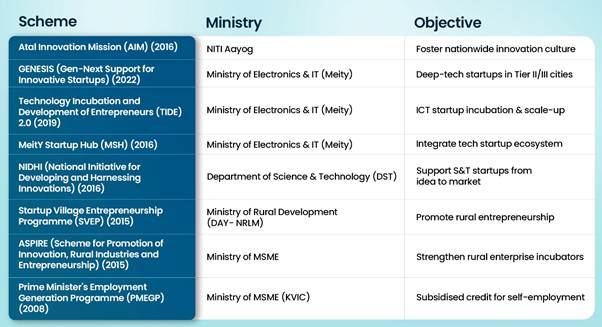
Way Ahead
- Shift from “Valuation-led” to “Value-led” Growth: There is a need to Move beyond the unicorn obsession towards sustainable, profitable business models.
- Deep-Tech Priority: Treat sectors like AI, semiconductors, space tech, biotech as part of economic and national security.
- Decentralised Innovation Clusters: Move beyond metro-centric growth to cluster-based innovation ecosystems such as;
- Agri-tech clusters in rural belts,
- Manufacturing clusters in industrial corridors,
- Deep-tech hubs near research institutions.
Source: PIB