
Brief Context
Recently, the Supreme Court of India has emphasized the critical need to prioritize education, hygiene, and healthcare in rural areas to foster holistic development.
Source Content
Syllabus: GS2/Issues Relating to Development; Health; GS3/Infrastructure
Context
- Recently, the Supreme Court of India has emphasized the critical need to prioritize education, hygiene, and healthcare in rural areas to foster holistic development.
Key Observations by the Supreme Court
- Focus on Basic Infrastructure: The court underscored that ensuring access to quality education, healthcare, and hygiene is essential for improving the living standards of rural populations.
- Budgetary Allocations: It suggested that states allocate at least 10-15% of their budgets to enhance rural infrastructure, addressing long-standing disparities in resource distribution.
- Libraries vs. Basic Needs: The court acknowledged the importance of public libraries, and stressed that immediate priorities should include addressing hunger, healthcare, and education.
Rural Landscape in India: Positive Transformations in Rural India
- India is home to 6.65 lakh villages, with 2.68 lakh Gram Panchayats and Rural Local Bodies, which form the backbone of the nation’s rural landscape.
- National Multidimensional Poverty Index (MPI) Report: Declined from 24.85% to 14.96% between 2015-16 and 2019-21 (13.5 crore individuals escaped multidimensional poverty during this period).
- Rural Internet Connectivity: India had 954.40 million internet subscribers (March 2024). Out of this, 398.35 million were rural internet subscribers.
- Income Distribution (Gini Coefficient): Declined from 0.266 in FY22-23 to 0.237 in FY23-24, for rural areas.
- Rural Wage Growth: As per data from the Labour Bureau, rural wages in FY25 showed a growth of above 4% each month year-on-year:
- Agriculture wages grew by 5.7% for men and 7% for women.
- Non-agricultural wages grew by 5.5% for men and 7.9% for women.
- Annual Status of Education Report (ASER) of 2024 reveals improvements in rural education, including pre-primary enrollment and learning outcomes, with a focus on foundational literacy and numeracy, and increased digital literacy among older children.
Key Government Initiatives
- Education in Rural India:
- Samagra Shiksha Abhiyan: Integrates Sarva Shiksha Abhiyan (SSA), Rashtriya Madhyamik Shiksha Abhiyan (RMSA), and teacher education programs.
- Mid-Day Meal Scheme: Aims to improve nutrition and attendance rates.
- Digital India Initiative: Promotes e-learning and smart classrooms in rural schools.
- Beti Bachao Beti Padhao: Encourages education for girl children.
- Health & Hygiene in Rural India:
- Swachh Bharat Abhiyan (G): Currently in Phase 2 the focus is on maintaining the ODF status, managing solid and liquid waste by 2024-25 and transitioning all villages from ODF to the ODF Plus model.
- Other schemes include Deendayal Antyodaya Yojana-NRLM, Ayushman Bharat Yojana (PM-JAY), Poshan Abhiyan, Jan Aushadhi Yojana, Total Sanitation Campaign, National Rural Drinking Water Programme, and National Rural Health Mission (2005).
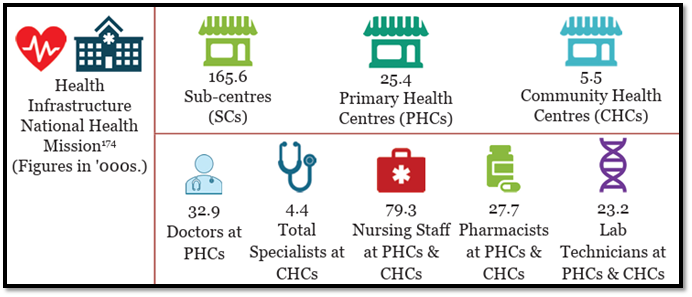
- For Betterment of Socio-Economic Conditions:
- Water Supply – Jal Jeevan Mission (extended until 2028): Operation and maintenance of rural piped water supply schemes through a citizen-centric approach, known as ‘Jan Bhagidhari’.
- India Post as a Catalyst for Rural Economy: 1.5 lakh rural post offices, India Post Payment Bank, and 2.4 lakh Dak Sevaks.
- Pradhan Mantri Gram Sadak Yojana (PMGSY) – Roads: rural connectivity through a single all-weather road.
- Pradhan Mantri Awaas Yojana-Gramin (PMAY-G) – Housing
Challenges in Rural Development
- Financial Constraints: States often cite limited budgets as a barrier to implementing comprehensive rural development programs.
- Inadequate Infrastructure: Many villages still lack basic amenities like clean drinking water, functional schools, and healthcare services.
- Lack of Policy Focus: The absence of targeted policies for rural areas has led to uneven development and persistent inequalities.
Way Forward
- Integrated Development Approach: Governments must adopt a holistic strategy that simultaneously addresses education, healthcare, and hygiene to ensure sustainable rural development.
- Corporate Social Responsibility (CSR): The court suggested leveraging CSR funds to establish e-libraries and other essential facilities in rural areas.
- Community Participation: Empowering local communities to take ownership of development initiatives can lead to more effective and sustainable outcomes.