
Brief Context
In News Recently, Security agencies have raised alarms over the illegal use of satellite communication devices in Indian waters, citing potential national security threats. About In an era defined by digital connectivity, terrestrial networks (fiber optics, mobile towers) often face limitations due to difficult geographical terrains and vulnerability to natural disasters. Satellite-Based Communication (SATCOM) has emerged as the critical infrastructure bridging these gaps.
Source Content
Syllabus: GS2/Governance; GS3/Science and Tech/Internal Security
In News
- Recently, Security agencies have raised alarms over the illegal use of satellite communication devices in Indian waters, citing potential national security threats.
About
- In an era defined by digital connectivity, terrestrial networks (fiber optics, mobile towers) often face limitations due to difficult geographical terrains and vulnerability to natural disasters.
- Satellite-Based Communication (SATCOM) has emerged as the critical infrastructure bridging these gaps.
- For a vast and diverse nation like India, SATCOM is not just a technological convenience but a strategic necessity, underpinning disaster management, remote connectivity, tele-education, and national security.
What is Satellite-Based Communication?
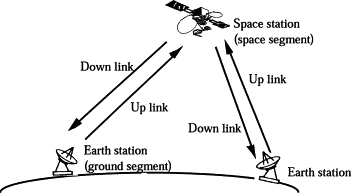
- Satellite communication involves the use of artificial satellites in orbit around the Earth to relay radio signals between different points on the ground.
- The satellite acts as a “mirror in the sky,” receiving signals from one earth station, amplifying them, and re-transmitting them to another earth station or user terminals.
How it Works: The Mechanism
- Uplink: A ground station (earth station) transmits a signal (carrying voice, data, or video) up to the satellite.
- Transponding: The satellite receives the signal. Its onboard equipment, called a transponder, shifts the signal’s frequency (to avoid interference between incoming and outgoing signals) and amplifies it.
- Downlink: The satellite re-transmits the amplified signal back down to Earth, over a specific geographical area known as its “footprint.”
- Reception: Receiving dishes on the ground (like DTH antennas or VSAT terminals) capture the signal.
Satellite-Based Communication in India Current Status
- India has over 1 billion internet subscribers, yet rural penetration remains limited (about 46 per 100 people).
- Satellite internet is being positioned as a solution to bridge this digital divide.
- The government has allowed 100% FDI in satellite internet services, enabling private participation alongside ISRO.
- India is moving towards LEO (Low Earth Orbit) and MEO (Medium Earth Orbit) satellite systems, which provide faster and more reliable broadband compared to traditional GEO satellites.
- Global players like SpaceX (Starlink) and Eutelsat OneWeb (backed by India’s Bharti Enterprises) are vying to enter the Indian broadband market using LEO constellations.
Advantages of SATCOM for India
- Digital Inclusion: Satellite communication can connect remote villages, border areas, and disaster-prone regions where fiber networks are unfeasible.
- National Security: Secure satellite communication is vital for defense, maritime safety, and disaster response.
- Economic Growth: Expanding connectivity supports e-governance, online education, telemedicine, and digital commerce.
- Strategic Autonomy: Indigenous satellite systems reduce dependence on foreign operators and enhance India’s global standing in space technology.
Issues and Challenges
- Security Concerns: Illegal use of satellite phones in Indian waters has raised alarms, as they can bypass monitoring systems and pose risks to national security.
- High Costs: Satellite internet remains expensive compared to terrestrial broadband, limiting affordability for rural populations.
- Regulatory Barriers: Licensing, spectrum allocation, and coordination with international operators require streamlined policies.
- Technical Limitations: Weather disruptions, latency issues (though reduced in LEO/MEO systems), and infrastructure for ground stations remain challenges.
- Geopolitical Dependencies: Reliance on foreign-owned LEO constellations for critical national infrastructure could be risky during diplomatic tensions or conflicts, as services could be denied.
Government Steps
- Security Measures: The Directorate General of Shipping (DGS) has proposed stricter penalties to curb the unauthorised use of satellite phones and messaging devices, including Zoleo devices linked to Iridium systems.
- While Iridium-based equipment is permitted solely for distress and safety communications under the Global Maritime Distress and Safety System (GMDSS), Thuraya devices remain banned.
- Personal devices must be declared and sealed by authorities.
- Space Sector Reforms: In 2020, the Government introduced Space Sector Reforms to open the doors for private sector participation in space activities. Building on this momentum, the Indian Space Policy, 2023 established a level playing field for Non-Government Entities (NGEs) in the space sector by enabling their participation across the entire value chain of space activities in an end-to-end manner.
- ISRO partnering with private firms for satellite launches and communication payloads.
- Indian National Space Promotion & Authorisation Centre (IN-SPACe): It plays a pivotal role in enabling satellite internet in India. It is responsible for promoting, authorizing and supervising various space activities of the non-governmental entities (NGEs).
- This nodal agency acts as an interface between ISRO and NGEs, facilitating the growth of space-based activities including the use of India’s satellite resources for broadband connectivity.
Source :TH