
Brief Context
Context India’s rural development trajectory over the past decade indicates a structural transition from fragmented welfare provision towards an integrated, decentralised, and community-led development paradigm. Decentralisation in Governance The 73rd Constitutional Amendment (1992) institutionalised Panchayati Raj Institutions (PRIs) as vehicles of grassroots democracy, enabling communities to participate directly in the planning, implementation, and monitoring of development initiatives. Parti
Source Content
Syllabus: GS2/Polity and Governance
Context
- India’s rural development trajectory over the past decade indicates a structural transition from fragmented welfare provision towards an integrated, decentralised, and community-led development paradigm.
Decentralisation in Governance
- The 73rd Constitutional Amendment (1992) institutionalised Panchayati Raj Institutions (PRIs) as vehicles of grassroots democracy, enabling communities to participate directly in the planning, implementation, and monitoring of development initiatives.
- Participation is increasingly supported through capacity building, technology-enabled engagement, strengthened community institutions, and participatory planning and budgeting processes.
- Direct fiscal transfers to panchayats have been increased from around ₹2.36 lakh crore under the 15th Finance Commission (2021-2026) to nearly ₹4.35 lakh crore under the 16th Finance Commission (2026-2031).
Need for Decentralisation
- Deepening Grassroot Democracy: Strengthens participatory democracy by empowering village-level institutions like the Gram Sabha to take decisions on local development.
- Need-Based Local Planning: Local bodies better understand region-specific issues related to agriculture, irrigation, drinking water, sanitation, and rural infrastructure.
- Improved Service Delivery: Enhances last-mile delivery and monitoring of schemes like Mahatma Gandhi National Rural Employment Guarantee Act.
- Greater Accountability and Transparency: Proximity of elected representatives to citizens improves answerability and strengthens mechanisms like social audits.
- Strengthening Cooperative Federalism: Supports fiscal decentralisation through State Finance Commissions and grants recommended by the Finance Commission.
Challenges
- Incomplete Devolution: Many States have not fully devolved Functions, Funds, and Functionaries to Panchayati Raj Institutions despite the 73rd Constitutional Amendment Act.
- Financial Dependence on Higher Governments: PRIs rely heavily on grants recommended by the Finance Commission and State governments, with limited own-source revenue generation.
- Capacity Constraints: Lack of trained personnel, technical expertise, and administrative capacity hampers effective planning and implementation.
- Elite Capture and Proxy Representation: Local elites sometimes dominate decision-making; in some cases, women representatives face proxy control by male family members.
- Weak Gram Sabha Functioning: The Gram Sabha often suffers from low participation, irregular meetings, and limited awareness among citizens.
- Poor Accountability and Transparency Mechanisms: Weak auditing, irregular social audits, and limited digital governance increase risks of corruption and fund misutilisation.
Achievements in Rural Development
- Poverty has declined significantly, with extreme poverty at 5.3% (2022-23), which is less than the global average, and multidimensional poverty has reduced to 11.28%.
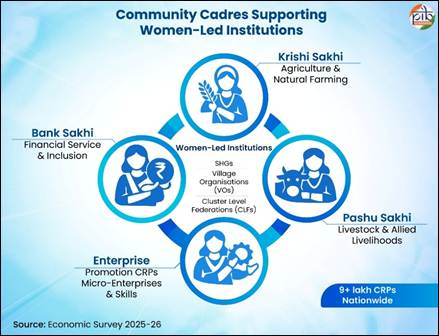
- Women-led collectives anchor last-mile delivery, mobilizing 10.05 crore women across 90.09 lakh SHGs, supported by 9 lakh community cadres.
- Rural connectivity is near-universal, with budgetary allocations for Pradhan Mantri Gram Sadak Yojana increasing from ₹12,581 crore in 2016-17 to ₹19,000 crore in 2026–27 (an increase of 51%).
- Housing-led security has expanded at scale, with 3.70 crore rural homes built over 11 years, budgetary allocations for PMAY-G (Pradhan Mantri Awas Yojana-Grameen) increased by 266.1%.
Government Initiatives
- Rural Development Budget allocations rose over 211% from ₹87,765 crore (2016-17) to ₹2.73 lakh crore (2026-27).
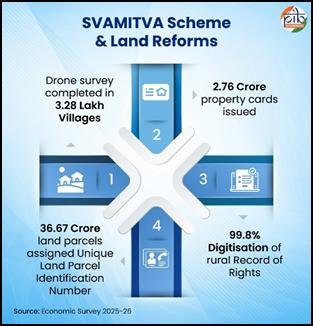
- Land Reforms:
- The Model Youth Gram Sabha (MYGS) promotes democratic engagement and civic awareness by familiarising students with grassroots governance through simulated Gram Sabha processes in schools.
- Revamped Rashtriya Gram Swaraj Abhiyan (RGSA) strengthens decentralised governance by enhancing the institutional capacity of Panchayati Raj Institutions through leadership development, e-governance, and deeper constitutional devolution.
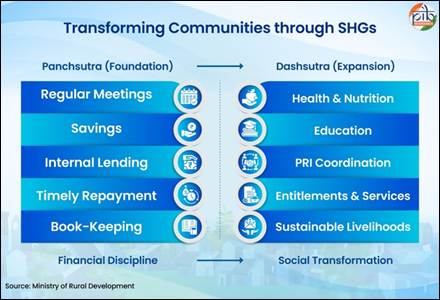
- Women-Led Institutions as Drivers of Rural Transformation: Women-led institutions are central to the Deendayal Antyodaya Yojana–National Rural Livelihoods Mission (DAY-NRLM), positioning women as key drivers of rural transformation.
- Community Resource Persons (CRPs), including Bank Sakhis, Krishi Sakhis, Pashu Sakhis, and Enterprise Promotion CRPs, facilitate the smooth functioning of women-led community institutions.
Conclusion
- India’s rural development trajectory over the past decade indicates a structural transition from fragmented welfare provision towards an integrated, decentralised, and community-led development paradigm.
- Collectively, these reforms position rural India not merely as a recipient of development interventions but as a pivotal driver of inclusive growth, democratic governance, and long-term socio-economic sustainability.
Source: PIB