
Brief Context
Context India has made significant strides in the dairy sector, but the potential of small ruminants (goats, sheep) and poultry remains underutilised. Dairy Sector of India Global Leadership: India is the world’s largest milk producer, contributing 24.76% of global milk output. Production Growth: Milk production rose from 146.31 million tonnes in 2014-15 to 239.30 million tonnes in 2023-24.
Source Content
Syllabus: GS3/ Economy
Context
- India has made significant strides in the dairy sector, but the potential of small ruminants (goats, sheep) and poultry remains underutilised.
Dairy Sector of India
- Global Leadership: India is the world’s largest milk producer, contributing 24.76% of global milk output.
- Production Growth: Milk production rose from 146.31 million tonnes in 2014-15 to 239.30 million tonnes in 2023-24.
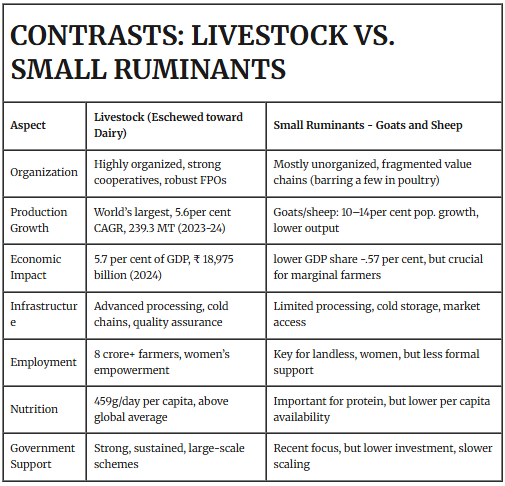
- Economic Contribution: Dairy is India’s single largest agricultural commodity, contributing 5% to GDP and employing over 8 crore farmers.
- Growth Performance: Livestock sector grew at a CAGR of 7.9% (2014-15 to 2020-21), outpacing the agriculture sector.
Growth Trends of Small Ruminants and Poultry
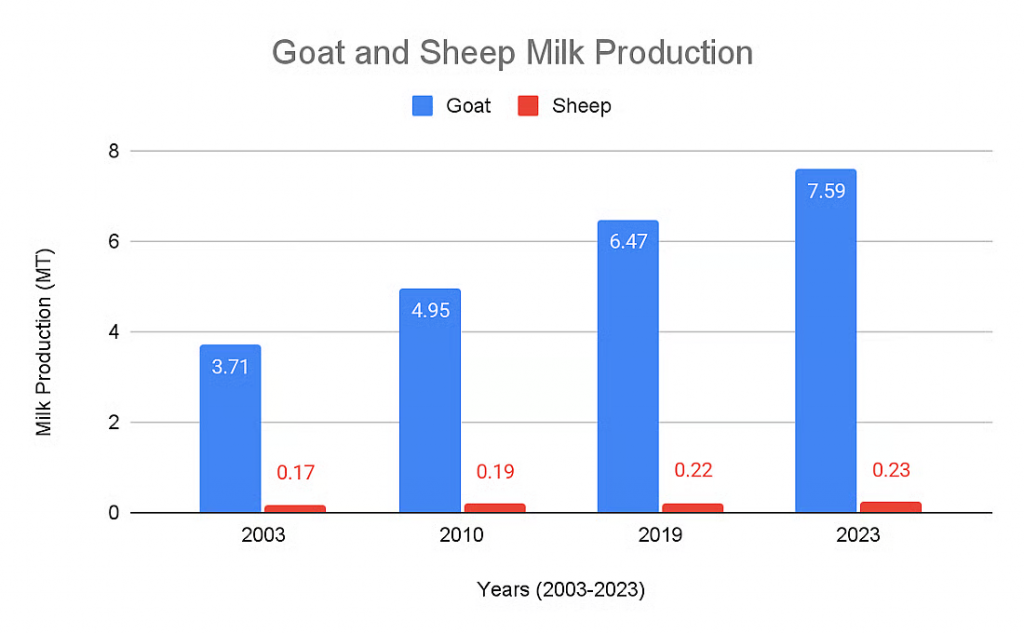
- Goat Population: India has 148 million goats, accounting for 16% of the global goat population – the highest globally.
- Sheep Population: India ranks third in the world with 74.26 million sheep, comprising 4.03% of global population.
- Poultry: The population stands at 851.81 million, marking a 16.8% increase from the last census.
Role of Small Ruminants and Poultry
- Livelihood Support for Marginal Farmers: Goats, often termed the “poor man’s cow”, are vital for landless and marginal farmers, especially women, owing to their low input costs and easy maintenance.
- Economic Buffer During Distress: These animals act as financial safety nets during droughts and crop failures, ensuring income continuity for vulnerable rural households.
- Suitability to Harsh Climates: Small ruminants and poultry are well-adapted to arid, semi-arid, and rain-fed regions, making them ideal for areas where crop cultivation and dairy farming are not viable.
- Economic Contribution: Small ruminants contribute ₹31,449 crore annually to the Indian economy through milk, meat, and export, highlighting their growing economic relevance.
Key Interventions Needed for Scale
- Scientific feeding and nutrition: Balanced diets, silage and hay bailing units and mineral supplementation increase weight gain, reproductive performance, and milk yield.
- Breed selection and housing: Indigenous breeds adapted to local conditions and better housing reduce disease and mortality.
- Health and disease management: Regular vaccination, deworming, ectoparasite control, and ethno-veterinary practices lower mortality and improve herd health.
- Value chain integration: Supporting direct market access and value-added products boosts profitability.
- Community-based models: Cooperatives and women-centric models foster knowledge sharing, collective bargaining, and access to finance and technology.
- Sustainable practices: Silvipastoral systems, agroforestry systems, alternate eco-friendly feed (crop residues, shrubs, legumes) and climate-resilient models enhance productivity and sustainability.
Way Ahead
- To unlock the full potential of small ruminants, India needs robust policy and extension support, simplified subsidy access, investment in infrastructure, and climate-resilient, sustainable practices.
- Forming a specialised agency—modelled on the NDDB—for goat and sheep could help replicate dairy’s cooperative success, transforming these sectors into organised, high-impact value chains.
Source: DTE