
Brief Context
Context Prime Minister Narendra Modi has said that the government is moving towards opening up the nuclear sector for private players. About Traditionally, nuclear power plants in India have been owned and operated only by state-owned Nuclear Power Corporation of India Ltd (NPCIL) and its fully-owned subsidiary Bharatiya Nabhikiya Vidyut Nigam (BHAVINI). To allow private sector participation government has proposed amendments to key legislations; Atomic Energy Act, 1962, a framework for nuclear
Source Content
Syllabus: GS3/ Energy
Context
- Prime Minister Narendra Modi has said that the government is moving towards opening up the nuclear sector for private players.
About
- Traditionally, nuclear power plants in India have been owned and operated only by state-owned Nuclear Power Corporation of India Ltd (NPCIL) and its fully-owned subsidiary Bharatiya Nabhikiya Vidyut Nigam (BHAVINI).
- To allow private sector participation government has proposed amendments to key legislations;
- Atomic Energy Act, 1962, a framework for nuclear energy development and regulation.
- Civil Liability for Nuclear Damage Act, 2010, ensuring compensation mechanisms for nuclear incidents.
| What is Nuclear Energy? – Nuclear energy is the energy released during nuclear reactions, either through fission (splitting of atomic nuclei) or fusion (merging of atomic nuclei). – In nuclear fission, heavy atomic nuclei, such as those of uranium or plutonium, are split into lighter nuclei, releasing a large amount of energy. 1. This process is utilized in nuclear power plants to generate electricity. Status of Nuclear power capacity in India – The current installed nuclear power capacity in the country is 8,180 MW, spread across 24 nuclear power reactors. – The government has set an ambitious target to increase the country’s nuclear power capacity to 100 GW by 2047 – Capacity Expansion: 10 new reactors (totaling 8 GW) under construction across Gujarat, Rajasthan, Tamil Nadu, Haryana, Karnataka, and Madhya Pradesh. 1. Approval for a 6×1208 MW nuclear plant in Andhra Pradesh in collaboration with the USA. 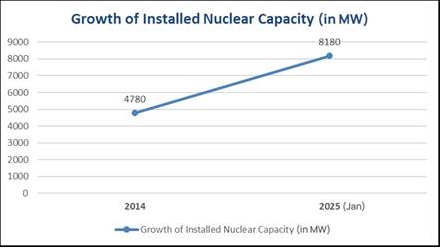 |
Benefits of Private Sector Involvement
- Faster Capacity Expansion: Private investment will help bridge the financial gap needed for rapid nuclear power growth.
- Technological Advancement: Collaboration with private companies drive innovation and bring in global expertise.
- Cost Efficiency: Competitive bidding and private participation will help reduce project costs and delays.
- Energy Security: Increased nuclear power generation helps India reduce dependence on fossil fuels and meet clean energy goals.
Concerns to Private Sector Entry
- Regulatory Hurdles: Amendments to existing laws are required to enable private sector participation.
- High Capital Requirement: Nuclear power projects involve long gestation periods and large upfront investments, which deters private players.
- Liability Concerns: The Civil Liability for Nuclear Damage Act imposes high liability on operators, making private investment risky.
- Safety and Security: Nuclear energy requires strict safety protocols, and allowing private firms to operate reactors necessitates robust regulatory oversight.
- Public Perception: Concerns over nuclear safety, waste management, and radiation risks will face public resistance.
Government steps
- India had announced a Rs 20,000 crore R&D mission for development of small modular reactors (SMRs).
- India is also targeting the deployment of at least five of these indigenously developed reactors by 2033.
- NPCIL and National Thermal Power Corporation (NTPC) have signed a supplementary Joint Venture (JV) agreement to develop nuclear power facilities in the country.
- The JV named ASHVINI will build, own, and operate nuclear power plants, including the upcoming 4×700 MWe PHWR Mahi-Banswara Rajasthan Atomic Power Project.
Way Ahead
- Clear Regulatory Framework: Establish a robust regulatory environment to ensure safety, compliance, and transparency, addressing concerns about accountability and national security.
- Public-Private Partnerships (PPPs): Promote partnerships where the government maintains oversight, while private players handle operations, innovation, and investment, ensuring a balance of interests.
- Gradual Implementation: Start with pilot projects and small-scale initiatives to test private sector involvement, ensuring risk management before large-scale implementation.
Source: AIR