
Brief Context
Context According to a new study published in the journal Science, If the world gets warmer by 2.7°C due to the current trajectory of climate policies, only 24% of the world’s present-day glaciers will remain. What are glaciers? They are essentially large and thick masses of ice that are formed on land due to the accumulation of snow over centuries.
Source Content
Syllabus: GS3/ Environment
Context
- According to a new study published in the journal Science, If the world gets warmer by 2.7°C due to the current trajectory of climate policies, only 24% of the world’s present-day glaciers will remain.
What are glaciers?
- They are essentially large and thick masses of ice that are formed on land due to the accumulation of snow over centuries.
- They hold 70 per cent of the Earth’s freshwater, currently encompassing around 10 percent of the planet’s land area.
Key findings of the study
- Massive Glacier Loss: The study cautioned that even if temperatures stopped rising today, the world’s glaciers would still lose 39% of their mass, compared to 2020 levels, and that would lead to a sea level rise of 113 mm.
- Disproportionate Impact on Some Regions: Glaciers in Scandinavia, the Rockies in Western Canada and the US, and the European Alps are particularly vulnerable.
- A recent glacier collapse in Blatten, Switzerland, which buried parts of a village, highlights this vulnerability.
- High Sensitivity to Incremental Warming: For every 0.1°C increase in global temperature between 1.5°C and 3°C, there is a 2% global glacier loss, with steeper regional impacts.
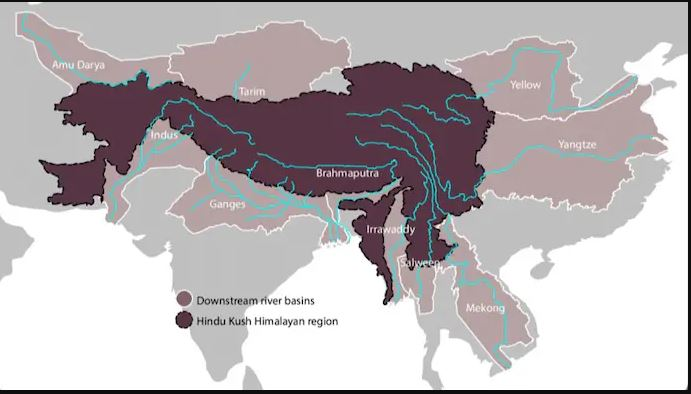
- Hindu Kush Himalaya Under Threat: The study estimates that only 25% of ice will remain in the Hindu Kush Himalayan region at 2°C warming. This region feeds key river systems– Ganga, Indus and Brahmaputra –vital to South Asia.
| Hindu Kush Himalaya (HKH) – The HKH mountains extend around 3,500 km over eight countries — Afghanistan, Bangladesh, Bhutan, China, India, Nepal, Myanmar, and Pakistan. – These mountains are also called the “water towers of Asia” because they are the origins of 10 crucial river systems on the continent — Amu Darya, Indus, Ganga, Brahmaputra, Irrawaddy, Salween, Mekong, Yangtse, Yellow river, and Tarim. 1. These river basins provide water to almost one-fourth of the world’s population and are a significant freshwater source for 240 million people in the HKH region. |
Impacts of Glaciers loss
- Water Security in South Asia: Himalayan glaciers serve as perennial sources for India’s major rivers.
- Their depletion threatens agricultural output, drinking water supplies, and hydroelectric generation, particularly during the dry season.
- Sea-Level Rise and Coastal Risk: The glacier melt contributes to global sea-level rise, endangering coastal populations, particularly in low-lying nations like the Maldives and coastal Indian cities.
- Ecosystem Disruption: Glacial melt impacts mountain biodiversity, alpine ecosystems, and can lead to glacial lake outburst floods (GLOFs).
- Socioeconomic Consequences: Loss of water sources may lead to climate-induced migration, conflict over resources, and increased poverty in already vulnerable regions.
Global Initiatives to conserve glaciers
- Paris Agreement 2015, aims to limit global warming to well below 2°C, preferably to 1.5°C, above pre-industrial levels.
- High Mountain Summit (WMO): Recognizes mountains and glaciers as climate sentinels and promotes early warning systems and enhanced data sharing.
- International Cryosphere Climate Initiative (ICCI): Established in 2009 as a result of the COP-15, it is a network of senior policy experts and researchers that works with governments and organizations.
- It creates and implements initiatives designed to preserve the Earth’s cryosphere.
- National Mission for Sustaining the Himalayan Ecosystem (NMSHE) is a government initiative aimed at addressing climate change and its impacts on the Himalayan region.
- It focuses on developing sustainable strategies, and addressing issues like glacial melt, natural hazards, and biodiversity loss.
- The Arctic Council: It is a forum for Arctic countries to collaborate on environmental protection, sustainable development, and climate change mitigation in the Arctic region.
- Global Ice Monitoring Initiatives like the World Meteorological Organization’s Global Cryosphere Watch (GCW) and the European Space Agency’s CryoSat mission use satellite-based remote sensing to monitor changes in glaciers and ice sheets.
Concluding remarks
- The accelerating loss of glaciers due to rising global temperatures is a stark reminder of the urgent need for coordinated climate action.
- While global initiatives such as the Paris Agreement and IPCC reports provide a strategic framework, their success hinges on timely implementation and increased ambition by all nations.
Source: IE